Showing posts with label Lucia. Show all posts

Tuesday, December 6, 2011

Top Ten Tuesday: Lucia's Childhood Favourites


This week's Top Ten Tuesday, hosted over at the Broke and the Bookish, I (Lucia) knew would be easy. But choosing ONLY ten childhood favourites... I think picking Christmas gifts for small children is the most fun of all holiday gift buying. So!

Fantastic Mr Fox and The Twits by Roald Dahl. The former is the first book I remember reading by myself and the latter I recently read to some French kids who referred to it as 'Les Twits.'

Hazel Green and Antonio S and the Mystery of Theodore Guzman

by Odo Hirsch. After reading Hazel Green I decided I would be either a baker or a florist (not happening), and also become that really ballsy neighbourhood kid (think Flavia de Luce of The Sweetness at the Bottom of the Pie). I actually don't really remember what Antonio S was about or what happened but I definitely remember enjoying it.

Possum Magic by Mem Fox. Classic! And with very
beautiful illustrations.


Holes by Louis Sachar. This was probably the most complicated plot I had read at the time, and boy was that appealing.

Peter Pan by J.M Barrie.

The Sisterhood of the Travelling Pants by Ann Brashares. Does thirteen still count as a child? Legally yes, I guess. This was the first 'teenage' fiction book that I read and recently reread.

The Upside-Down Girl by Justin D'Ath. About a girl who rides a roller coaster so many times she becomes 'degravitised.'


The Gift of the Gab by Morris Gleitzman. Rowena is literally dumb, but still manages the gift of the gab. You can read the first chapter here.

Have a good week!

Tuesday, October 18, 2011

Top Ten Tuesday: Best Covers and Titles

This week's Top Ten Tuesday topic, hosted over at the Broke and the Bookish, asks do you judge a book by it's cover? Or title? Yep, sure do. This is my (Lucia's) list of top ten prettiest/ most colourful/ interesting/ eye catching/ weirdest covers and titles which were the main reason I parted with my hard earned cash on the over priced buggers.

Water for Elephants by Sara Gruen. This title and cover combination meant it's story was about a circus. Sold. Read Connie's review here.

The Guernsey Literary and Potato Peel Pie Society by Mary Ann Shaffer and Annie Barrows. Needless to say, it was the title that got me here. I didn't even know people put peel (other than of a citrus fruit) into pies. But a society which discussed literature on an island on the English channel while eating a pie made out of the peel?


The Secret Lives of Baba Segi's Wives
by Lola Shoneyin. This cover was just so so pretty I couldn't go past it. The blurb was interesting too, although the story mostly didn't deliver.

The Elegance of the Hedgehog by Muriel Barbury. Another lovely cover and quirky title masking a story which I really didn't like.


The End of Everything by Megan Abbott. This cover reminded me of summer which I am well and truly ready for (end of uni/ exams, going to the beach, Christmas). While this book is very disturbing, it is one of the best I have read all year. Hopefully I'll get a
review up.


I Have a Bed Made of Buttermilk Pancakes by Jaclyn Moriarty. Because don't we all?

A Fraction of the Whole

by Steve Toltz. Okay, so this book has been sitting on my shelf unread for two years since it's cover sucked me in.


The Children's Book by A.S Byatt. Another lovely cover of a book I haven't read yet. I'll admit I'm often drawn to shiny things.


A Pocketful of Eyes by Lili Wilkinson. Since I always thought eyes belonged in the head, I was curious.

Good Oil by Laura Buzo. This title reminded me of my mother telling me not to use the 'good oil' (ie, the olive oil which my grandparents made) to fry vegan sausages. The book, on the other hand, has nothing to do with oil, but is one of the best
young adult novels I have read. I highly recommend it even to those who generally don't read the genera (I don't).

Thursday, September 8, 2011

Literary Blog Hop: Sep 8-11

Welcome to the Literary Blog Hop hosted by The Blue Bookcase!

This monthly blog hop is open to blogs that primarily feature book reviews of literary fiction, classic literature, and general literary discussion.

How do I know if my blog qualifies as "literary"? Literature has many definitions, but for our purposes your blog qualifies as "literary" if it focuses primarily on texts with aesthetic merit. In other words, texts that show quality not only in narrative but also in the effect of their language and structure. YA literature may fit into this category, but if your blog focuses primarily on non-literary YA, fantasy, romance, paranormal romance, or chick lit, you may prefer to join the blog hop at Crazy-for-books that is open to book blogs of all kinds.

Instructions for entering the Literary Blog Hop:

1. Grab the code for the Button.

Literary Blog Hop


2. Answer the following prompt on your blog.
(Suggestions for future prompts? Email to them us at thebluebookcase@gmail.com)

Must all literary writing be difficult? Can you think of examples of literary writing that were not difficult?

Our answer comes from Lucia:

I think the response to this question really depends on how the word 'difficult' is interpreted. Assuming it refers to the language itself which is difficult, then I think its degree of difficulty is to be determined by the individual reader. In this respect, the first time I read anything by Jane Austen, it took me 3 months because I was so unused to the style of writing. Although now (6 years on) I find Austen's language fairly easy to read, I still struggle with some classics. A Christmas Carol was gruelling, as was Mrs Dalloway. However, I find the writing styles of authors such as Arthur Conan Doyle very straight forward to read, as well as many contemporary authors of literary fiction. The pace of a novel, for me, also affects the how difficult it is to read.

On the other hand, if the word 'difficult' refers to the subject matter or content of the novel which is challenging or confronting, I think the answer to the question is a little more objective. I think an author who deals with an issue skillfully and thoughtfully so as to engage the reader and put forth their point of view, may be easier to read as opposed to an author whose handling of a subject is tacky and superficial. That being said I don't mean to suggest that Dickens or Woolf are either of these things, as the difficulty of their writing for me lies solely in the language. Examples of works I believe are not difficult to read for these reasons include Speak by Laurie Halse Anderson, To Kill A Mocking Bird by Harper Lee and The Bean Trees by Barbara Kingsolver.

3. Add your link to the Linky List below.Happy Hopping!
*PLEASE NOTE: if you do not answer the question and link back to The Blue Bookcase in a post on your blog, you will be removed from the Linky list.

Friday, August 26, 2011

Reading Lists: Australian Fiction

Welcome to this week's installment of our newest feature here at The Blue Bookcase: Reading Lists. Every week either one of us or a guest blogger will post on one of his or her favorite topics and provide a list of books he or she is familiar with on that topic. At the end of each post we will invite you to throw out any suggestions of books, fiction or non-fiction, that you have read or know about on that topic and we will add them to the list on that post.

These lists are not comprehensive by any means, but may be useful in helping you find your next read. Enjoy!

This week, Lucia is compiling a list on Australian Fiction.

The questions of what Australian is and what it means to be Australian are asked multiple times a day. I consider myself Australian because I, along with my parents, was born here, I speak English as my first language, my passport says so, and I've never called anywhere else home. On the other hand, I, like an extreme number of others in Australia, have European ancestry. But what about Indigenous Australians or our connection with Asia? Tricky questions, no doubt. I have only very recently begun to actively pursue the reading of Aus fiction, because up until recently I didn't know what it felt like to be homesick for my comparatively quiet state capital . So, in terms of Australian literature and fiction, I've decided to go with books written by Australians which include an opinion about something significant to Australia.

Possum Magic by Mem Fox. Probably the most famous Australian children's book, this is the story of Hush who has been turned invisible by Grandma Poss. Their quest to make Hush visible again takes them all around Australia, discovering icons in Aussie food. “Once upon a time, but not very long ago, deep in the Australian bush, there lived two possums. Their names were Hush and Grandma Poss. Grandma Poss made bush magic…”

The Boat by Nam Le. Le is a Vietnamese author who migrated to Australia. The Boat is a collection of the most beautiful short stories, with the title story addressing one of the biggest issues in Australia today: boat people. One of my favorite stories was Waiting For Elise, about an ill and aging painter, mourning the loss of his lover and the daughter he doesn't know. Somehow, impossibly, the voice of the story is unbiased towards the situation of the narrating character. I believe that this reflects the title of the story, in that the central character is waiting as opposed to actually doing, and he knows this. I think the reader can sympathise with this because at the heart of the story is a commonly felt fear. Read the rest of my review here.

Looking for Alibrandi by Melina Marchetta. As I've mentioned, many people (including myself) come from a European background, and this young adult novel deals very realistically and often hilariously with this. The story is a wonderful twist; Josie Alibrandi is caught between a gaggle of gossiping Italians and the backdrop of Aus culture.


People of the Book by Geraldine Brooks. I love love this book, although it's hardly set in Australia (and I think I've gushed about it on several posts before, though not actually written a review). Brooks is Australian, though, and she is brilliant. The references to Aus come up like jewels in the plot. An ancient Jewish prayer book, supplies the core of this novel. When an Australian restorer is asked to work on the book after it is found in broken Sarajevo for the first time since World War II, her discoveries form the stems to the different segments which compile Brooks' text. Capturing diverse societies and covering several centuries, Brooks expertly draws together the pieces and people who became part of the book. The way in which she moves through the centuries and countries is evident in the colloquialisms and style of prose. Brooks' observations contributing to this are impressive; her use of modern day Australian language to everything from conversational tones of the Inquisition, to that of ancient African slaves. Her diversity is astounding.

And I hope to read so much more classic Australian fiction soon!


Your Suggestions:
(Let us know in the comments and we'll add them to the list!)
The White Earth
by Andrew McGahan (recommended by Beachreader)
Jasper Jones by Craig Silvey (recommended by Ellie and mummazappa)
(YA) Abhorsen Trilogy by Garth Nix and Children's Illustrators Robert Ingpen and Shaun Tan, and YA writers Markus Zusak and P.L. Travers (recommended by Befabian)
Sorry by Gail Jones (recommended by L)
Breath by Tim Winton (recommended by mummazappa)
Red Queen by Honey Brown (recommended by mummazappa)
How It Feels by Brendan Cowell (recommended by mummazappa)
Anything by Kirsty Eager (recommended by mummazappa)
I for Isobel by Amy Witting (recommended by Christina)
The Tomorrow Series by John Marsden (recommended by SarahSparrow)
Rhubarb by Craig Silvey (recommended by BookLoverBookReviews)
Wanting by Richard Flanagan (recommended by BookLoverBookReviews)
The Forgotten Garden by Kate Morton (recommended by BookLoverBookReviews)
The Chicken Thief by Fiona Leonard (recommended by BookLoverBookReviews)
The Book Thief by Markus Zusak (recommended by Becky at Page Turners)
Gould's Book of Fish by Richard Flanagan (recommended by Becky at Page Turners)
My Brother Jack by George Johnson (recommended by Becky at Page Turners)
Swords and Crowns and Rings by Ruth Park (recommended by Becky at Page Turners)
The Households Guide to Dying by Debra Adelaide (recommended by Becky at Page Turners)
Picnic at Hanging Rock by Joan Lindsay (recommended by Becky at Page Turners)
Ransom and An Imaginary Life, both by David Malouf (recommended by Susan at Reading World)
And the Ass Saw the Angel and The Death of Bunny Munro, both by Nick Cave (recommended by ParrishLantern)

Do you consider yourself particularly well-read on a certain topic? Or maybe you find yourself drawn to books about specific people, places, or things? We would love to have you write a Reading List post for us! If you are interested please email us at thebluebookcase@gmail.com.

Tuesday, August 16, 2011

Top Ten Tuesday Freebie


When I saw this week's topic at the Broke and the Bookish, I thought about what I'm reading at the moment and why, and came up with my Top Comfort Books. Like comfort food, these are the books I turn to when I need to know how everything is going to turn out and I'm guaranteed to be satisfied.

Charlie and the Chocolate Factory by Roald Dahl. I re-read this when I was in Italy and the only two books my host family had in English was this and Romeo and Juliet.

The Time Traveler's Wife by Audrey Niffenegger. This is one of my favourite books, and I like to go back to it every now and again just because it's so familiar.

Harry Potter by J.K Rowling (the whole series). When I need to get out of this world.

The Sisterhood of the Traveling Pants by Ann Brashares. This is probably one of the only real teenage fiction I got into, and I liked it because it was so easy to relate to.

My Sister's Keeper by Jodi Picoult. This is the book I'm re-reading at the moment. In a class today, someone asked if I got something new out of it every time I read it and I think I do. I'm always in a different part of my life when I pick it up, so I feel like I approach it differently each time. Plus, I'm studying law so I understand that aspect better but question it also.

Here I stop, because it would be untrue to say that I loved re-reading any other books. However, since it's freebie week, I'll continue with by Top Books I Would Never Touch Again. Not necessarily because they were horrible, or I didn't like them, I just wouldn't pick them up if I were in the mood for a cup of tea and a chocolate biscuit.

The Elegance of the Hedgehog by Muriel Barberry.

Possession by A.S Byatt. I absolutely loved this book, and would put it on a list of my favourites. But it was a struggle to get through.

Atonement by Ian McEwan. Read Christina's review here.

The Princess Bride by William Goldman. This is my comfort film.

The Slap by Christos Tsiolkas. Actually haven't finished this one, and will probably go back to it in a few years time, but at the moment I don't think I can stomach the intense language.

Tuesday, July 12, 2011

Top Ten Tuesday: Top Ten Authors Lucia Would DIE to Meet


Top Ten Tuesday is hosted by the group over at the Broke and the Bookish, and this week, I (Lucia), will be listing the authors (living or dead) that I would die to meet. Oh I love love this topic!

Roald Dahl would probably be my favourite writer.

Virginia Woolf. I have become recently fascinated by the way she writes.

Marina Lewycka. I have read all three of her books in the last two weeks, and am now very upset about it because there is nothing more.

J.K Rowling. Is she not on many people's lists?

Lewis Carroll. I'm currently reading Alice In Wonderland (in French!) and would love to have been able to pester this writer with questions.

Barbara Kingsolver, Xiaolu Gou and Margaret Atwood. Three wonderful contemporary writers.

Odo Hirsch. I think he writes under a pseudonym. I read all of his childrens books and still read the new ones as they are released.

Every year in February my city hosts a Writers' Week, where people can hear local and international writers talk about their work for free. Last year I heard Audrey Niffenegger talk about The Time Traveler's Wife (one of my favourites). To me this is like superstar week.

Friday, June 24, 2011

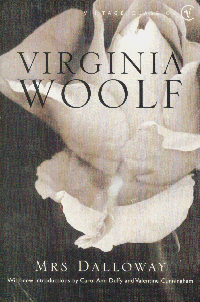
Review: Mrs Dalloway by Virginia Woolf


Reviewed by Lucia

Published: 1923

It's about: Everything and nothing. A single day in the life of upper middle class Mrs Dalloway, and everyone who passes in and out of the affected bubble. Woolf comments on the British class system and the effects of WWI. Think Seinfeld; a lot of things going on but not much happening.

I thought: Okay, so that description of the plot does not make this novel sound that interesting. Woolf's writing, on the other hand, is quite intoxicating. She moves through her characters' minds in long but fragmented sentences. Her use of this stream-of-consciousness style allows the reader to see both the inside and outside of characters. That is, what characters are thinking and what others think of them. Woolf's language is lively, expressive and well punctuated which supports this rambling style and stops the reader drowning in confusion.

Thursday, June 16, 2011

Review: The Distant Hours by Kate Morton

Reviewed by Lucia.

Published: 2010.

It's about: It all started when Raymond Blythe wrote the celebrated children's book 'The True History of the Mud Man.' However the answer to the question of the author's inspiration puzzling readers and critics and is lodged further back than most would guess, its repercussions still resonating soundly when narrator Edie begins to discover how her mother's childhood intertwines with the Blythe family's enigmatic history. Still living together in Milderhurst Castle, Kent, the Blythe sisters nurse their own secrets and regrets as well as their youngest sister Juniper, for whom life crashed to a halt the night during WWII when her fiance abandoned her.

I thought: I read this book partly as part of my vow to read more by Aussie authors, but mostly because the blurb sounded brilliant and I like the author. Morton's rambling, descriptive and sometimes unconventional style does not appeal to many, but to me it doesn't seem forced. It's detailed enought to be well thought out and engaging, but it doesn't lag. Occasionally the foreshadowing becomes excessive, but I liked having lots of ends to tidy and seeing how the author dealt with an undoubtedly complex plot. One aspect which confused me was the narration. Some sections were told in the first person by Edie, but some were in third person and reflected on the Blythe sisters' pasts. I was never sure if Edie knew about what was being discussed in these third person segments.

Monday, June 6, 2011

Review: Possession by A.S Byatt

Reviewed by Lucia.

Published: 1990.

It's about: Passionate academics Roland Michell and Maud Bailey uncover a stash of letters between the two Victorian poets they have dedicated their careers to: Randolph Ash and Christabel LaMotte, a connection which was not previously known to have existed. Initially, Roland and Maud's discovery alters their research only, but as they unearth the truth of the correspondence, their involvement becomes increasingly personal. Desperately concealing their purpose from competing researchers, they are drawn together by their urgency, both of them from solitude and loneliness, challenging the most basic knowledge about themselves, and uncovering their unique entitlement to the secret of Ash and LaMotte's past.


I thought:Byatt's daunting novel is intricately written and passionate in every sense, and reading it reminded me why I love the English language. Her style is lush and wordy in the best possible manner. I was primarily drawn to the details of emotional description as opposed to the author's physical descriptions, and Byatt succeeds brilliantly at this. I loved simply her choice of words, over other literary techniques. The depictions of people and the images evoked from them are built with a fluid yet occasionally bizzare choice language, however I quite liked this peculiarity and was interested by it. Moreover, the author's use of poetry in very intense. Not being a huge reader of the text type, I read the poems without looking too much into their meaning in relation to the overall storyline. Despite this, the plot was comprehensible, and the metaphors which I did pick up on were clever and well integrated.


Wednesday, May 18, 2011

Review: The Boat by Nam Le


Reviewed by Lucia

Published: 2008

It's about: This is a collection of several short stories by Vietnamese author Le, who later migrated to Australia. The settings of the stories however, trek across multitude of countries and cities, and are, at times, seemingly autobiographical. Spanning several decades, Le dabbles in a variety of times, cultures, and emotions.

I thought: This book is beautiful. Not necessarily that I found the characters
likable or the story enjoyable, but Nam Le's language is unparalleled. I enjoyed the book most as a whole, when I allowed myself to simply appreciate the story for the language and the emotions of the characters.

Le's style is captivating. The way in which the author manipulates the prose to build landscapes and create emotions is very unique, and I enjoyed the novel relying solely on these elements. At times Le's bluntness is startling but fresh. I find that I have read many short stories whose author's build them up singularly on the evocation of the character's emotion, which can become monotonous. Yet Le's sharp truths come precisely when required.

One of my favorite stories was Waiting For Elise, about an ill and aging
painter, mourning the loss of his lover and the daughter he doesn't know. The
structure Le has pieced together such that the reader discovers the narrating
character's past slowly but not lethargically. Somehow, impossibly, the voice
of the story is unbiased towards the situation of the narrating character. I
believe that this reflects the title of the story, in that the central character is waiting as opposed to actually doing, and he knows this. I think the reader can sympathise with this because at the heart of the story is a commonly felt fear.

Verdict: Stick it on the shelf.

Reading Recommendations: Nam Le's website is quite interesting.

Warnings: None.

Favorite excerpts: Just read the book, its worth it.

What I'm reading next: Mrs Dalloway by Virginia Woolf.

Tuesday, May 17, 2011

Top Ten Minor Characters


HELLO! This week's Top Ten Tuesday topic from The Broke and the Bookish is minor characters. I (Lucia) was strangely interested to tackle this one because I do spend a lot of time thinking about minor characters, especially as they often supply some essential aspect of the story.

Lady Bracknell from The Importance of Being Earnest by Oscar Wilde. I usually wouldn't call her a minor character because she's so integral to the play's ridiculousness. However, but for the fact that she loves poking her nose into other people's business, she really needn't bother herself with the goings on of the other characters.

Mr Bingley from Pride and Prejudice by Jane Austen. Forget Darcy. I'd like to marry silly Mr Bingley.

Violet Brown from The Lacuna by Barbara Kingsolver. Quite a sweet character, I think. See Christina's review of the book here.

Anna from The Hare with Amber Eyes by Edmund de Waal. In a memoir of his family, the author didn't know the surname of his great grandparents' maid, so she's just Anna. Secondly, from this book, Elizabeth, de Waal's grandmother. If I didn't already have two grandmothers, I'd want her to be mine. Both women do individually unbelievable things.

Huizi from 20 Fragments of a Ravenous Youth by Xiaolu Guo. Fenfang, you must take care of your life. Not bad for what I'm sure is this character's only piece of dialogue.


Luna Lovegood
from the Harry Potter series by J. K Rowling. She made me really want horseradish earrings.

Ellen Ash from Possession by A. S Byatt. Not as trivial as she allows herself to be perceived to be.
Have a good week!

Wednesday, May 11, 2011

Literary Blog Hop: May 12-15

Welcome to the Literary Blog Hop hosted by The Blue Bookcase!

This blog hop is open to blogs that primarily feature book reviews of literary fiction, classic literature, and general literary discussion.

How do I know if my blog qualifies as "literary"? Literature has many definitions, but for our purposes your blog qualifies as "literary" if it focuses primarily on texts with aesthetic merit. In other words, texts that show quality not only in narrative but also in the effect of their language and structure. YA literature may fit into this category, but if your blog focuses primarily on non-literary YA, fantasy, romance, paranormal romance, or chick lit, you may prefer to join the blog hop at Crazy-for-books that is open to book blogs of all kinds.

Instructions for entering the Literary Blog Hop:

1. Grab the code for the Button.

Literary Blog Hop


2. Answer the following prompt on your blog.

(Suggestions for future prompts? Email to them us at thebluebookcase@gmail.com)

What books have you read that have been hyped as literary and, in your opinion, were not?

Our answer comes from Lucia:

Lovesong by Alex Miller

I heard amazing reviews praising both the book and it's Australian author. It won/ was shortlisted for a handful of literary prizes. However did I not like the story's plot, and was bored by the author's style and descriptions. Before I go further I will say that this is just one girl's opinion and that others may have perfectly legitimate reasons why this book is literary. Miller's language is simple in a way that I did not find captivating or reflective of the proposed mood of the text. The primary theme which I obtained from Lovesong was how even very ordinary lives can be both beautiful and ripe with aching sadness. I felt that the descriptions were meant to be intimate portrayals of the characters and their circumstances, although I did not understand how the use of language showed this. It just seemed flat and at times even teetered on being poorly written. For the most part, I found the characters to be the strongest element of the novel. The narrating character Ken, an aging writer searching for a last story, however, was highly disagreeable. In his constant niggling at obtaining the full story of another couple's relationship, Miller creates the impression that the character is somewhat unsympathetic or indifferent to his friend's evident despair. Furthermore, the details of Ken's past and the death of his wife propose to create an understanding and deeply empathetic character, yet to me he did not display either of these qualities. Miller sets the scene for Ken to be able to sympathize with John, and yet this does not occur.

3. Add your link to the Linky List below.

Happy Hopping!

*PLEASE NOTE: if you do not answer the question and link back to The Blue Bookcase in a post on your blog, you will be removed from the Linky list. 


Tuesday, April 19, 2011

Top Ten Tuesday: Rewind

Hi there, Lucia here. I was very excited to see over at The Broke and the Bookish that this weeks Top Ten would be a previous one that we hadn't completed. As a compulsive list-maker with a knack for missing her posts for this meme (some might even call it a talent) I am delighted to list my Top Ten All-Time Favourite Books. (In no order. It's too hard to pick just ten in the first place.


Persuasion by Jane Austen. Not the most popular of Austen's novels, but definitely my preferred.

People of the Book by Geraldine Brooks.

Harry Potter by J. K Rowling. Cliché I know, but I can't help it. I only just recently saw the first part of the seventh film too, the best one so far I think. I love the whole series but I'd say either the fifth or the sixth are my favourites.

Matilda by Roald Dahl.

Prodigal Summer by Barbara Kingsolver. After several years of reading Kingsolver, I still haven't made it to The Poisonwood Bible (undoubtedly her most well-known), but am very interested to read Animal, Vegetable, Miracle.

The Time Traveller's Wife by Audrey Niffenegger.

Mao's Last Dancer by Li Cunxin.

To Kill A Mocking Bird by Harper Lee.

Brideshead Revisited by Evelyn Waugh.

The Guernsey Literary and Potato Peel Pie Society by Mary Ann Shaffer and Annie Barrows.

Saturday, March 26, 2011

Review: The Hungry Tide by Amitav Ghosh

Reviewed by Lucia.

Published: 2004

It's about: Set in the Sundarbans, a cluster of islands drifting on the reckless tides of the coast of India, the story is of the place's strange peace. It is unsettled by Piya, an Indian/ American woman researching a breed of river dolphin and who doesn't speak the local language, and Kanai, a sharp but arrogant translator from the mainland. On the island of Lusibari, Kanai's aunt Nilima has build a legacy in the first hospital to be erected on the vicious landscape, and spends a lifetime protecting it from the harsh thoughts of her political radical husband until his death. Finally, there is Fokir a local fisherman, who guides Piya through the labyrinth of waters. Together they constitute the history of the region's unyielding habitat, and the people who live through it.

I thought: The most wonderful thing about this novel are the descriptions of the tide country, particularly Lusibari and the water and riverside itself, but also the types of people who live there and how they make their life. The language that Ghosh uses is lovely in that for a book so crammed with details and descriptions, it's not difficult to get through or dull so that the images seem flat. For example, the depictions of the mud which seems to completely cover the islands and extends to the shores and bottom of the river. It appears in so many aspects of the story, because it makes up an important part of the landscape, yet it isn't just the author telling the reader what mud is. He knows we know. It's how this mud makes the place, how it swallows up your feet if you don't curl your toes into it, and in this way Ghosh describes the way people live in the Sundarbans, and how it is truly singular.

The style and language that Ghosh uses to develop the characters is also artful. They are each different and present a different idea and background to the story. The fact that there is often no resolution to the conflicts that these differences cause, gives the reader the idea that people simply live differently, and are required to do things in varying ways depending on their situation and the nature of where they live. Ghosh makes these differences and disagreements in opinion okay.

The only negative thing I would say about this novel is that the beginning is a little slow. I read the blurb and then was 100 pages in and wondering when everything was going to start. Although, other than that, this book is fascinating. The plot is brilliantly intriguing and makes you curious about what the reader is trying to say.

Verdict: Stick it on the shelf.

Reading Recommendations: I regret not reading this book in a shorter period of time, in order to make the most of the atmosphere and sense of place.

Warnings: None.

Favorite excerpts: 'Kanai, the dreamers have everyone to speak for them,' she said. 'But those who're patient, those who try to be strong, who try to build things - no one ever sees any poetry in that, do they?'

Soon the dawn fog was as distant a memory as the chill of the night. With the mud banks and the forests holding back the wind, no breeze could find its way down to the water. In the stillness, the river seemed to give birth to a second sun, so that these was almost as much heat radiating from the water's surface as from the cloudless sky. As the temperature peaked, subterranean currents of life rose seething to the surface of the nearby mud banks, with legions of crabs scuttling to salvage the rich haul of leaves and other debris left behind by the retreating tide.

What I'm reading next: Persuasion by Jane Austen