Showing posts with label Memoir. Show all posts

Saturday, May 11, 2013

The Diary of Napoleonic Foot Soldier by Jakob Walter

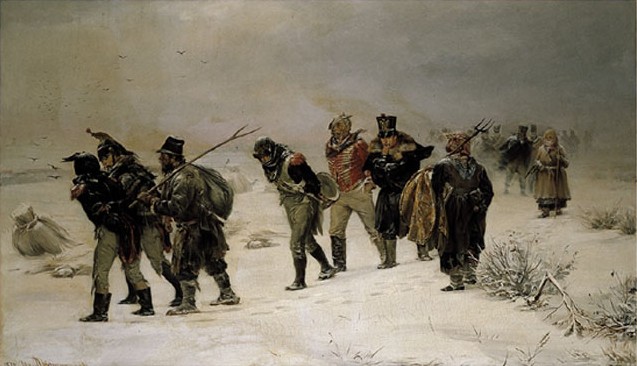
In 1812, by Illarion Pryashnikov, via

Reviewed by Susanna Allred

Published: 1991

It's about: The Diary of a Napoleonic Foot Soldier is the memoir of Jakob Walter, a German conscript in Napoleon's Grand Army. While many veterans of the Napoleonic Wars eventually wrote memoirs of their military service, Walter's is unique among them because it is written from the point of view of a private foot soldier. All first-person accounts to have surfaced so far have been written by men of the officer class who were more educated, cultured, and ideologically invested than he. Consequently, Walter's diary is especially valuable for its candid insights into the day-to-day experiences of a lowly conscript in Napoleon's massive military campaigns.

The Diary itself is divided into three sections; the 1806-7 campaign in Poland, the 1809 campaign in Austria, and the 1812 campaign in Russia. All three are a mix of Walter's casual anthropological observations of Eastern European culture, his accounts of combat in various battles, and personal reminiscences of military culture among foot soldiers. By far, the bulk of the Diary focuses on his memories of the retreat from Moscow, and the long months of starvation, cold, disease, and reprisals from Russian cossacks that it entailed. This section is rendered especially vivid though Walter's focus on his unending efforts to scavenge enough food to keep himself and his friends from starvation: a handful of raw meat from a slaughtered horse one night, a bit of cabbage boiled with dog fat the next. Nevertheless, the visceral nature of his memories is balanced by an off-hand and modest tone. 

I thought: Jakob Walter's memoir is a concise and engaging account of a foot soldier's observation of the turmoil wrought by Napoleon's wars. By this point in history, most people's mental image of those wars is heavily influenced by fiction: War and Peace, Horatio Hornblower, and Master and Commander study the Napoleonic Wars through the eyes of ideologically engaged and aristocratic literary heroes. By contrast, the historical Jakob Walter embarked on his first campaign as a foot soldier conscripted out of private life as a stonemason. Furthermore Walter was remarkably indifferent to Napoleon's personal charisma and political principles for two reasons. First, Walter's native German principality of Swabia had recently been made a tributary state of Napoleonic France; second, as a low-ranking private citizen, Walter had little to gain from his participation in the wars.

For the most part, the Diary actually benefits as a work of literature from Walter's political indifference and lesser education. His prose style is plain, direct, informal, and completely readable. Walter generally restricts his attention to his own experiences, generally refusing to speculate or comment on the political context of the war or the motivations of the generals and princes who directed its progress. While he does not shrink from fully recounting the shocking deprivations of the retreat, he is never stoops to self-pity or recrimination. However, this same limited scope can become frustrating. As a reader, I very much wanted to know what Walter thought of his own conscription and Napoleon's military projects, but the author is generally silent on these matters.

Walter's self-portrait is filled with intriguing contradictions. In the 1806-7 portion especially, he casually recounts drinking binges, brutally requisitioning supplies, and violently forcing Polish peasants to act as guides and translators with little  embarrassment. This unapologetic roughness is offset by pious allusions to his Catholic beliefs, and his evident affection for the brother and two sisters from whom he is separated by war. At one point, he finds a book he deems insulting to his faith and "bound a stone to this book, and sank it in the big lake." When Walter, nearly dead from typhus and malnutrition, is finally able to visit with his younger sister after the retreat from Moscow he mentions that they "tarried as a loving brother and sister for an hour's time and then parted again with tears." However, Walter's personal contradiction add up to a convincing portrayal of a conflicted, complex human.

Verdict: Stick it on the shelf. 

Reading Recommendations: For an interesting historical comparison, read In Deadly Combat: A German Soldier's Memoir of the Eastern Front Gottlob Herbert Bidermann's account of his military service to Nazi Germany against the Soviet Union.

Warnings: Some mild references to alcohol.

Favorite excerpts:

He [Napoleon] watched his army pass by in the most wretched condition. What he may have felt in his heart is impossible to surmise, His outward appearance seemed indifferent and unconcerned over the wretchedness of his soldiers; only ambition and lost honor may have made themselves felt in his heart; and, although the French and Allies shouted into his ears many oaths and curses about his own guilty person, he was still able to listen to them unmoved.

What I'm reading next: If On a Winter's Night a Traveler by Italo Calvino

Wednesday, December 26, 2012

Review: Born to Run by Christopher McDougall

Tarahumara runners in Copper Canyon, via Running Matters
Reviewed by Christina

Full Title: Born to Run: A Hidden Tribe, Superathletes, and the Greatest Race the World Has Never Seen

Published: 2009

It's about:  In this mishmash of memoir, travel writing, persuasive essay, and sports science journalism, Christopher McDougall describes his own experience with a running-induced injury and his subsequent quest to discover how a native Mexican tribe of natural-born runners, the Tarahumara, can run absurd distances at breakneck speeds for their entire lives without injury or burnout.  Along the way he researches and becomes acquainted with a number of eccentric American ultra-marathoners.  It all comes together in a climactic 50-mile footrace in the forbidding Copper Canyons.

I thought: I LOVED THIS BOOK.  LOVED.  I can't remember the last time I was so continuously engrossed, inspired, and awestruck while reading.  I almost don't want to give too much away about it because I so enjoyed learning something new on nearly every page while also being drawn along by McDougall's enthusiastic storytelling.  Born to Run is full of amazing information about what humans can do.  I especially loved his chapter about our evolutionary background and how distance running may have saved and created modern mankind.  I realize that the jury is still out about the scientific validity and health benefits of certain ideas McDougall favors: minimalist running, the endurance running hypothesis, and ultramarathoning.  But I can't remember the last time I met so many interesting and new (to me) topics in one book.  I'm pretty convinced by McDougall's writing, and I'm generally not an easy person to convince.  Plus the end is heartwarming, even to a crusty old cynic like me.

Because of my own adoration, it's hard for me to accurately judge whether the average reader would react as strongly to Born to Run as I did.  It's hard for me to resist overstating things here; I really do feel that this book has changed my life.  I've only ever been a casual runner at best, but now I feel motivated to learn to love to run.  And in a more broad sense this book has awaked in me a new respect for what we as people are capable of accomplishing.  I've already begun recommending it to every person I know who has even a mild interest in running or sports/exercise science, but I think I could expand that recommendation to anybody who loves adventurey nonfiction.

Verdict: Stick it on the shelf!  Do it now!  Especially if you consider yourself a past, present, or future runner!

Reading Recommendations:  Perfect for giving you a new passion for running (and life in general) after the gluttony of the holidays.

Warnings:  a few swears.

Favorite excerpts“That was the real secret of the Tarahumara: they'd never forgotten what it felt like to love running. They remembered that running was mankind's first fine art, our original act of inspired creation. Way before we were scratching pictures on caves or beating rhythms on hollow trees, we were perfecting the art of combining our breath and mind and muscles into fluid self-propulsion over wild terrain. And when our ancestors finally did make their first cave paintings, what were the first designs? A downward slash, lightning bolts through the bottom and middle--behold, the Running Man.
Distance running was revered because it was indispensable; it was the way we survived and thrived and spread across the planet. You ran to eat and to avoid being eaten; you ran to find a mate and impress her, and with her you ran off to start a new life together. You had to love running, or you wouldn't live to love anything else. And like everyhing else we love--everything we sentimentally call our 'passions' and 'desires' it's really an encoded ancestral necessity. We were born to run; we were born because we run. We're all Running People, as the Tarahumara have always known.” 

“There's something so universal about that sensation, the way running unites our two most primal impulses: fear and pleasure. We run when we're scared, we run when we're ecstatic, we run away from our problems and run around for a good time.” 

What I'm reading next:  Anna Karenina by Leo Tolstoy (!!!!!)

Friday, November 16, 2012

Review: A Girl from Yamhill & My Own Two Feet by Beverly Cleary


A Girl from Yamhill & My Own Two Feet by Beverely Cleary
Reviewed by Christine-Chioma

Published: 1988 (A Girl from Yamhill) & 1995 (My Own Two Feet)

It's about: These two books are autobiographies from Beverely Cleary, the famous writer of the much-beloved Muggie Maggie, Dear Mr. Henshaw, and the Ramona series. A Girl from Yamhill covers some family history, Clearly's girlhood and young adulthood in Oregon until she leaves home for college. My Own Two Feet takes off where A Girl from Yamhill finished and covers Clearly's life up until the publication of her first books.

I thought: These are some of my favorite books. I was delighted to know that some of the stories about Ramona were based off Cleary (such as taking one bite into multiple apples because the first bite tastes the best). There were a lot of humorous parts in the memoirs especially in A Girl from Yamhill. Cleary didn't sugarcoat her life. I was impressed by Cleary's candor especially in regards to the strained relationship between her and her mother. Although written several decades after the events occurred, Cleary was able to appropriately capture her thoughts at various ages and stages in her life. She is a great story-teller and someone who understands children well. It was fascinating to read about life during the Depression, what college was like for women in the 1940's, and her impressions of the pacific northwest and California, which are place that are very dear to me. I am really impressed by Cleary and think she's a great role model for women. She has a website that is worth checking out as well.

Verdict: Stick it on the shelf or Rubbish Bin? Stick it on the shelf! I wish she had continued writing more about her life.

Reading Recommendations: For young (12ish) and older! The books easily flow into each other and I think the only reason they aren't just one book is because of the length and because she wrote the second book years later, but I would definitely recommend reading both.

Warnings: Nothing at all offensive

Favorite excerpts: Sometimes it was Uncle Fred, my father's oldest brother, who had a fascinating bald head. After we passed him, Mother said, "You mustn't stare at Uncle Fred's bald head. You might hurt his feelings." How could I hurt his feelings when I so admired his bald head? I once tried to cut off my own hair so I would be bald, too. - A Girl from Yamhill

Claudine and I studied The Century Handbook of Writing, giggling all the way. Examples seemed even funnier. When we came to Rule 68, "Avoid faulty diction," we studied the examples: "Nowhere near. Vulgar for not nearly." "This here. Do not use for this." "Suspicion. A noun. Never to be used as a verb." Our conversation became sprinkled with gleeful vulgarisms we had never used before. When I announced my presence by noisily tap-dancing on the Klums' wooden porch and probably annoying all the neighbors on the block, Claudine said she was nowhere near ready for school. "I suspicioned you weren't." Claudine's reply was something like, "This here shoe-lace broke." - A Girl from Yamhill

I knew they were thinking of me and missing me more than I, on the brink of a new life, was missing them - My Own Two Feet

I was not entirely sure I wanted to stay with relatives again. Even though I loved them all there had been moments of discomfort, of not knowing where I stood, of feeling I was not doing the right thing. Beneath my happiness there had been some strain... - My Own Two Feet

Some of Professor Lehman's words also echoed through my mind: "The minutiae of life", and "the proper subject of the novel is universal human experience." - My Own Two Feet

What I'm reading next: The Age of Miracles  by Karen Thompson Walker

Wednesday, October 3, 2012

Review: The Chronology of Water by Lidia Yuknavitch

via
The Chronology of Water by Lidia Yuknavitch
Reviewed by Ingrid

Published: 2011

It's about: This is a tough one to summarize. Here's the goodreads description:

"This is not your mother’s memoir. In The Chronology of Water, Lidia Yuknavitch expertly moves the reader through issues of gender, sexuality, violence, and the family from the point of view of a lifelong swimmer turned artist. In writing that explores the nature of memoir itself, her story traces the effect of extreme grief on a young woman’s developing sexuality that some define as untraditional because of her attraction to both men and women. Her emergence as a writer evolves at the same time and takes the narrator on a journey of addiction, self-destruction, and ultimately survival that finally comes in the shape of love and motherhood."

I thought: Cheryl Strayed called this book "a brutal beauty bomb and a true love song." I like that description. This book is brutal and sometimes difficult to digest, but it is beautiful. I was stunned by Yuknavitch's writing - I read almost the whole thing sitting on my bed in the same position. I reveled in it. I read and reread sentences and paragraphs that impressed me. I laughed at Yuknavitch's clever and funny chapter titles. I dog-eared pages I liked even though the copy I was reading was from the library. I absolutely DIED over this book, I loved it so much. I told Derik that, hands-down, this is the best book I've read all year and perhaps one of the best books I've read, ever.

a still of Yuknavitch from the book trailer
While I don't usually like very experimental, poetic-ish writing, Yuknavatitch does it well in a way that feels real and is convincing. Yuknavitch figured out how to shape her experience into a narrative that makes sense to her while still keeping her voice and her story authentic. This is sort of hard, because our lives never play out in a way that fits nicely into a little memoir. There's just so much stuff that happens to us, all the time, and depending on how you look at it, all those things can be interpreted in millions of ways. It's difficult to write down our stories without imagining our audience and wondering, what will they think of me? Do they even care about this or that? Is this entertaining, or beautiful, or important? How can I make it seem like it is?

Yuknavitch's writing breaks down all these barriers. Her narrative flows in many directions without losing its center and its force. Like the nature of water, her writing style is flowing, moving, all encompassing. It is heartbreakingly honest and mindbendingly beautiful. My edition contained a short interview with Lidia Yuknavitch that gave me some great insight into her writing. She talks about bodies - "I think bodes are the coolest thing in ... ever. Your body, Mine. All the different kinds. What glory bodies are" - and how she tries to bring language closer to corporeal experience - "To bring langauge close to the intensity of eperiences like love or death or grief or pain is to push on the affect of language ... I want you to hear how it feels to be me inside a sentence." This is what I think makes Yuknavitch stand apart.
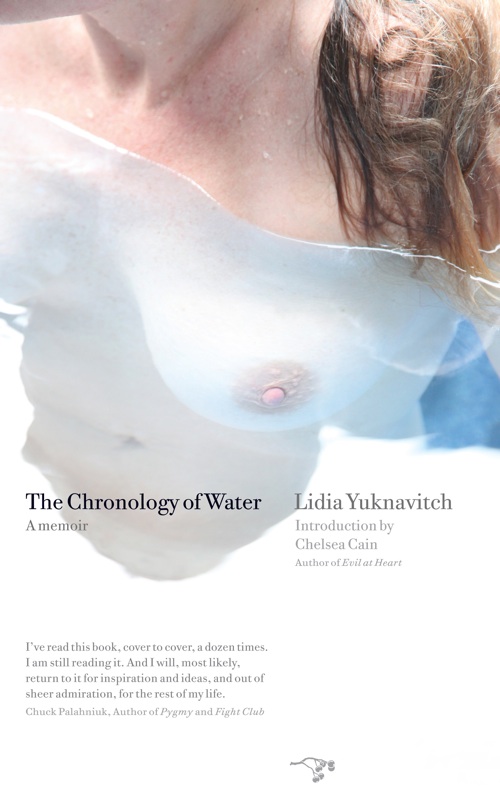
And speaking of bodies .. yes, that is a boob on the cover. The book is sold in stores with a charcoal band around the front covering the boob. I chose to show you the real cover, though, because I think the human body should more often be seen as something beautiful without having to be sexualized. Yuknavitch wrote about the image on the cover here.

Verdict: Stick it on the shelf. This is by far my favorite book I've read this year.

Warnings: There is a lot of rough language and content in this book. I would not recommend it to everyone. In fact, because of the content I would recommend it to very few. If it sounds like something you would like, I would suggest flipping through and reading a few pages at your local bookstore or library and see if it is something that appeals to you.

Favorite excerpts: "I used to watch Miles fall asleep from drinking boob milk late into the night. I'm guessing all mothers do this. But I bet not all mothers were thinking of Shakespearean sentence structures when they watched their babies drunkenly drift into sleep...when I watched Miles go from mother's milk to burp to deep and frothy dream, his body heavy in my lap, the blue-black of night resting on us, I thought of Shakespearean chiasmus. A chiasmus in language is a crisscross structure. A doubling back sentence. A doubling of meaning. My favorite is 'love's fire heats water, water cools not love.'
     As a motif, a chiasmus is a world within a world where transformation is possible. In the green world events and actions lose their origins. Like in dreams. Time loses itself. The impossible happens as if it were ordinary. First meanings are undone and remade by second meanings.
     I didn't sleep much the first two years in the forest house. Miles, bless his hungry little head, wanted more milk than any man alive. All night. I thought of my mother--and my own unquenchable, milkless mouth. If this boy wanted milk, I would give it to him. Maybe all our lives were being reborn in the forest. ...
     The exhaustion of new parents is absurd. Beyond absurd. But I'm not about to get all righteous about that. In fact, it's something else altogether I want to tell you. I think our exhaustion in the green world brought us to our best selves. Listen to this: the first two years of Miles' life? When I was supposed to be depleted? I wrote a novel and seven short stories. Andy wrote a novel and three screenplays. Read that again. How is it that so much writing happened inside the least amount of time or energy?
     Green world.
     We had no time. We had no energy. We had no money. What we had was making art in the woods. So when Andy turned to me one night over scotches and said 'We should invent a Northwest press that isn't about f-ing old growth and salmon,' and I laughed my ass off, and then said, 'Yeah, we should,' we just...did. Which is how the zenith of our depletion changed into the zenith of our creative production. Andy and me, we had anther child. An unruly literary press, which we named 'Chiasmus.' Turned out, there were lots of writers in the Northwest who were tired of old growth and salmon. Our first publication was an anthology called Northwest Edge: The End of Reality. Because, you know, it was. Everything we were before we were this, utterly transformed.
     Shakespeare.
     In our forest we gave art to life, and art to life made us."

What I'm reading next: The Rules of Civility by Amor Towles

Monday, September 17, 2012

Review: My Life in France by Julia Child, with Alex Prud'Homme

photos by Paul Child
 Reviewed by Christina

Published: 2006

It's about: The wikipedia summary is excellent and I'm feeling lazy tonight, so I'm just going to copy/paste it for you:
"My Life in France is an autobiography by Julia Child, published in 2006. It was compiled by Julia Child and Alex Prud'homme, her husband's grandnephew, during the last eight months of her life, and completed and published by Prud'homme following her death in August 2004.[1]
In her own words, it is a book about the things Julia loved most in her life: her husband, France (her "spiritual homeland"), and the "many pleasures of cooking and eating." It is a collection of linked autobiographical stories, mostly focused on the years between 1948 and 1954, recounting in detail the culinary experiences Julia and her husband, Paul Child, enjoyed while living in Paris, Marseilles, and Provence.[2]
The text is accompanied by black-and-white photographs taken by Paul Child, and research for the book was partially done using family letters, datebooks, photographs, sketches, poems and cards.[3]
My Life in France provides a detailed chronology of the process through which Julia Child's name, face, and voice became well known to most Americans.
The book also contains an extremely detailed index cataloging every person, place, ingredient, recipe, topic and event discussed."

I thought: I love Julia Child!  She is so bubbly and enthusiastic, without coming off as airheaded or annoying.  She's an extremely likeable narrator, and Alex Prud'Homme beautifully captures her voice and her casual, confidential manner.  When I picked up My Life in France, I hoped to like her as much as I did in Julie and Julia.  She's even more wonderful here, since she's actually herself (as opposed to a character).  I love the way she freely expresses her love and admiration for France, food, and her husband.  She really was a charming woman, and this is a charming book. 

One thing I find particularly inspiring about Julia Child's life story is that she had very little interest in cooking and no interest in French food until she moved to France when she was in her late 30's.  JULIA CHILD didn't find her calling in life until well into her adulthood.  Isn't that so great?  In a world where every preschooler is pushed to be great at something (or everything) from the very beginning, and we're all encouraged to settle on a major/career in our late teens, it's so refreshing to read about someone who had a fascinating and fulfilling young adult life (she served in the foreign service during WWII), and then finally REALLY found what she loved when she was nearly 40.  I love that.

My Life in France is not an action-packed read.  The readers who will appreciate it most are people (like myself) who love France, cooking and Ms. Child.  But it's very nicely written, with all sorts of interesting cultural vignettes not just about the French, but about Germans, Norwegians, and Americans as well.  I just ate this book up!  (Pun fully intended.) 

I gotta say, though, that most of the foods she describes sound totally disgusting to this picky pescetarian.    

Verdict: It may not be for everyone, but I'll still happily stick it on the shelf.

Reading Recommendations:  Light, sweet reading.  Check it out when you want to get to know Julia Child, I guess!

Warnings:  nothing

Favorite excerpts: “Maybe the cat has fallen into the stew, or the lettuce has frozen, or the cake has collapsed. Eh bien, tant pis. Usually one's cooking is better than one thinks it is. And if the food is truly vile, then the cook must simply grit her teeth and bear it with a smile, and learn from her mistakes.”

“The sweetness and generosity and politeness and gentleness and humanity of the French had shown me how lovely life can be if one takes time to be friendly.”

What I'm reading next: Last Night in Twisted River by John Irving

Thursday, September 13, 2012

Double Review: Beyond the Sling and Why Have Kids?

Beyond the Sling: A Real-Life Guide to Raising Confident, Loving Children the Attachment Parenting Way by Mayim Bialik

Why Have Kids? by Jessica Valenti

Reviewed by Ingrid

Published: 2012

They're about: While both Beyond the Sling and Why Have Kids? would be shelved in the "Parenting" section of your local bookstore, they are two very different books.

Mayim Bialik has the more "traditional" parenting book; using stories of her own experience, she describes specific parenting techniques and explains why they work. Bialik advocates Attachment Parenting, a parenting style whose major tenants are co-sleeping, breastfeeding, baby wearing, and gentle discipline. Bialik claims that this is the most natural and intuitive style of parenting.  Much of the book is written like a memoir, with very short sections explaining the science (Bialik has a PhD in neurobiology) and statistics. She hits on all those things listed above as well as her experience with natural birth, breastfeeding into toddlerhood, elimination communication, and natural home remedies. Bialik argues that you should always do what's best for baby.

Jessica Valenti, however, isn't interested in telling you the best way to parent. She is more interesting in exploring how the messages about parenting within our society are often harmful to parents and children. Valenti challenges her readers to think critically about the choices they make and how they affect their children, their lives, and the rest of society. Interestingly, Valenti goes through a list of almost the exact same issues that Bialik writes about and directly challenges them with lots of statistics. Valenti argues that you should NOT always do what society tells you is "best" for baby, because often those things may not actually be best, and because doing those things reinforces the expectation that women need to sacrifice pretty much all of their time and energy to raise a happy, healthy child when that is not necessarily the case.

Mayim Bialik via
I thought: I don't have kids. But I like reading parenting books, because I'm cool. I also really like Mayim Bialik, because she's smart, articulate, funny, and I like the soothing sound of her voice. The thing that intrigues me most about her, though, is that she is both a Modern Orthodox Jew and a feminist. Women who identify as feminists AND as members of strongly patriarchal religious groups always stand out to me, because I am one myself - I identify as a Mormon feminist. A lot of people think these things are conflicting. They often are. But I think that having a strong stake in two conflicting communities provides more opportunites to explore questions pertaining to both communities in new ways.

Case in point: in Beyond the Sling, I was specifically interested Bialik's point of view regarding the intersection of feminism and the strong family values that stem from her religious views. The principles behind her parenting techniques were very appealing to me. She claims that attachment parenting encourages children to make strong emotional connections with their parents that will later translate into strong, healthy relationships with other people, as well a healthy sense of self-confidence. Those are certainly things I want for my future children, things I think most people want. This parenting style takes some MAJOR, commitment though, and I mean MAJOR. Bialik is literally involved with her children 24 hours a day - whether she's breastfeeding (on demand, day and night, until the child no longer shows an interest,) watching her child's body language to be able to discern when the child needs to be taken and held over the toilet to "eliminate," (sometimes this is every 15 minutes,) sleeping next to your child (and thus waking up every time they wake up,) watching them for any signs of sickness or discomfort, carrying them around every where you go in a sling, etc, etc. That is exhausting just to think about. However, Bialik seems to imply that the strong emotional connection to create with your child when you make this sacrifice is empowering to both mother and child.

While I still had Bialik's book on my mind, I saw Rebecca's review of Why Have Kids? a few days ago and borrowed a copy on my kindle right away. The first thing I noticed is that Valenti has a much more polemic tone to her writing. Bialik wants to gently suggest what might work best for you, and constantly reminds you that she knows there are many different kinds of parents with different circumstances and blah blah. Valenti wants to force you to confront the implications of your choices. A little jarring at first, but definitely effective. This is important stuff, after all. And it worked on me. By the end, I was all fired up and eager to explain to my husband about all of the unfair, unrealistic expectations put on mothers in our society.

Interestingly, both of these books were written by mothers who identify as feminists. I think this points to the fact that feminism is growing and evolving to encompass many different possible life choices and points of view, while still holding to the principle that women should hold an equally-valued place within society. I think this is a very good thing.

Jessica Valenti via
Obviously it's up to each parent to decide how to raise their child. I think it's worth reading both books and thinking carefully about which issues are most important to you and can benefit you and your child the most. However, these arguments can get a little exhausting. If you need something to lighten things up a little bit, I like this article.

Verdict: Stick them both on the shelf. Or maybe check them out from the library.

Reading Recommendations: Since these book address many of the same issues from different perspectives, it's quite enlightening to read them together.

Warnings: None.

Favorite excerpts:
"What I have discovered, and what I seek to share with you, dear reader, is this: you already know the majority of what you need to know to be an incredible parent. It was only when I believed this and began to apply it consistently to my growing family that my anxiety, worry, and exhaustion began to lift. It was then that I truly began to enjoy being a parent and to see myself as a successful parent; not a perfect parent, and not always the most patient parent, but a sensitive, loving, and confident parent who truly loves this life I have chosen." -Bialik

"Families that don’t force independence encourage children to grow at their own pace, fully express their needs, and feel truly understood. This style of parenting is not the only way to guarantee a securely attached child, but in my experience and observations, I would hedge my bets that this path, broad though it can be, is a great way toward a smooth and minimally complicated relationship with children." -Bialik

"This is a book about how the American ideal of parenting doesn’t match the reality of our lives, and how that incompatibility is hurting parents and children. Because the expectation of a certain kind of parenthood—one where we’re perfect mothers who have perfect partners, where our biggest worry is whether or not to use cloth diapers—makes the real thing much more difficult to bear." -Valenti

"My pump, which came in a jaunty little nylon purse that looked like a 1990s Kate Spade knockoff, made a rhythmic sound when operating that sounded a little too much like House music for my comfort. There’s something about a club kid beat set to your breasts being tortured that makes the whole ridiculous scenario feel even crueler." (Haha!) -Valenti

"Vast amounts of research show that children do best when they’re raised by a community of people—parents, grandparents, friends, and neighbors. It’s in our DNA—we are social beings, and we should be raised as such. Yes, mothers are important, but not because we are women or because we’re biologically related (or not) to our children. We’re important because we’re one of the people that love and care for a growing human. But if we want to take some joy in that experience, we need to let go of the notion that we are the only ones who can do it correctly, and that if we are doing it right, it should mean some sort of suffering or tremendous self-sacrifice." -Valenti

What I'm reading next: Possession by A.S. Byatt

Monday, August 27, 2012

Review: Anarchy Evolution by Greg Graffin and Steve Olson

Greg Graffin, via
 Reviewed by Christina
I received a complimentary copy of this book in exchange for an honest review. 

Complete Title: Anarchy Evolution: Faith, Science, and Bad Religion in a World Without God


Published: 2010

It's about: Greg Graffin, UCLA science lecturer and singer/songwriter for Bad Religion, explains his naturalist worldview in this blend of memoir and science writing.  He describes the origins of Bad Religion within the world of L.A. punk in the early 1980's, explains how he came to love Life Sciences (especially evolutionary biology and paleontology) and argues for Naturalism as guiding truth.

I thought:  Well.  For starters, I've got to tell you what a fascinating person Greg Graffin is.  How many people can love two worlds so whole-heartedly?  He's passionate and successful in both art and science, and that is something I really respect.  The persona he presents in Anarchy Evolution is pretty likeable, too- he's far less arrogant than I expected.  I can get behind a lot of what he says, and I learned a lot from reading his ideas.  I liked learning how he experiences and interprets the world.

And it's a good thing, too, because a little likeability goes a long way in a book that is as heavily weighted with personal experience and opinion as this one.  Graffin uses a very casual, personal, "I"-based style in the more memoir-y passages.  Then, in the more persuasive, science-based sections, his voice changes quite drastically to become informative, argumentative, sometimes almost academic.  Honestly, this didn't make for the best flow within chapters.  I found myself wondering where Steve Olson stepped in; did the two authors situation cause some of the loss of consistency?  The entire book reads like it's Greg Graffin's own, but then there's Steve Olson's name on the cover.  What was his role in writing this book?  Was he more a glorified editor than a true co-author?

This is the first book I've read that argues against the existence of God.  My husband loves Richard Dawkins and Christopher Hitchens, though, while I haven't picked them up yet, the atheist/antitheist ideas and arguments are fairly familiar to me.  So I was curious to see how Greg Graffin would present things.  In general, I think he takes a more conciliatory attitude than the more famous guys, and it does seem like he tries, in a way, to be reasonably sensitive to religious people.  But there's still quite a bit of condescension in the air here, as well as oversimplification of religious belief.  (For example, the implication that all faith is based in fear and all religious childrearing is gentle brainwashing.)  But then, this is Graffin's book.  It's his presentation of his own worldview; his perceptions of religion are a legitimate part of that.  So I personally wasn't offended.  In fact, I really liked his argument against the term "atheism."

Me in high school.
(I blurred out my mildly offensive gesture
because this is a family friendly website.
You're welcome.)


One thing I loved: learning about the early punk scene in Southern California.  Those sections reminded me a little of Fargo Rock City, only more amusing since I actually know and relate to the bands and unifying ideas Graffin discusses.  A few parts of Anarchy Evolution read like a punk rock primer: this is what punk is about, this is how and why it started, and this is why it's still relevant.  I loved revisiting this subject that I haven't thought about in ten years.  I'd love to read a real cultural history of punk.  I know they're out there, but I don't want to waste time with a bad one.  Recommendations?

One final thing: the title.  Come on!  Anarchy Evolution doesn't really say anything.  Instead of two nouns side-by-side, shouldn't it be "Anarchic Evolution" or "The Anarchy of Evolution" or "Anarchy and Evolution"?  I know I'm over-thinking this.  It just bugs me.      

Verdict: Stick it on the shelf.  It's a unique piece of work from an unusual point of view- just what I was hoping for when I picked it up.

Warnings: Maybe a swear or two?  And then, obviously, the whole atheism thing.  Watch out if you're sensitive to that.

Favorite excerpts: "Suffering is an inevitable consequence of evolution.  Naturalists see tragedy as an outgrowth of natural processes that have been occurring in multicellular organisms throughout history: bacterial parasitism, infant mortality, infection, starvation, catastrophe, species extinction.  Does all this suffering serve any purpose other than reminding us to try to avoid suffering in the future?  Perhaps it's too much to ask of any worldview- whether based on naturalism or religion- that it provide an ultimate answer to the question of tragedy."

What I'm reading next: The Time Traveler's Wife by Audrey Niffenegger

Tuesday, August 21, 2012

Review: The Happiness Project by Gretchen Rubin


via

The Happiness Project: Or, Why I Spent a Year Trying to Sing in the Morning, Clean My Closets, Fight Right, Read Aristotle, and Generally Have More Fun by Gretchen Rubin

Reviewed by Christine-Chioma

Published: 2009

It's about: Gretchen Rubin realizes she is not as happy as she could be despite good life circumstances. She sets out to increase her happiness in her every day life through researching happiness and concentrating on monthly happiness themes and goals.

I thought: I've actually read and enjoyed Rubin's blog for quite sometime, but only now got around to picking up the book from the library. I really enjoyed how Rubin interlaced statistics and facts with her own personal experiences with happiness. I found myself telling others how happier people do better in school and that people who donate to charities actually end up being richer. The book is definitely more personal than the blog and I really liked that. She also talked about why it's important to be happy and addressed the stigma of happiness being unsophisticated. I found myself implementing small tips such as smiling more, de-cluttering, and getting more sleep. However, it didn't motivate me to actually try a happiness project of my own (it seems like too much work). She had comments from her blog posts from readers which I didn't really care for.

Verdict: Stick it on the shelf or Rubbish Bin? Stick it on the shelf!

Reading Recommendations: This book is definitely not for people who are actually clinically depressed and Rubin makes that quite clear. You don't have to be unhappy to read it. I generally think I am happy but I still enjoyed it. I was not interested in starting a happiness project of my own, but if you are there is a Happiness Project one sentence journal that could help with one of the tips she mentions. There is also a reading guide for book clubs. Another suggestion would be to take off the jacket cover, because I had to field a lot of unwanted questions and teasing about why I was reading a book about being happier.

Warnings: Nothing inappropriate.

Favorite excerpts: "Studies show that recalling happy times helps boost happiness in the present. When people reminisce, they focus on positive memories, with the result that recalling the past amplifies the positive and minizes the negative. However, because people remember events better when tehy fit with their present mood, happy people remember happy events better, and depressed people remember sad events better. Depressed people have as many nice experiences as other people--they just don't recall them well."

What I'm reading next: I hate saying what I'm going to read next because it really depends on my mood and the phase of the moon and what pants I'm wearing.

Tuesday, August 14, 2012

Review: Tolstoy and the Purple Chair by Nina Sankovitch

Nina Sankovitch via
Tolstoy and the Purple Chair: My Year of Magical Reading by Nina Sankovitch

Reviewed by Ingrid

Published: 2011

It's about: After the death of her sister, Nina Sankovitch decides to read one book a day for a year. She hopes that daily reading will bring a new organization to a life scattered by grief. Each morning, Sankovitch writes a review on her blog of the book she finished the day before. Jumping between memories of her sister, themes that stand out to her in the books she reads, and specific passages that touch her, Sankovitch works through her grief by throwing herself into the alternate worlds and new lives in her books.

I thought: One of the first things I noticed about this book is that its subtitle is a play on the phrase "magical thinking," probably a reference to Joan Didion's famous memoir about mourning the death of her husband, The Year of Magical Thinking. Some people were surprised that there was so much about Sankovitch's sister in this book, but I think it may have been the best part of the book - it held together the narrative and gave purpose to Sankovitch's reading. I think one of the best things about reading is how subtly literature can weave itself into our lives, opening our eyes to new intellectual and emotional understanding. Sankovitch definitely captured this.

I thought this book was a beautiful monument to the author's sister, and the writing was authentic and deeply felt. Some parts were great. But I just couldn't get behind the formula of it. I'm not a huge fan of this whole "I did ___ for a year a found myself" memoir thing going on. Ultimately I'm just not going to love anything that's formulated to sell. I know, I suck. I'm one of those art for art's sake kind of people. Another problem with this formula is that it immediately alienates anyone who doesn't have the resources to go about the same project. Sankovitch obviously needed to have the money to be able to sacrifice eight or so hours a day to reading and writing. She also needed someone (in her case, her husband) to take care of her four children while she read. She is obviously privileged in comparison to many, if not most Americans who can't sacrifice that kind of time. This is the most common criticism I've heard of these one-year memoirs, and I think it's legitimate. Sankovitch recognizes this, but I think it still gets in the way of her point. I would have appreciated a more organic, authentic memoir about a working mother who still found time to have the same experience with books in her spare time - even if (especially if) she didn't have time to finish a whole book in one day. It would have felt more real.

I also suspect that Sankovitch had her conclusion in mind when she started the project (otherwise why would she do it?) Maybe it's just memoirs in general that are difficult for me to love. I recognize though that writing about one's own experience is much more difficult than writing fiction. The memoirist doesn't control over the events of the story, only the way those events are framed and interpreted. I imagine it is difficult to make a memoir feel completely authentic and still have an acceptable beginning, middle, and end. I don't think I've found that perfect ("perfect"?) memoir yet. If you have, please direct it my way.

Alright, so while I didn't love this book, it was still a fun and worthwhile read. I took it to the beach with me while I was in California and we had a nice time together. It brought some great reading memories. But ultimately, it's the reading that's the thing - not the reading about the reading. You can't truly appreciate it until you experience it. So I say, read this book - but also read Tolstoy, Edith Wharton, Louise Erdrich. Maybe take a few recommendations from the great list at the back of the book.

Verdict: Stick it on the shelf. I couldn't bring myself to put this one in-between. So put it on your shelf, but put it amongst a bunch of other really great books. This is a good time-out from all your other reading. ;)

Reading Recommendations: This book feels like it was written with book bloggers in mind. It appeals to all those things we love: reading for long periods of time and writing about the books we love. If you love reading, you'll like this book.

Warnings: None.

Favorite excerpts: Sankovitch on reading Kevin Canty's story "Burning Bridges, Breaking Glass" -

"I finished reading that story with my own 'green fuse lit,' my own youth recovered. I remembered lying in bed at night with the windows opened to let in the warm summer air. From the bed, I could hear the traffic on Gold Road and the radio playing on the neighbor's porch. I smelled the dankness of freshly turned earth in our garden, the sweet scent of cut grass, and the smoky smell of barbecues. The smells and sounds were like an invitation to me, a summons to run out and join the universe. I was older then, beyond hide-and-seek games and waiting for the ice-cream truck, but I still believed my future was limitless. I knew that the breeze coming in from the window was full of promises of adventure and love and fun, promises just waiting to be fulfilled."

On memory -

"It is a gift we humans have, to hold on to beauty felt in a moment for a lifetime. Suddenly beauty comes to us, and gratefully we take it. We may not be able to recite time and place, but the memories can come flooding back, felt full force without warning or brought on purposefully by a triggering event. The smell of pinecones, the whiff of popcorn, the taste of a cold beer, or the bite of mint: a jumble of feelings, and then a sudden clarity of beauty or joy or sadness. Beauty is in the moments that endure, the moments that enliven us again and again. We stand on memory's sturdy pilings. We thrive on the nourishment provided by the past."

What I'm reading next: Beautiful Ruins by Jess Walter

*I received a complimentary copy of this book from the publisher in exchange for an honest review.

Monday, May 21, 2012

Review: The Center Cannot Hold by Elyn R. Sacks

Reviewed by Christina

Published: 2007

Full Title: The Center Cannot Hold: My Journey Through Madness

It's about:  Elyn Saks, a brilliant professor and scholar, describes her inner schizophrenic life in this surprisingly inspiring memoir.

I thought:  I loved this book.  I think I should modify my Top Seven Inspirational People post, bump it up to eight and add Elyn R. Saks.  This lady is, first of all, incredibly intelligent.  She cares for others immensely and has dedicated a huge chunk of her career to developing material that argues for the rights of people with mental illness.  And, luckily for me (and all of us!) she wrote this honest, brave, and important book. 

The Center Cannot Hold is a perfect example of the idea I tried to get at with my Mental Illness in Fiction Reading List.  It is a text that attempts that noblest goal: to encourage human empathy in the reader.  Ms. Saks hopes to dispel the awful stigmas associated with schizophrenia- those enduring prejudices about people with thought disorders being dangerous, absolutely hopeless cases, people who can be discarded from functional society and labeled "crazy."

Anyway, I'm a big fan of this author and her work.  Here are a couple of interesting tidbits that struck me and/or changed my mind about something:
  • HIPAA.  I am now a believer in it.  It used to be not illegal for health care professionals to discuss patients' histories with other people!  At one point, an E.R. tech actually told Ms. Saks the name of another student at Yale who had suffered a psychotic episode.  And soon after that, a hospital told the school's administration about Ms. Saks' condition, effectively withdrawing her from law school without her consent.  (This was also before the Americans with Disabilities Act.) 
  • Speaking of consent, holy moly!  It apparently didn't exist for many American patients in the 1980's.  Ms. Saks was unwillingly committed to a hospital, restrained and in solitary confinement for days at a time, and force-fed medications.  I don't think I'm overstating this when I say: WTF?!?!  Contrast that with the laissez-faire attitude toward psychotic people in England during the same period, when Ms. Saks (who clearly needed antipsychotic medication) was allowed to stay in the hospital if she and her demons wanted to, but she didn't really receive any treatment other a recommendation for psychoanalysis.
  • Psychoanalysis, if you ask me, is generally a bunch of hooey.  I thought pretty much everyone believed this, so I was surprised when Ms. Saks described her own very positive experiences with it.  And she did soften my attitude a bit.  She argues for (and demonstrates her own need for) a combined regimen including medication and some sort of talk therapy.  And that, I have to admit, does make sense. 
SO.  If you have any interest at all in this subject or if you're hoping to relate more closely to people with schizophrenia, PLEASE read The Center Cannot Hold.  It's an vivid, insightful, and hopeful book.

Verdict: Stick it on the shelf.

Reading Recommendations:  In some very basic ways, this reminded me of Autobiography of a Schizophrenic Girl and An Unquiet Mind.  I liked it WAY better than either of them, though.

Warnings: Nothing I can remember.  Maybe one or two swears that I glossed over?  Nothing to deter you, really.

What I'm reading nextThe Robber Bride by Margaret Atwood

Tuesday, May 1, 2012

Review: The Woman Warrior by Maxine Hong Kingston

Maxine Hong Kingston (via)
The Woman Warrior: Memoirs of a Girlhood Among Ghosts by Maxine Hong Kingston

Reviewed by Christine-Chioma & Ingrid


Published: 1976

It's about: This memoir is organized in a series of stories and legends. Some stories are from Kingston's own experiences, others are her mother's stories, and others without origin. All of the stories are about women in Kingston's family, and the stories weave together as if from a single source.

C-C thought: I loved the first narrative, "No Name Woman". In it Kingston's unnamed aunt becomes pregnant while her husband is at war. Kingston fictionalizes the details, emotions and motives behind the pregnancy and the ensuing persecution. The memoir's themes of woman's roles, family, and ancestry are well-woven into the haunting narrative and appropriately connect to Kingston's life. I also really enjoyed "The Song for a Barbarian Reed Pipe" which greatly focused on growing up as an immigrant's child. However, most of the other stories fell short. They were either too supernatural ("White Tiger") or disturbing ("Shaman") for me to appreciate. I found myself concentrating on understanding meaning that I assumed I was missing instead of enjoying the narrative.

Ingrid thought: The narrative of this book was a little confusing to me at first, because I wasn't sure who was narrating or whose story was whose. By the time I finished, though, I realized that Kingston did this on purpose. By appropriating the stories of her mother, her mother's sister, and her aunt on her father's side, Kingston is showing that their experiences have come to be a part of her individual identity. Ancestors and family are central to Chinese culture, so I thought it was especially beautiful that Kingston set up her memoir this way.

I'm glad I read this book, but it wasn't the most exciting book I've ever read. I appreciated how it was constructed, I liked how Kingston showed how stories and the telling of stories have helped her construct her own identity. But I just wasn't dying over this book. I think we'll put this one in between.

Verdict: In between. 

Reading Recommendations: It's a book that would be great to read for a class and to analyze, but not really to enjoy.

Warnings: Some language

Favorite excerpts: "The work of preservation demands that the feelings playing about in one's guts not be turned into action. Just watch their passing like cherry blossoms. But perhaps my aunt, my forerunner, caught in a slow life, let dreams grow and fade and after some months or years went toward what persisted."

"Long ago in China, knot-makers tied strings into buttons and frogs, and rope into bell pulls. There was one so complicated that it blinded the knot-maker. Finally an emperor outlawed this cruel knot, and the nobles could not order it anymore. If I had lived in China, I would have been an outlaw knot-maker."

"To make my waking life American-normal, I turn on the lights before anything untoward makes an appearance. I push the deformed into my dreams, which are in Chinese, the language of impossible stories. Before we can leave our parents, they stuff our heads like the suitcases which they jam-packed with homemade underwear."

Friday, April 20, 2012

Review: Heaven is Here by Stephanie Nielson

via


Reviewed by Christine-Chioma

Published: 2012


It's about
: Stephanie Nielson (NieNie) is a famous Mommy-blogger whose life changed dramatically when she and her husband were in a serious near-fatal plane crash which left 80% of her body burned. The memoir chronicles her life before the crash and her struggles to deal with the aftermath of it

I thought: I actually started reading NieNie's blog back in the days when she went by the alias of "Gracie J. Brunswick". I was captivated by her ability to make every day life seem magical, romantic and beautiful.  The same talent comes across in her book. NieNie's describes her mostly idyllic childhood with gratitude and awe. As she describes her child's first birth, I could feel her love for her children and her role as a mother. Although she is positive, she is not unrealistic about the more difficult parts of her life. It's never sappy, corny, or predictable. It is a story of hope and courage, but included in her memoir are also her fear and despair. She describes her depression and guilt for getting on the plane and other difficult emotions and adjustments. I typically do not like books that are described as inspiring, but I really enjoyed this one. I really appreciated her honesty, because sometimes memoirs paint a picture of un-relatable saint, but NieNie comes across as very real and human.

With much criticism of the Church of Jesus Christ of Latter-day Saints in the media today, it was refreshing to hear NieNie's point of view and to see how she applied her beliefs and principles. Although I am a member myself, I tried to take a step back and think of the accessibility of the book to someone who isn't familiar with the church at all. NieNie does a great job of explaining Mormon terminology and culture. She is very firm in her faith and testimony, but nothing in her writing comes across as preachy or written for the intent to convert. It is clear that her faith is a natural part of herself. Her relationship with God is her rock. While people may not be able to relate to her beliefs, the humanity, struggles and triumphs are relatable and they are at the forefront of this book. One thing that's pointed out in the book is that most of her blog readers have dramatically different lives and views than hers, but still appreciate the glimpses into her life. It kept me captivated--I read it in literally one day.

Each section of the book has pictures of NieNie and her family and I think it really helps to see her physical transformation from before the crash to after. You can watch a clip of her on Oprah and a video the Mormon church did of her story.

Verdict: Stick it on the shelf! 

Reading Recommendations: Share copies with friends?

Warnings: None. She alludes to sex but never anything even bordering on inappropriate.

Favorite excerpts:

"One nurse was planning a wedding, and so we talked about her wedding dress and the plans she was making. Another was expecting a baby, and I asked about her doctor's appointments. I genuinely liked to hear about their lives outside the hospital...However, when it was time for their shift to end, I had to adjust to the miserable realization that they actually were going to lead the lives we'd talked about."

"Our accident had been my mother's worse fear. She had warned us of the danger of flying and even begged me not to get in a small airplane. I knew I had broken her heart on that day in August. When she came to visit, I dried my tears and took a deep breath so I could smile when she walked in the room. It was worth the effort to see her shoulders relax and the crease in her forehead disappear."

"My brothers and sisters loved me like they always had, and despite all the upheavals in my physical and emotional life, they reminded me of the one thing that had always mattered most in my life: what it means to belong to a family."

"Those precious, beautiful children didn't deserve a disfigured, incapable mother. They needed someone strong, who could take care of them no matter what. Seeing them, and the way they looked at me, destroyed any hope I'd harbored that I could take care of them again. I was inadequate in every way, and they didn't even want to look at me."

What I'm reading next: A Prayer for Owen Meany by John Irving