Showing posts with label Philosophy. Show all posts

Wednesday, August 14, 2013

A Universal History of Iniquity by Jorge Luis Borges

Borges via
Reviewed by Susanna Allred

Published: 1935

It's about: Borges appropriates and tweeks lives of historical criminals--Chinese pirates, Old West gunslingers, New York street toughs--to explore paradox. Each entry into this collection masquerades as a truthful historical narrative; however, Borges liberally diverges from his source material, essentially turning factual events and people into props through which to set up elaborate philosophical ironies and paradoxes. For example, the protagonist of the first story in the collection, "The Cruel Redeemer Lazarus Morell", is a bloodthirsty and pious con man who induces enslaved African Americans to run away with his band of thieves, promising that if they allow him to sell them back into slavery, only to "steal" them away again, they will eventually be escorted North to freedom. Every time, of course, Morell eventually kills his victim when he begins to suspect the true nature of his "Redeemer." Eventually, one of Morell's confederates denounces his scheme to the authorities. Morell, ironically, believes his only hope of salvation lies in fomenting an insurrection among those slaves who still believe rumors of his benevolence--essentially taking on sincerely the role he had only maliciously affected before. The greater irony however, is that rich possibilities afforded by the potential turn of events are thwarted when Morell himself is robbed and killed by a petty thief who does not recognize him.

Part of the richness of A Universal History of Iniquity stems from Borges' ability to weave his dense, darkly humorous paradoxes into genres that tend to be consigned to the pulpy end of the high-low cultural divide. Borges sets his short stories into contexts modeled after Westerns, crime stories, and orientalizing adventure tales. His nominally historical characters participate in the theft, murder, and warfare endemic to these genres, but remain essentially flat characters who exist to be irony incarnate. One of the most intriguing stories, "Hakim, the Masked Dyer of Merv" purports to be the tale of a prophet who rises up in the Middle East in the 8th century to spearhead the meteoric rise of a blasphemous religion. Claiming that communion with God had made his face too brilliant for mortals to look upon, Hakim goes about imposing his religion through warfare while veiled, promising that men will be able to look on his face when they have accepted the truth. Hakim's truth is typically Borgesian.
The earth we inhabit is an error, an incompetent parody. Mirrors and paternity are abominable because they multiply and affirm it. Revulsion, disgust, is the fundamental virtue, and two rules of conduct (between which the Prophet left men free to choose) lead us to it; abstinence and utter licentiousness--the indulgence of the flesh or the chastening of it.
This being a collection of tales about violence and deceit, Hakim's charade is spoiled when one concubines lets slip that his supposedly glorified body is, in fact, riddled with leprosy. The suggestion, seemingly, is that an entire religion of degradation and heresy had sprung up to justify one man's physical corruption.

I thought: The entire collection boasts similarly clever, circuitous ironies that can be revisited endlessly. While the tales are all philosophically dense, they contain enough swashbuckling adventure to sustain interest in casual readers as well. The tone of scholarly historicity is a playful contrast to to the elaborately constructed labyrinths of plot twists that Borges builds into each story. The one entry into the collection that wears less well is "Man on Pink Corner", Borges' attempt to write a wholly fictional crime store that pivots around a knife fight between two Argentine street toughs. While exotic backdrops are a favorite for Borges, the setting and dialogue feel oddly forced or stilted in this attempt, as if Borges still needed to lean heavily on specific historical and literary texts in order to create lively literature of his own at this point.

While Borges eventually moved away from drawing so explicitly on other historical and literary sources (though his writing always remained famously inter-textual; many of his stories are literally books about books), the edition of A Universal History of Iniquity I read, which is part of Penguin Classics Collected Fictions, a complete anthology of Borges' short stories, contains helpful footnotes to each story. The footnotes are most enlightening and intriguing when highlighting Borges' divergence from his source material. For example, they confirm the existence of an actual set of "Rules for Pirates" in a book Borges cites in "The Widow Ching--Pirate" but the footnotes also reveal that Borges has (perhaps deliberately) appropriated and changed several other minor details of the story for apparently no reason. None of this really detracts from the stories themselves; rather, it adds to their enigmatic character.

Verdict: Stick it on the shelf or Rubbish Bin? On the shelf. 

Reading Recommendations: An interesting discussion of Borges the man and his propensity for certain themes.

Wednesday, April 24, 2013

The Last Man by Mary Shelley


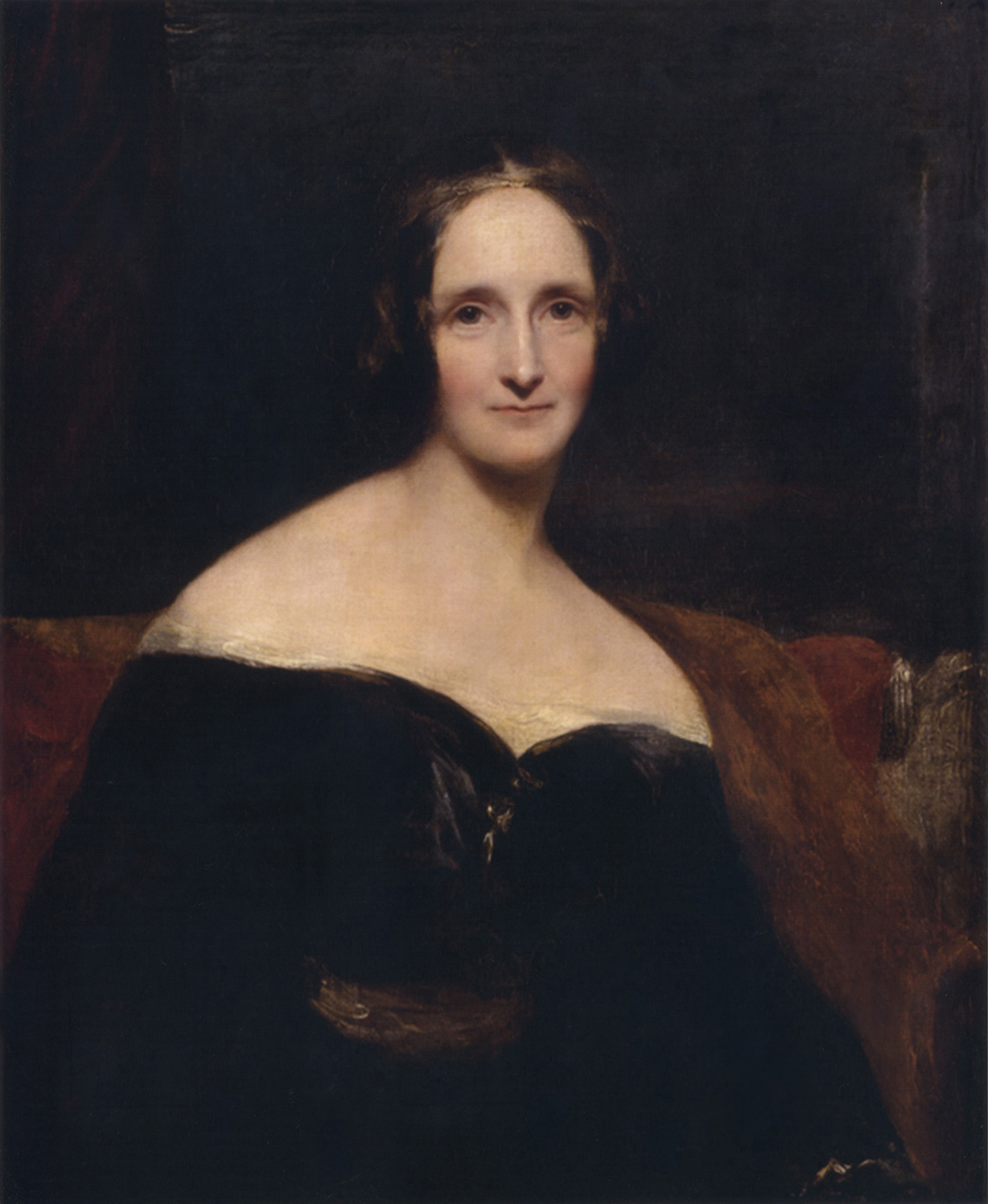
Mary Shelley, via

Reviewed by Susanna

Published: 1826

It's about: The year is 2096. In the past few decades, England has retired the monarchy in favor of a republican government, Greece has reconquered Constantinople, and men have begun to travel long distances by hot air balloon. Now, however, plague ravages the globe, upending law and order, breaking down social barriers, and giving rise to a deadly messianic cult.

The end of the world is observed by Lionel Verney, an English historian who, by accident of fortune, is both immune to the plague and uniquely placed to document its progress. Verney's account begins as an autobiography: he spends the first third of the novel relating his and his sister Perdita's impoverished youth as orphans in the rugged countryside, his eventual friendship with the former Crown Prince of England, Adrian Windsor (who paradoxically cherishes republican beliefs); his courtship of Adrian's vivacious sister Idris; and Perdita's marriage to the brooding, tempestuous Lord Raymond.

The pastoral romance of the first third takes an abrupt, Gothic turn when a seemingly-abandoned ship drifts into an English harbor. Its lone surviving crew member lives only long enough to spread a deadly, voracious contagion to London. As England's population rapidly dies off, Adrian attempts to stave off chaos and lead the few survivors to safety across the English Channel, only to encounter warfare, accident, and further sickness.

I thought: Mary Shelley is better known for Frankenstein, but The Last Man is her lost masterpiece. At the time of its publication in 1826, the possibility of humanity's extinction was considered grotesque and almost offensive. Consequently, the novel languished in obscurity for over a century. It was only after the possibility of a nuclear holocaust was realized in the mid-twentieth century that critics began to revisit The Last Man and recognize its innovative and prescient nature. Specifically, Shelley is the first major writer to treat the theme of apocalypse as a primarily secular, scientific event, and to thoroughly explore is social repercussions. Novels like The Walking Dead and The Road, which prominently feature dwindling bands of survivors attempting to preserve some semblance of morality and civilization in the face of a dubious future, can claim The Last Man in their literary ancestry.

Nevertheless, The Last Man is a highly unique work that differs significantly from its modern descendants. Unlike the emotionally spartan works of fellow post-apocalyptic writers Cormac McCarthy, George Orwell, and Ray Bradbury; Shelley is an unabashedly emotive writer. She ably demonstrates her place in the pantheon of Romantic writers with numerous, rapturously beautiful descriptions of pastoral abundance and rugged wilderness. She is also adept at turning debates on moral philosophy between her characters into riveting, poetic exploration of psychology. These two qualities are united in Shelley's exploration of the psychological differences between Raymond who believes that
Our virtues are the quick-sands, which shew themselves at calm and low water; but let the waves arise and the winds buffet them, and the poor devil whose hope was in their durability finds them sink from under him.
While Adrian muses that
The choice is with us; let us will it, and our habitation becomes a paradise. For the will of man is omnipotent, blunting the arrows of death, soothing the bed of disease, and wiping away the tears of agony.
Shelley's skill at crafting elaborate Gothic thrills only fully comes to the fore in the latter two thirds of the novel, as she expertly conjures up bizarre and unsettling images, increasing their intensity and frequency as the horrors of the plague ramp up. They foreshadow social chaos by disturbing the orderly progress of natural events. As the survivors cross the English Channel
three other suns, alike burning and brilliant, rushed from various quarters of the heavens toward the great orb; they whirled round it. The glare of light was intense to our dazzled eyes; the sun itself seemed to join in the dance, while the sea burned like a furnace, like all Vesuvius alight, with flowing lava beneath.   
Her ability to seamlessly combine political commentary, horror, romance, and nature writing makes for a unique, complex reading experience that readers return to repeatedly. Fans of Wuthering Heights, The Road, and Edgar Allan Poe should make this lost classic a priority. 

Verdict: Stick it on the shelf!

Reading Recommendations: The Wordsworth Classics edition has an engaging introduction and notes by Pamela Bickley and the Wikipedia entry contains a detailed plot summary and character list.

Warnings: None.

Favorite excerpts:
There were few books that we dared read; few, that did not cruelly deface the painting we bestowed on our solitude, by recalling combinations and emotions never more to be experienced by us. Metaphysical disquisitions; fiction, which wandering from all reality, lost itself in self-created errors; poets of times so far gone by, that to read of them was as to read of Atlantis and Utopia....
What I'm reading next: Angle of Repose

Monday, August 27, 2012

Review: Anarchy Evolution by Greg Graffin and Steve Olson

Greg Graffin, via
 Reviewed by Christina
I received a complimentary copy of this book in exchange for an honest review. 

Complete Title: Anarchy Evolution: Faith, Science, and Bad Religion in a World Without God


Published: 2010

It's about: Greg Graffin, UCLA science lecturer and singer/songwriter for Bad Religion, explains his naturalist worldview in this blend of memoir and science writing.  He describes the origins of Bad Religion within the world of L.A. punk in the early 1980's, explains how he came to love Life Sciences (especially evolutionary biology and paleontology) and argues for Naturalism as guiding truth.

I thought:  Well.  For starters, I've got to tell you what a fascinating person Greg Graffin is.  How many people can love two worlds so whole-heartedly?  He's passionate and successful in both art and science, and that is something I really respect.  The persona he presents in Anarchy Evolution is pretty likeable, too- he's far less arrogant than I expected.  I can get behind a lot of what he says, and I learned a lot from reading his ideas.  I liked learning how he experiences and interprets the world.

And it's a good thing, too, because a little likeability goes a long way in a book that is as heavily weighted with personal experience and opinion as this one.  Graffin uses a very casual, personal, "I"-based style in the more memoir-y passages.  Then, in the more persuasive, science-based sections, his voice changes quite drastically to become informative, argumentative, sometimes almost academic.  Honestly, this didn't make for the best flow within chapters.  I found myself wondering where Steve Olson stepped in; did the two authors situation cause some of the loss of consistency?  The entire book reads like it's Greg Graffin's own, but then there's Steve Olson's name on the cover.  What was his role in writing this book?  Was he more a glorified editor than a true co-author?

This is the first book I've read that argues against the existence of God.  My husband loves Richard Dawkins and Christopher Hitchens, though, while I haven't picked them up yet, the atheist/antitheist ideas and arguments are fairly familiar to me.  So I was curious to see how Greg Graffin would present things.  In general, I think he takes a more conciliatory attitude than the more famous guys, and it does seem like he tries, in a way, to be reasonably sensitive to religious people.  But there's still quite a bit of condescension in the air here, as well as oversimplification of religious belief.  (For example, the implication that all faith is based in fear and all religious childrearing is gentle brainwashing.)  But then, this is Graffin's book.  It's his presentation of his own worldview; his perceptions of religion are a legitimate part of that.  So I personally wasn't offended.  In fact, I really liked his argument against the term "atheism."

Me in high school.
(I blurred out my mildly offensive gesture
because this is a family friendly website.
You're welcome.)


One thing I loved: learning about the early punk scene in Southern California.  Those sections reminded me a little of Fargo Rock City, only more amusing since I actually know and relate to the bands and unifying ideas Graffin discusses.  A few parts of Anarchy Evolution read like a punk rock primer: this is what punk is about, this is how and why it started, and this is why it's still relevant.  I loved revisiting this subject that I haven't thought about in ten years.  I'd love to read a real cultural history of punk.  I know they're out there, but I don't want to waste time with a bad one.  Recommendations?

One final thing: the title.  Come on!  Anarchy Evolution doesn't really say anything.  Instead of two nouns side-by-side, shouldn't it be "Anarchic Evolution" or "The Anarchy of Evolution" or "Anarchy and Evolution"?  I know I'm over-thinking this.  It just bugs me.      

Verdict: Stick it on the shelf.  It's a unique piece of work from an unusual point of view- just what I was hoping for when I picked it up.

Warnings: Maybe a swear or two?  And then, obviously, the whole atheism thing.  Watch out if you're sensitive to that.

Favorite excerpts: "Suffering is an inevitable consequence of evolution.  Naturalists see tragedy as an outgrowth of natural processes that have been occurring in multicellular organisms throughout history: bacterial parasitism, infant mortality, infection, starvation, catastrophe, species extinction.  Does all this suffering serve any purpose other than reminding us to try to avoid suffering in the future?  Perhaps it's too much to ask of any worldview- whether based on naturalism or religion- that it provide an ultimate answer to the question of tragedy."

What I'm reading next: The Time Traveler's Wife by Audrey Niffenegger

Monday, February 13, 2012

Guest Review: Works of Love by Søren Kierkegaard

Guest Review by Rachel Hunt Steenblik. Rachel is a philosopher, librarian, and reader. She is currently getting her PhD at Claremont Graduate University. She also blogs at tenderheartedmercy.blogspot.com.

 Søren Kierkegaard via
Title: Works of Love by Søren Kierkegaard

Published: 1995. First published 1845.
It's about: Works of love, nor merely love. Kierkegaard tells us that this is the case because the book is full of Christian deliberations. What this means for us is that Kierkegaard is not giving us a theory of love. He is not giving us love as sentimentality, or passion, or feeling. Neither is he teaching us exactly what we need to do to be loving. For instance, he never says, "do this and this and this, and turn around three times, and then you are loving." Instead, he is taking a topic, love, that most people think they know something about, and he is telling them that it is both easier and harder than they think. He wants there to be an earnestness, and he wants there to be a difficulty.

More than anything, it is asking people to truly believe in love, and then to live it by practicing, and practicing again. It takes self-denial and it takes self-looking at. It also takes looking at God, and understanding the way God looks at us and those around us. We come to learn that everyone is the neighbor because everyone has the same relation before God. In the world, there is a ladder, with some people higher and some people lower. We admire some, we may not admire others. There are kings and there are poor people. There are beautiful people and there are ugly people. There are lovers and there are friends who share preferential relationships. For God and for Kierkegaard there are only neighbors. It is this neighbor love, this God love, this eternal, true love, that Works of Love is interested in.

The book itself is divided into two parts. (Fascinating fact: Kierkegaard thought he would die before he turned 34. He finished the first part, assuming that that would be all. He celebrated his birthday, and was still alive. He went to the registers to see if his birthday could possibly have been a different day. It couldn't be, so he wrote part II.) These two parts contain deliberations, or discourses on love. Each deliberation is inspired by a single verse from the New Testament. For example, one deliberation is on love's ability to believe all things from Paul's famous treatise on love in 1 Corinthians 13, but goes further and asserts that it is never deceived. Another is on love's ability to hope all things, but goes further and asserts that it is never put to shame. Still other deliberations focus on true love's ability to abide, to build up, and to cover a multitude of sins.

Kierkegaard was writing at a time when many things in his world were becoming easier. In one sense everyone was Christian because everyone belonged to the state church, but in another sense, this made it so very few people were actually Christian. Kierkegaard fought against this, and wanted to make it harder to be a Christian, so some people actually could be. He was concerned with helping people become individuals and selves, as he believed they were not born that way, but became that way by proper relations and choices. One way he did this was by writing indirectly and often pseudonymously. While Works of Love does bear Kierkegaard's own name, it does not make his task any different.

Saturday, September 10, 2011

Review: Atlas Shrugged by Ayn Rand

Reviewed by Meagan

Published: 1957

It's about: This book is a million pages long, so I browsed a few summaries online and am stealing the summary off Wikipedia:

"The book explores a dystopian United States where leading innovators, ranging from industrialists to artists, refuse to be exploited by society. The protagonist, Dagny Taggart, sees society collapse around her as the government increasingly asserts control over all industry (including Taggart Transcontinental, the once mighty transcontinental railroad for which she serves as the Vice President of Operations), while society's most productive citizens, led by the mysterious John Galt, progressively disappear. Galt describes the strike as "stopping the motor of the world" by withdrawing the "minds" that drive society's growth and productivity. In their efforts, these people "of the mind" hope to demonstrate that a world in which the individual is not free to create is doomed, that civilization cannot exist where people are slaves to society and government, and that the destruction of the profit motive leads to the collapse of society."

Saturday, September 3, 2011

Review: The Elegance of the Hedgehog by Muriel Barbery

Reviewed by Christina

Published: in French as L'élégance du hérisson in 2006.  In English, as translated by Alison Anderson, in 2008

It's about: 7 rue de Grenelle is a bourgeois Paris apartment building inhabited by successful, respected, well-educated, well-moneyed citizens.  They have no idea that their unassuming concierge, Renée Michel, is a closet intellectual who observes and sharply criticizes the residents' every word, every move, and every punctuation mark.  One of the residents, twelve-year-old Paloma Josse, also hides her intelligence.  Paloma is extremely precocious and she has decided, since life is futile, to commit suicide and set fire to her home on her thirteenth birthday.
In The Elegance of the Hedgehog, Renée and Paloma take turns pontificating, philosophizing, and gossiping for about 200 pages.  Then something like a story happens at the very end.

I thought: WOW, did I have a hard time getting into this bad boy.  My only thought for the first 150 pages was that this book was SLOW and pretentious.  The situation was probably exacerbated by the fact that I started listening to a little audiobook you might have heard of called The Hunger Games.  It happens to be the polar opposite of Hedgehog in just about every way possible.  But that's a story for another day.

Both narrators are elitists with nihilistic tendencies, and while they're interesting and unusual people, I'm not sure I found them immediately likeable- this might have been a big part of why I had such a hard time getting into the story.  I didn't understand why Madame Michel felt compelled to act the stereotype of a concierge, and while this is explained a bit throughout the book, I still felt there might be a cultural difference there.  Are the French more stringent about class position?  Speaking of French-ness, that was one thing I immediately loved about this book: It feels so French.  The translation is seamless; idioms are substituted well and some appropriate words remain in French.  I loved that Ms. Anderson retained that original flavor while also making the book perfectly accessible to English-language readers.

As I kept on reading, I found myself relating to Renée and Paloma more.  Both characters developed nicely.  This would be a good book to re-read, since I didn't fully appreciate the protagonists until the last third of the book.  And now that I've finished, I think of them as people I liked.  This book is ALL about the relationships developed between the characters, and I liked that there was also sort of a reader-character relationship development thing going on as I read.   It was like a 3-D effect, you know?  And by the time I got to the suddenly sad ending, I was really won over and feeling the shock and heartbreak they felt.

Verdict: Well, I'm definitely going to stick it on my shelf.  BUT!  My esteemed colleague, Ingrid, was not such a fan.  At all.  So I hope we'll get to hear from her in the comments.

Reading Recommendations:  Be prepared for that slow beginning.  Pick this one up when you're in the mood for some, like, Deep Thoughts, man.  The author is a Philosophy Prof, and it shows.   

Warnings: Uh, I can't really remember.  A couple of swears?

Favorite excerpts: "I smeared my lips with 1 layer of 'Deep Carmine' lipstick that I had bought 20 years ago for a cousin's wedding.  The longevity of such a useless item, when valiant lives are lost every day, will never cease to confound me.  I belong to the 8% of the world population who calm their apprehension by drowning it in numbers."

"This is the death of Dido, from Purcell's Dido and Aeneas.  In my opinion, the most beautiful music for the human voice on earth.  It is beyond beautiful, it is sublime, because of the incredibly dense succession of sounds, as if each were linked to the next by an invisible force and, while each one remains distinct, they all melt into one another, at the edge of the human voice, verging on an animal cry.  But there is a beauty in these sounds that no animal cry can ever attain, a beauty born of the subversion of phonetic articulation and the transgression of the careful verbal language that ordinarily creates distinct sounds.
Broken steps, melting sounds.
Art is life, playing to other rhythms."

What I'm reading next:  Memoirs of a Woman Doctor by Nawal El Sadaawi