Showing posts with label Non-Fiction. Show all posts

Saturday, May 11, 2013

The Diary of Napoleonic Foot Soldier by Jakob Walter

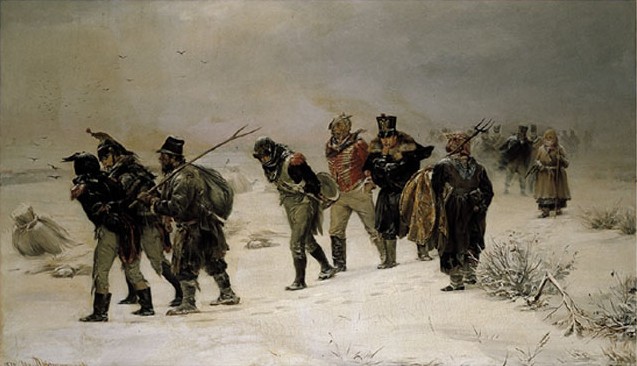
In 1812, by Illarion Pryashnikov, via

Reviewed by Susanna Allred

Published: 1991

It's about: The Diary of a Napoleonic Foot Soldier is the memoir of Jakob Walter, a German conscript in Napoleon's Grand Army. While many veterans of the Napoleonic Wars eventually wrote memoirs of their military service, Walter's is unique among them because it is written from the point of view of a private foot soldier. All first-person accounts to have surfaced so far have been written by men of the officer class who were more educated, cultured, and ideologically invested than he. Consequently, Walter's diary is especially valuable for its candid insights into the day-to-day experiences of a lowly conscript in Napoleon's massive military campaigns.

The Diary itself is divided into three sections; the 1806-7 campaign in Poland, the 1809 campaign in Austria, and the 1812 campaign in Russia. All three are a mix of Walter's casual anthropological observations of Eastern European culture, his accounts of combat in various battles, and personal reminiscences of military culture among foot soldiers. By far, the bulk of the Diary focuses on his memories of the retreat from Moscow, and the long months of starvation, cold, disease, and reprisals from Russian cossacks that it entailed. This section is rendered especially vivid though Walter's focus on his unending efforts to scavenge enough food to keep himself and his friends from starvation: a handful of raw meat from a slaughtered horse one night, a bit of cabbage boiled with dog fat the next. Nevertheless, the visceral nature of his memories is balanced by an off-hand and modest tone. 

I thought: Jakob Walter's memoir is a concise and engaging account of a foot soldier's observation of the turmoil wrought by Napoleon's wars. By this point in history, most people's mental image of those wars is heavily influenced by fiction: War and Peace, Horatio Hornblower, and Master and Commander study the Napoleonic Wars through the eyes of ideologically engaged and aristocratic literary heroes. By contrast, the historical Jakob Walter embarked on his first campaign as a foot soldier conscripted out of private life as a stonemason. Furthermore Walter was remarkably indifferent to Napoleon's personal charisma and political principles for two reasons. First, Walter's native German principality of Swabia had recently been made a tributary state of Napoleonic France; second, as a low-ranking private citizen, Walter had little to gain from his participation in the wars.

For the most part, the Diary actually benefits as a work of literature from Walter's political indifference and lesser education. His prose style is plain, direct, informal, and completely readable. Walter generally restricts his attention to his own experiences, generally refusing to speculate or comment on the political context of the war or the motivations of the generals and princes who directed its progress. While he does not shrink from fully recounting the shocking deprivations of the retreat, he is never stoops to self-pity or recrimination. However, this same limited scope can become frustrating. As a reader, I very much wanted to know what Walter thought of his own conscription and Napoleon's military projects, but the author is generally silent on these matters.

Walter's self-portrait is filled with intriguing contradictions. In the 1806-7 portion especially, he casually recounts drinking binges, brutally requisitioning supplies, and violently forcing Polish peasants to act as guides and translators with little  embarrassment. This unapologetic roughness is offset by pious allusions to his Catholic beliefs, and his evident affection for the brother and two sisters from whom he is separated by war. At one point, he finds a book he deems insulting to his faith and "bound a stone to this book, and sank it in the big lake." When Walter, nearly dead from typhus and malnutrition, is finally able to visit with his younger sister after the retreat from Moscow he mentions that they "tarried as a loving brother and sister for an hour's time and then parted again with tears." However, Walter's personal contradiction add up to a convincing portrayal of a conflicted, complex human.

Verdict: Stick it on the shelf. 

Reading Recommendations: For an interesting historical comparison, read In Deadly Combat: A German Soldier's Memoir of the Eastern Front Gottlob Herbert Bidermann's account of his military service to Nazi Germany against the Soviet Union.

Warnings: Some mild references to alcohol.

Favorite excerpts:

He [Napoleon] watched his army pass by in the most wretched condition. What he may have felt in his heart is impossible to surmise, His outward appearance seemed indifferent and unconcerned over the wretchedness of his soldiers; only ambition and lost honor may have made themselves felt in his heart; and, although the French and Allies shouted into his ears many oaths and curses about his own guilty person, he was still able to listen to them unmoved.

What I'm reading next: If On a Winter's Night a Traveler by Italo Calvino

Monday, April 1, 2013

Review: Eight Pieces of Empire by Lawrence Scott Sheets

Chechen rebels in Grozny, 1995. (via)

Reviewed by Christina
[I received a complimentary copy of this book from the publisher in exchange for an honest review.]

Published: 2011

It's about: "Not with a bang, but with a quiet, ten-minute address on Christmas Day 1991: this is how the Soviet Union met its end.  But in the wake of that one deceptively calm moment, conflict and violence soon followed.  Some of the emergent new countries began to shed totalitarianism while others sought to revive their own dead empires or were led by ex-Soviet leaders who built equally or even more repressive political machines.  Since the late 1980s, Lawrence Scott Sheets lived and reported from the former USSR and saw firsthand the reverberations of the empire's collapse.  Eight Pieces of Empire draws readers into the people, politics, and day-to-day life of the region, painting a vivid portrait of a tumultuous time.
Sheets's stories about people living through these tectonic shifts of fortune- a trio of female saboteurs in Chechnya, the chaos of newly independent Georgia in the early 1990s, young hustlers eager to strike it rich in the post-Soviet economic vacuum- reveal the underreported and surprising ways in which the ghosts of empire still haunt these lands and the world."  (back cover of my paperback edition)

I thought: I loved it.  I've never been particularly interested in war reporting, and I didn't really realize that's what I was getting into when I requested a copy of Eight Pieces of Empire.  I didn't know that this book would be difficult to read, and if I had I probably would have politely declined.  BUT.  I'm so glad it came my way.  You know those books that force you to examine how little you know about the world?  This is one of those books.

Lawrence Scott Sheets is a strong, journalistic writer (he covered the former USSR, especially the Causasus, for Reuters and NPR) and he fills these dire conflicts with some bizarre characters and absurd situations.  I can totally get behind the stories and the people in them; in a lot of ways, things weren't so different where/when I lived in Kazakhstan.  And despite the innately foreign and occasionally gruesome subject matter, Sheets makes his material human and relatable. 

There are a few stylistic things that grated on my nerves- the overuse of scare quotes,  Sheets' inconsistency in referring to characters sometimes by their given names and sometimes by their surnames, and a few other minor quirks.  But the book itself is excellently paced and so well-written.  Combine that with important and interesting recent history- I would never not recommend this.  It is interesting and worthwhile, especially for a reader who has any connection to or special interest in ex-Soviet countries.

Verdict: Stick it on the shelf!  сейчас!

Reading Recommendations:  Be ready for the war violence.  Technically this is a quick, easy read.  Emotionally, not so.

Warnings:  Appropriately grisly descriptions of war violence.  And a couple of swears.

What I'm reading next:  McSweeney's Issue 11

(P.S. - Sorry for not doing something funny today.  As you may have noticed, all the BB writers have a little preoccupied lately.  If you need a laugh, you can check out last year's post.)

Monday, March 4, 2013

The Other Side of Normal by Jordan Smoller

via
Reviewed by Christina
I received a complimentary copy of this book from the publisher in exchange for an honest review.

Full Title: The Other Side of Normal: How Biology is Providing the Clues to Unlock the Secrets of Normal and Abnormal Behavior

Published: 2012

It's about:  "In this enthralling work of popular science, respected Harvard psychiatrist Jordan Smoller addresses one of humankind's most enduring and perplexing questions: What does it mean to be "normal?" In The Other Side of Normal, Smoller explores the biological component of normalcy, revealing the hidden side of our everyday behaviors--why we love what we love and fear what we fear. Other bestselling works of neurobiology and the mind have focused on mental illness and abnormal behaviors--like the Oliver Sacks classic, The Man Who Mistook His Wife for a Hat--but The Other Side of Normal is an eye-opening, thought-provoking, utterly fascinating and totally accessible exploration of the universals of human experience. It will change forever our understanding of who we are and what makes us that way." (goodreads)

Wow, what a blurb!  I had high expectations for this one.

I thought:  I didn't love it.  And that's a shame, because it's right up my alley: I love pop science, especially when it's in the psychology/psychiatry/neurology department.  And The Other Side of Normal is certainly smart and well-researched.  There's a lot of interesting information about the brain and human behavior here.  It reads a little like an update for those of us who took AP Psych back in the day but haven't stayed up to speed with current trends in the field.

So why was I falling asleep when I read it?  The style itself isn't dull; Smoller writes conversationally and adds appropriate humor, research summaries, and personal anecdotes.  But there are also parts in each chapter where he delves into more of the nitty-gritty:  molecular biology, epigenetics, anatomy.  This book has far more detail about the inner workings of the brain than any other of its type (that I've read) and I'm a little embarrassed that I couldn't always concentrate.  In my (and the author's) defense, I did read this during a busy period of my life.  I was very, very tired most of the time when I finally sat down to read, and a more alert reader might have had no problem.  Still, I can't help but think that in the general populace the audience is pretty small for illustrations like this one:


I did enjoy Jordan Smoller's punny, Dad humor-ish subtitles.  Here are some examples: "Facial Profiling," "The Gland That Rocks the Cradle," "Crocodile Fears," and "Mind Your Pleasing Cues."  Teehee!  I have a feeling that this is one of those books that I'm going to look back on more fondly than what I'm thinking and feeling about it right now.
Verdict: Stick it on the shelf or Rubbish Bin?  In between.

Reading Recommendations:  Don't be tired.

Warnings: none

Favorite excerpts:  [About Big Five Personality tendencies in different states]
"North Dakotans seem to be the most outgoing, friendly bunch of traditionalists you'd ever want to know: they topped the list of all states in agreeableness and extraversion but came in last on openness.  On the other hand, Alaska scored at or near the bottom on all five traits, suggesting that the typical Alaskan is a calm but disagreeable and introverted slacker who doesn't like unconventional ideas.  If you're looking for open-minded, enthusiastic, friendly neighbors who are emotionally stable and conscientious, your best bet is to move to Utah."

(I'm amused by that paragraph because I have lived in both North Dakota and Utah.  By the way, I took the Big Five personality test and it told me that the highest concentration of personality traits similar to my own is found in North Carolina.  Guess where I live.)

What I'm reading next:  Where Things Come Back by John Corey Whaley

Thursday, February 14, 2013

Review: The Sweet Potato Queens' Book of Love by Jill Conner Browne

The Sweet Potato Queens, via
Reviewed by Christina

Published: 1999

It's about:  "To know the Sweet Potato Queens is to love them, and if you haven't heard about them yet, you will.  Since the early 1980s, this group of belles gone bad has been the toast of Jackson, Mississippi, with their glorious annual appearance in the St. Patrick's Day parade.  In The Sweet Potato Queens' Book of Love, their royal ringleader, Jill Conner Browne, introduces the Queens to the world with this sly, hilarious manifesto about love, life, men, and the importance of being prepared.  ... From tales of the infamous Sweet Potato Queens' Promise to the joys of Chocolate Stuff and Fat Mama's Knock You Naked Margaritas, this irreverent, shamelessly funny book is the gen-u-wine article." (back cover)

I thought:  You know, sometimes I don't notice or I'm not terribly annoyed when a person is being a little sexist if they're also being really funny and I get that it's not serious.  I mean, if an actual person is standing right in front of me saying mildly offensive things, I'll usually give them the benefit of the doubt and laugh at their jokes in the name of social nicety (within reason).  Making everyone in the room feel uncomfortable over a small or imagined slight wouldn't really do anything for the progress of feminism, and besides!  I just don't have a confrontational personality.

But books (and movies, and celebrities) get no such special treatment from me.  I will probably always be annoyed by books that exploit gender stereotypes and paint men and women rigidly, even if the goal is hyperbolic amusement.  I understand that lighthearted sexism is supposed to be funny.  But I'm not laughing when I know I've still got 200 pages to go.  Two hundred pages is a lot of time to spend with somebody who doesn't share your sense of humor.  So I'm not sure why I ever picked up this book.  I do consider myself a fan of Southern humor and Southern writing and Southern story telling.  And The Sweet Potato Queens do fit in that category and do some things well.  I did laugh aloud several times:  I loved Ms. Browne's Possum Under the Bed story, I liked her phonetic spellings of certain Southern words and phrases (see Favorite Excerpt below), and I LOVED reading her descriptions of and recipes for a few beautifully fattening foods.  She has some genuinely wise words to impart (humorously, of course).  And the mentions of "off brand" evangelists made me chuckle, as did the legit, hilarious obituaries.  This book IS funny, and I'll bet if Jill Conner Browne were to read this review she'd just shrug because some Yankee Feminist doesn't "get" her.  I'm pretty sure my cranky criticisms would roll right off her back.  I would probably have enjoyed a non-love-themed book more.

I'm not going to tell anyone to avoid this book, and I'm not going to warn you that you'll be terribly offended if you pick it up.  But it is very silly, and overall I didn't really think it was worth my time.  If you want to read something Southern and humorous, pick up some Celia Rivenbark instead or Julia Reed's Queen of the Turtle Derby.  And if you want something Valentiney, go back in time and read our posts from 2012 (They Call Me Naughty Lola) and 2011 (Are Feminism and Romance Mutually Exclusive in Literature?).

Verdict: In Between.  On the lower end of the category.

Warnings: Raunchy humor, a few swears.  And, like I said, sexism.

Favorite excerpts:
"'He-e-e-ey!  Cuteshoestellyoumamahi!'
That is the gist of most conversations in the state of Texas.  In Mississippi, a lot of conversations go like this:
'He-e-e-ey!  KewtshewsyewthenkOleMissgonweeun?'
(If you were born north of the Mason-Dixon line, you probably can't imagine what's being said.  I suggest that you read each line aloud several times, sounding out the syllables phonetically until the words register.  This would be a good preparatory exercise if you ever plan to visit the South.)"

What I'm reading next:  Moloka'i by Alan Brennert

Monday, January 28, 2013

Review: True Medical Detective Stories by Clifton K. Meador

pneumonia is kind of pretty! via
Reviewed by Christina
(I received a complimentary copy of this book from the author in exchange for an honest review.)

Published: 2012

It's about: This a collection of (you guessed it!) True Medical Detective Stories.  They are compiled and told by Dr. Meador, a physician and author with over fifty years of experience practicing and teaching medicine.  In this most recent book, he shares nineteen perplexing cases in which some one- a doctor, researcher, nurse, or family member- seizes upon an unusual or unexpected diagnosis.  In one chapter, a woman has unexplained paralysis associated with pregnancy.  In another, a young man frequently visits the E.R., healthy except for a fever and some air under his skin. (?!)  You get the idea.

I thought:  I love medical mysteries, and so I tore through this collection in one quick evening of reading.  Dr. Meador is a good writer: straightforward, clear and very concise, never condescending toward layperson readers.  There's really no extra jibber-jabber in this collection, which is probably why I read it so fast.  Meador describes and solves each case very quickly, providing only the minimum, most necessary information.  My only real complaint is that I wanted so much more: more information about the patients, the diseases, the treatments.  I wanted a little more flair in the storytelling- some red herrings, maybe, or even just more physical description of the settings, the people.  I wish each story had just been fleshed out a little more.

The cases themselves are great.  Some are bizarre, some are sad, all are fascinating.  And Dr. Meador has some nicely-woven recurring themes: the importance of taking a thorough patient history, the power our minds can wield over our bodies, the idea that the doctor isn't always the best detective in the room.  If you like medical mystery shows like House, M.D., Bones, and Doc Martin, you should definitely pick up True Medical Detective Stories and spend a pleasant hour with Dr. Meador's stories.  (By the way, I'm pretty sure the first episode of Doc Martin is based off the "Dr. Jim's Breasts" case, which was published in the New England Journal of Medicine in 1980.)

Verdict: Stick it on the shelf.

Warnings:  I don't know, some anatomy and stuff.  It's medical, not sexy.

What I'm reading next:  I Never Promised You a Rose Garden by Joanne Greenberg

Wednesday, January 23, 2013

Review: A Walk in the Woods by Bill Bryson

A view from the AT (Engine Gap, NC).  Photo by George Humphries
Reviewed by Christina

Published: 1998

It's about:  Upon returning to America after living in England for twenty years, humor and travel writer Bill Bryson decides to reacquaint himself with his native land by hiking one of its most established and daunting routes: The Appalachian Trail.  Along for most of the adventure is a woefully out-of-shape old college buddy, Stephen Katz.
Bryson and Katz soldier through hill and dale, all the while learning new survivaly things.  Bryson takes periodic breaks from the travelogue to provide the reader with The Trail's history and folklore.  He also argues for better conservation of U.S. national parks and forests.

I thought:  Well!  I just like Bill Bryson.  This is the third of his books I've read, and I find I can count on him to entertain and educate as well as any other nonfiction writer out there.  A Walk in the Woods especially won me over by being closer to home than any other travel writing I've picked up; it was cool to read someone else's thoughts about places I know and love.  And what's really impressive about this particular book is that Bill Bryson takes a fairly dull, repetitive activity (walking through the woods for hours upon hours, day after day after day) and weaves in enough information and humor to make an entertaining story.  Another aspect of this book that differs from Bryson's others: the presence of chubby, unambitious, good-natured Katz.  He nicely balances out Bryson personality-wise, and he adds an element of variety to the narrative that could have become stale pretty quickly.

I read this one aloud to Brooke, and he felt it was uneven, losing momentum midway through when Katz and Bryson part ways.  Without spoiling too much, Brooke was also pretty disappointed with the trajectory of their hike.  I can see what he means with both criticisms- I too liked the first half of the book better than the second half.  But overall I still look back on A Walk in the Woods with fond memories, and I'd still recommend it to hiking/camping people (of which I am not one at all), Bryson fans, and travelogue-lovers.   

Verdict: Stick it on the shelf!

Reading Recommendations:  I've said it before: Bill Bryson is perfect for reading aloud in the car.

Warnings:  A few swears, a little potty humor, and one or two mildly off-color jokes

What I'm reading aloud in the car next:  Moranthology by Caitlin Moran

Wednesday, December 26, 2012

Review: Born to Run by Christopher McDougall

Tarahumara runners in Copper Canyon, via Running Matters
Reviewed by Christina

Full Title: Born to Run: A Hidden Tribe, Superathletes, and the Greatest Race the World Has Never Seen

Published: 2009

It's about:  In this mishmash of memoir, travel writing, persuasive essay, and sports science journalism, Christopher McDougall describes his own experience with a running-induced injury and his subsequent quest to discover how a native Mexican tribe of natural-born runners, the Tarahumara, can run absurd distances at breakneck speeds for their entire lives without injury or burnout.  Along the way he researches and becomes acquainted with a number of eccentric American ultra-marathoners.  It all comes together in a climactic 50-mile footrace in the forbidding Copper Canyons.

I thought: I LOVED THIS BOOK.  LOVED.  I can't remember the last time I was so continuously engrossed, inspired, and awestruck while reading.  I almost don't want to give too much away about it because I so enjoyed learning something new on nearly every page while also being drawn along by McDougall's enthusiastic storytelling.  Born to Run is full of amazing information about what humans can do.  I especially loved his chapter about our evolutionary background and how distance running may have saved and created modern mankind.  I realize that the jury is still out about the scientific validity and health benefits of certain ideas McDougall favors: minimalist running, the endurance running hypothesis, and ultramarathoning.  But I can't remember the last time I met so many interesting and new (to me) topics in one book.  I'm pretty convinced by McDougall's writing, and I'm generally not an easy person to convince.  Plus the end is heartwarming, even to a crusty old cynic like me.

Because of my own adoration, it's hard for me to accurately judge whether the average reader would react as strongly to Born to Run as I did.  It's hard for me to resist overstating things here; I really do feel that this book has changed my life.  I've only ever been a casual runner at best, but now I feel motivated to learn to love to run.  And in a more broad sense this book has awaked in me a new respect for what we as people are capable of accomplishing.  I've already begun recommending it to every person I know who has even a mild interest in running or sports/exercise science, but I think I could expand that recommendation to anybody who loves adventurey nonfiction.

Verdict: Stick it on the shelf!  Do it now!  Especially if you consider yourself a past, present, or future runner!

Reading Recommendations:  Perfect for giving you a new passion for running (and life in general) after the gluttony of the holidays.

Warnings:  a few swears.

Favorite excerpts: “That was the real secret of the Tarahumara: they'd never forgotten what it felt like to love running. They remembered that running was mankind's first fine art, our original act of inspired creation. Way before we were scratching pictures on caves or beating rhythms on hollow trees, we were perfecting the art of combining our breath and mind and muscles into fluid self-propulsion over wild terrain. And when our ancestors finally did make their first cave paintings, what were the first designs? A downward slash, lightning bolts through the bottom and middle--behold, the Running Man.
Distance running was revered because it was indispensable; it was the way we survived and thrived and spread across the planet. You ran to eat and to avoid being eaten; you ran to find a mate and impress her, and with her you ran off to start a new life together. You had to love running, or you wouldn't live to love anything else. And like everyhing else we love--everything we sentimentally call our 'passions' and 'desires' it's really an encoded ancestral necessity. We were born to run; we were born because we run. We're all Running People, as the Tarahumara have always known.” 

“There's something so universal about that sensation, the way running unites our two most primal impulses: fear and pleasure. We run when we're scared, we run when we're ecstatic, we run away from our problems and run around for a good time.” 

What I'm reading next:  Anna Karenina by Leo Tolstoy (!!!!!)

Thursday, November 29, 2012

Review: Nomad by Ayaan Hirsi Ali

Somali women (via)
Reviewed by Christina

Full title: Nomad: From Islam to America: A Personal Journey Through the Clash of Civilizations

Published: 2010

It's about: "Nomad: From Islam to America: A Personal Journey Through the Clash of Civilizations is a memoir by Ayaan Hirsi Ali, a sequel to her New York Times bestseller Infidel. Released in the United States by Free Press, it deals in greater depth than the earlier book with certain aspects of the author's childhood in Somalia, Kenya and Saudi Arabia, and in particular with her family, as well as with her exile from Holland and her present home with the American Enterprise Institute in the United States. The book is highly critical of Islam and the multiculturalism which the author sees as enabling its extremism, and makes the controversial case that moderate Christian churches should seek actively to convert Muslim believers." (wikipedia)

I thought:  As you may remember from my Top Most Inspirational Characters post ages ago, I very much admire Ayaan Hirsi Ali.  Her first memoir, Infidel, blew me away.  I've thrust it into the hands of many friends and family members.  So it makes perfect sense that Nomad would sit on my shelf, unread, for nearly two years, right?  After finishing Infidel I learned that Ms. Hirsi Ali now works at a conservative think tank here in the U.S., and (don't hate me now) that made me reticent about Nomad.  I was worried I wouldn't like it as much and/or that it would diminish my fangirl feelings toward her.

And yes, Ayaan Hirsi Ali falls to the right of me on certain political (especially economic) issues.  I can't quite get behind the scathing blame she places on multiculturalism.  And here and there I felt she was using experiences from her own personal and family life to support her ideas rather than drawing the ideas out naturally from her experiences as she did in her first memoir.  But I'm pleased to report that I like her just as much now as I did before reading Nomad.  We agree on a lot of social issues; she is a fierce feminist who places the practical lives of women above any religion or ideology. (See the nonprofit she founded, AHA.)  And her perspective is invaluable.  If there is anyone on earth qualified to criticize Islam and our Western cultural attitudes toward it, it's Ayaan Hirsi Ali.    

Verdict: Stick it on the shelf.  And Infidel too.

Warnings:  Some disturbing (but factual and important) material related to rape and female circumcision.

Favorite excerpts:  “It is easy to be disgruntled if you are denied rights and freedoms to which you feel entitled. But if you are not coherent, if you cannot put into words what it is that displeases you and why it is unfair and should change, then you are dismissed as an unreasonable whiner. You may be lectured about perseverance and patience, life as a test, the need to accept the higher wisdom of others.” 

What I'm reading next:  Les Misérables by Victor Hugo

Friday, November 16, 2012

Review: A Girl from Yamhill & My Own Two Feet by Beverly Cleary


A Girl from Yamhill & My Own Two Feet by Beverely Cleary
Reviewed by Christine-Chioma

Published: 1988 (A Girl from Yamhill) & 1995 (My Own Two Feet)

It's about: These two books are autobiographies from Beverely Cleary, the famous writer of the much-beloved Muggie Maggie, Dear Mr. Henshaw, and the Ramona series. A Girl from Yamhill covers some family history, Clearly's girlhood and young adulthood in Oregon until she leaves home for college. My Own Two Feet takes off where A Girl from Yamhill finished and covers Clearly's life up until the publication of her first books.

I thought: These are some of my favorite books. I was delighted to know that some of the stories about Ramona were based off Cleary (such as taking one bite into multiple apples because the first bite tastes the best). There were a lot of humorous parts in the memoirs especially in A Girl from Yamhill. Cleary didn't sugarcoat her life. I was impressed by Cleary's candor especially in regards to the strained relationship between her and her mother. Although written several decades after the events occurred, Cleary was able to appropriately capture her thoughts at various ages and stages in her life. She is a great story-teller and someone who understands children well. It was fascinating to read about life during the Depression, what college was like for women in the 1940's, and her impressions of the pacific northwest and California, which are place that are very dear to me. I am really impressed by Cleary and think she's a great role model for women. She has a website that is worth checking out as well.

Verdict: Stick it on the shelf or Rubbish Bin? Stick it on the shelf! I wish she had continued writing more about her life.

Reading Recommendations: For young (12ish) and older! The books easily flow into each other and I think the only reason they aren't just one book is because of the length and because she wrote the second book years later, but I would definitely recommend reading both.

Warnings: Nothing at all offensive

Favorite excerpts: Sometimes it was Uncle Fred, my father's oldest brother, who had a fascinating bald head. After we passed him, Mother said, "You mustn't stare at Uncle Fred's bald head. You might hurt his feelings." How could I hurt his feelings when I so admired his bald head? I once tried to cut off my own hair so I would be bald, too. - A Girl from Yamhill

Claudine and I studied The Century Handbook of Writing, giggling all the way. Examples seemed even funnier. When we came to Rule 68, "Avoid faulty diction," we studied the examples: "Nowhere near. Vulgar for not nearly." "This here. Do not use for this." "Suspicion. A noun. Never to be used as a verb." Our conversation became sprinkled with gleeful vulgarisms we had never used before. When I announced my presence by noisily tap-dancing on the Klums' wooden porch and probably annoying all the neighbors on the block, Claudine said she was nowhere near ready for school. "I suspicioned you weren't." Claudine's reply was something like, "This here shoe-lace broke." - A Girl from Yamhill

I knew they were thinking of me and missing me more than I, on the brink of a new life, was missing them - My Own Two Feet

I was not entirely sure I wanted to stay with relatives again. Even though I loved them all there had been moments of discomfort, of not knowing where I stood, of feeling I was not doing the right thing. Beneath my happiness there had been some strain... - My Own Two Feet

Some of Professor Lehman's words also echoed through my mind: "The minutiae of life", and "the proper subject of the novel is universal human experience." - My Own Two Feet

What I'm reading next: The Age of Miracles  by Karen Thompson Walker

Wednesday, November 14, 2012

Review: Deadly Choices by Paul A. Offit, M.D.

Cilia of Respiratory Tract infected with Pertussis.  via

Reviewed by Christina

Complete Title: Deadly Choices: How the Anti-Vaccine Movement Threatens Us All

Published: 2011

It's about: [From the bookjacket] "There's a war going on.  Science is under siege.  And the casualties are mounting.  The victims aren't professors or researchers- they're children.
In 2010, California suffered the largest and deadliest outbreak of pertussis, also known as 'whooping cough,' in more than fifty years, killing at least nine children.  Worse- this tragedy was avoidable.  An effective vaccine has been available to prevent pertussis since the 1940's.  In recent years other diseases, like measles and mumps, have also made a comeback.  The reason for these epidemics can be traced to a group whose vocal proponents insist, despite evidence to the contrary, that vaccines are poisonous.  As a consequence, parents, caretakers, and other adults are rejecting vaccines for themselves and their families.
In Deadly Choices, infectious-disease expert Paul Offit takes a look behind the curtain of the anti-vaccine movement and tells the story of a handful of parents who, having witnessed a life-saving tool wilt before an epidemic of fear, are fighting back.  This book is more than just a vigorous rebuttal of arguments against vaccines: It's a reminder of the power of scientific knowledge, and the harm we risk if, as a society, we give it up.  A cry from the heart and a call to arms, Deadly Choices is essential reading for a society confronted with a vital decision."

I thought: I went ahead and used the bookjacket text above because I wanted to start by condemning its melodramatic tone.  That first paragraph sets my teeth on edge.  The very last sentence, too.  Why is this necessary?  It's like the author is trying to fight anti-vaxers' nonsensical fear with other ramped up emotional responses: indignation and, yes, more fear.  This drives me crazy.  Sound argumentation and scientific backing do not need a coating of inflammatory, alarmist crap.

So, even though I absolutely support vaccines and I knew I would agree with Dr. Offit, I opened Deadly Choices (ugh, that title) with one eyebrow cocked.  And yes, there's some unnecessary filler material that serves solely to heighten the drama.  It appears mainly toward the beginning and ending of each chapter, which leads me to wonder if it might not have occurred naturally in Dr. Offit's writing.  As I complained to my husband about this, he pointed out that many readers like a little excitement- straight up science writing can be pretty dry.  Maybe an editing/publishing team encouraged the more melodramatic tone inserted here and there.

But anyway, I still really appreciated and enjoyed this book.  It is full of sound, persuasive writing and fascinating history about vaccines and the waxing and waning backlashes against them.  The author really nicely lays out the arguments of anti-vaccine thinkers and then logically dismisses them, using the abundant facts available for support.  I feel more certain than ever before that vaccination is the right thing to do.  But then, I pretty much already felt that way.  I'm very curious about how a more wary parent would respond to Deadly Choices. 

Verdict: Stick it on the shelf!

Reading Recommendations: I found this to be a very quick, interesting read.  It's not very long, and it's full of information presented in an easy-to-absorb manner.  But if you're not wild about nonfiction (or, more specifically, science writing) you could read it a chapter at a time and still get just as much out of it.

Warnings: Quoted swears from class act Jenny McCarthy and a few other prominent anti-vax voices.

What I'm reading next:  The Annotated Alice: Alice's Adventures in Wonderland and Through the Looking Glass by Lewis Carroll; Introduction and Notes by Martin Gardner

Psssssst!  Here's a funny clip of Paul Offit and Deadly Choices on The Colbert Report.
          

Wednesday, November 7, 2012

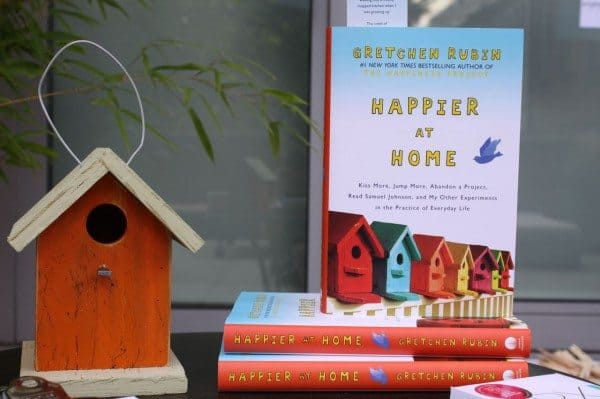
Review & Giveaway: Happier at Home by Gretchen Rubin


Happier at Home: Kiss More, Jump More, Abandon a Project, Read Samuel Johnson, and My Other Experiments in the Practice of Everyday Life by Gretchen Rubin

Reviewed by Christine-Chioma

The publisher, Crown, is sponsoring a giveaway of the book. Enter to win your own copy at the end of this review. There will be three winners (one per household).

Published: 2012

It's about: Gretchen Rubin previously embarked on a "happiness project" to improve her happiness levels in her every day life. This book is a sequel of sorts in which she tries another happiness project with the main focus and theme of home. Each month she focused on different aspects of home such as possessions  interior design, time, and neighborhoods.

I thought: As a single after graduating college sometimes nowhere really feels like "home" so this was a good read for me. I learned that having a sense of home is very important to happiness. Rubin's life and circumstances are very different from mine, but I was still able to glean truths from it. I  especially liked the interesting facts about various factors that contribute to a home environment that Rubin weaved into her personal experiences (for example, Rubin's parents never allowed teasing growing up and Rubin discovered in her research that people who tease believe they are conveying a spirit of playfulness whereas the person being teased finds it more mean-spirited). I appreciated the fact that the book was to the point--in her first book, Rubin already figured out how to have a happiness project so in this book she was able to jump in with the project immediately. I appreciated being able to see the things Rubin described through the various images and pictures in the book and I was glad there weren't reader comments like there were in the previous book.

Verdict: Stick it on the shelf or Rubbish Bin? In-between. I really enjoyed the book myself, but I am generally an introspective person who likes pondering happiness.  For most people I would suggest either her first book or this one, but I don't necessarily see the need for both---unless you're a happiness fanatic.

Reading Recommendations: The intended audience is people who are already happy who need a happiness boost. It is not for people who are unhappy. As well, it is not a how-to guide. The book is more of a memoir with suggestions and tips.

Warnings: Nothing

Favorite excerpts: "An unhappy truth about happiness is that one of the best predictors of whether a person will be happy in the future is whether they have been happy in the past."

"To 'Be Gretchen' was the way to happiness, but there was also a sadness to this resolution--the sadness that comes from admitting my limitations, my indifferences, all the things that I wish I were that I will never be".


*I received a free copy of this book in exchange for an honest review

To enter the giveaway for a free copy of this book, like "The Blue Bookcase" facebook page and/or become a follower then leave a comment on this post including your email address. We will leave the giveaway open until 12:00 am on Wednesday, November 14th.

Wednesday, October 24, 2012

Review: The Feminine Mystique by Betty Friedan

Anne Taintor
 Reviewed by Christina
I read this as part of A Year of Feminist Classics.  Head on over there for some discussion about it! 

Published: 1963


It's about: "In 1957, Friedan was asked to conduct a survey of her former Smith College classmates for their 15th anniversary reunion; the results, in which she found that many of them were unhappy with their lives as housewives, prompted her to begin research for The Feminine Mystique, conducting interviews with other suburban housewives, as well as researching psychology, media, and advertising. She originally intended to publish an article on the topic, not a book, but no magazine would publish her article."  (wikipedia)
The book, now a classic, served as the spark for 2nd-wave feminism.  Thanks to its widespread readership and popularity, Betty Friedan was able to connect with other feminists and take measures to change the situation of women in the United States; she started NOW in 1966.

I thought: Wow, was this a reading experience to remember.  Rarely do I read something that makes me examine my own life choices and the culture that influences them.  I honestly feel a little twilight-zone-y after reading The Feminine Mystique.  More about that in a minute.

1st ed.
Though it's nearly 60 years old now, the basic tenets of The Feminine Mystique are still sound: Housewifery is not fulfilling in itself for most women, especially for women who were drafted into it by societal default rather than making an educated, informed, mature decision.  And yes, it's important to develop one's own identity first, rather than depending on husband/children/home to supply that identity.  Every person deserves to express him or herself through creativity, leadership, and/or meaningful work.  These ideas are not radical to most modern readers; we accept them as basic "right to pursue happiness"-type truths.  But in Betty Friedan's time, these things needed to be said.  They needed to be argued for, and she lays out the history of feminism and antifeminism brilliantly.

The Feminine Mystique will probably be most strikingly relevant (eerie, really) to readers who, like me, come from an especially conservative religious background.  There are still communities in which "career women" are vilified and all women are expected to embrace SAHM-ness as their divinely-appointed role.  That's why I think this book was a healthy one for me to read.  I feel justified in wanting more than I get from staying home with my kids, and I feel better about taking anti-feminist religious teachings with a grain of salt, now that I know a more about the cultural history that may have had a strong hand in creating them.

One of the typical criticisms about The Feminine Mystique is that it is grossly and offensively outdated in its references to and research about homosexuality, and yes- that absolutely stood out to me.  It's very uncomfortable to read.  Another criticism is that it focuses on the plight of middle to upper-class white women, brushing everyone else under the rug.  That's unfortunate, too- there is a heavy dose of privilege here, with housewives complaining about how they want more out of life while other, unmentioned women are living in dire circumstances.  But I justify Betty Friedan's perspective with a little "ends justify the means" philosophy: The Feminine Mystique led directly to 2nd wave feminism, which in turn resulted in changes to improve life for ALL women- not just desperate housewives.  

Verdict: Stick it on the shelf.

Reading Recommendations:  I wish I had read this in closer tandem with Perfect Madness, which is a sort of updated version.  If you're interested in the subject and you haven't read either, read them together and tell me what you think!

Warnings: Journalistic/statistical discussions about sex.  Nothing graphic.

Favorite excerpts: “In almost every professional field, in business and in the arts and sciences, women are still treated as second-class citizens. It would be a great service to tell girls who plan to work in society to expect this subtle, uncomfortable discrimination--tell them not to be quiet, and hope it will go away, but fight it. A girl should not expect special privileges because of her sex, but neither should she "adjust" to prejudice and discrimination”

What I'm reading next:  Cairo Modern by Naguib Mahfouz

Monday, October 8, 2012

Review: The Mask of Motherhood by Susan Maushart

Thought I'd add a little personal touch -- this is me at 26 weeks pregnant
The Mask of Motherhood: How Becoming a Mother Changes our Lives and Why We Never Talk About It

Reviewed by Connie

Published: 1999

It's about: The Mask of Motherhood is a series of critical essays examining the physical, emotional, and psychological effects that motherhood has on women. Its premise is that we have a cultural taboo against discussing any of these radical changes, so new mothers are entering this transformational period completely unprepared for what lies ahead. Different essays specifically examine pregnancy, child birth, breast feeding, new motherhood, the juggling act, and marital relationships.

I thought: I cannot believe I only found this book because I stumbled across it in a thrift store and thought it looked interesting. Why has no one ever told me about this book before? Why has no one ever shoved a copy in my hands and forced me to read it?

As an expecting new mother, I have found myself feeling rather ambivalent about the drastic changes that are about to take place in my life and marriage. At times, I am unbelievably excited and can't wait to hold my baby boy in my arms for the first time. Yet there are plenty of other times I am so overwhelmed and overcome by anxiety that I can't sleep for nights on end, and just the sight of a onesie or a pacifier makes me sick to my stomach with worry.

Up until this point, I have found most resources for new mothers unhelpful, to say the least. Most of them are split into two camps -- 1. the motherhood is so beautiful, babies are such miracles, and when the baby comes, all is wondrous and glorious, and there are lots of rainbows; or 2. motherhood is the most difficult and least rewarding thing a woman can ever do; it's really hard, and it mega sucks. The former seems ridiculous and unrealistic; the latter, hyperbolic and unnecessarily negative.

Somehow, this book strikes a cord somewhere between the two. Maushart manages to communicate the extreme and unexpected difficulties of pregnancy, childbirth, and mothering while not stripping motherhood of its due credit or praise. In other words, somehow Maushart is simultaneously brutally honest and empowering and comforting.

Plus, though it's a series of critical essays, Maushart mixes in plenty of personal anecdotes and humor to make this very readable. I don't necessarily agree with all of her assertions, but it is a thought-provoking, well-researched book well worth a read. As it was published in '99, many of the statistics are over 10 years old, but I think the issues discussed are still very much relevant to the struggles of mothers today.

All in all, this book has better emotionally prepared me for motherhood than all other resources I've encountered -- combined.

Verdict: Stick it on the shelf. Just as I believe We: Understanding the Psychology of Romantic Love is a must-read for any person who enters marriage or a serious relationship, I think this book is a must-read for any woman considering motherhood. I suspect it would be a useful read for those who are already mothers as well.

Reading Recommendations: Just read it. Just do it. And then give it to all your expecting friends.

Warnings: none

Favorite excerpts:
"Professionally, financially, socially, and spiritually we are primed for achievement. The more we can do, the more we should do. But the more we do, the worse we feel. And the sillier we look. It is surely worthy of note that the word contemporary women use more than any other to describe the management of their lives is the verb 'to juggle.' The women Friedan described felt as if their lives had been tranquilized... For women in the 1990s, by contrast, life is hyper-caffeinated; it's going so fast we can't assimilate it, let alone enjoy it. Yet when things slow down, we go into withdrawal, panicking that we must be somehow missing out. We are indeed the generation of 'women who do too much.'"

"Childbirth is one day, more or less, in a woman's life; motherhood is forever. Yet like gawkers at the empress's new maternity outfit, we steadfastly resolve not to notice. Other observers have noted that we devote more care to the licensing of automobile drivers than we do to preparing adults for parenthood. It's a point worth pondering. Limiting our education for parenthood to prenatal classes is a bit like limiting driver education to defensive strategies for getting out of the driveway. No one would dispute their usefulness, but they can only take you so far."

"To see motherhood properly, I am convinced, is to see it heroically, which means making full acknowledgment of the pain, the dangers, and the risks and taking the full measure of glory for its exquisite rewards. When we consider the inaugural maternal experience -- the journey we call childbirth -- the epic nature of the undertaking emerges with startling clarity. The drama of childbirth foreshadows both the pain and the power implicit in the journey ahead. Thus, it can function as a kind of prism through which the wider experience of motherhood is refracted."

What I'm reading next: The Return of the Native by Thomas Hardy

Monday, October 1, 2012

Review: The Einstein Syndrome by Thomas Sowell

I couldn't come up with a better photo idea for this post than my very own late talker.
 Reviewed by Christina

Published: 2002

It's about:  Economist Thomas Sowell coined the term "Einstein Syndrome" to describe children who start speaking later than their peers, despite their being unusually analytically intelligent.  In this, his second book on the subject, he lays out the characteristics of such children and their families using research performed by himself and Stephen Camarata of Vanderbilt University.  (You can read a quick description of said characteristics on wikipedia if you're curious)

Mr. Sowell also describes multiple late-talking yet bright children and adults as case studies before giving a fair amount of advice to parents who believe their children may fit the Einstein Syndrome description.  He cautions against putting too much faith in the "dogma" of speech therapists and school professionals who will be quick to label most late talkers as autistic or developmentally delayed. 

I thought: My father-in-law gave this book to me because my own son, Jude, is a fairly late talker- at two and a half he is just beginning to communicate.  Naturally, his grandfather was interested in the idea that Jude might turn out to be highly gifted in math, science, and/or music like so many of the children and adults described in The Einstein Syndrome.  I, too, wanted to explore the possibility and so I was eager to read the book.

Now that I've learned all about Thomas Sowell's theories, I don't think Jude fits the Einstein Syndrome mold.  But still, it's a fascinating concept.  My favorite part was the chapter hypothesizing why these children talk late:  their unusual brains funnel resources to the sections of the brain devoted to analytical thought, causing those math/science/music abilities to appear earlier and language later.  The tendency appears to be hereditary- nearly all of the Einstein Syndrome children have close relatives who work in analytical fields and/or play musical instruments and/or were themselves late talkers.

But there were a few things that really bothered me about this book.  First of all, Mr. Sowell writes about the research as if it were vast, but the sample of Einstein Syndrome children he and his colleague have contacted is less than 300.  Almost all of these children seem to come from upper-middle class homes;  Among the markers for Einstein Syndrome, Sowell lists "highly educated" (Bachelor's degree +) parents, and relatives with analytical careers (scientists, pilots, physicians).  I think these are markers for an extremely skewed sample.  I kept getting the sense that Sowell came up with the idea for the Einstein Syndrome using his own son as an example, and then all his research revolved around finding other children to suit his ideas.  That's just not even real research.  It is gross confirmation bias masquerading as research.

It's easy for me to think these disapproving thoughts about Mr. Sowell's work because I just didn't like him.  He has an opinionated and forceful manner that comes through quite strongly in his writing.  He seems to think that ADD and ADHD actually do not exist.  He brushes Asperger Syndrome under the rug, too, despite the fact that several of the case studies in The Einstein Syndrome sound like they could be copy/pasted into a book about Asperger.  He writes glowingly about the situation in public schools in the 1960's and earlier, back in the good old days when children with learning disabilities didn't exist and students were just expected to pass or fail with no help from anyone.  I'd bet money that Thomas Sowell LOVES Ayn Rand.  He's an insufferable elitist who mocks virtually all public school teachers, speech therapists, and school psychologists, calling almost everyone without a Ph.D. or M.D. a self-interested and unethical "semi-professional" or "mediocrity."

And, given the fact that The Einstein Syndrome was published in 2002, Thomas Sowell's ideas are also based on outdated ideas about the diagnosis of autism spectrum disorders and the highly typical language delay seen in children raised in multilingual homes (a phenomenon Sowell doesn't believe exists).  I'd be curious about an updated edition, and I'd like to hear how the Einstein Syndrome children in his sample are doing ten years years later.  I'd love to read the results of some real, rigorous research about the Einstein Syndrome.  But I'm not sure I could suffer through another book written by Thomas Sowell;  our personalities just do not mesh well.       

Verdict: I'll very grudgingly put it In-Between, since some parents who are concerned about a late-talking child might find useful and/or comforting info here.  But it has WAY too much unhelpful filler opinion material for my taste.   

Reading Recommendations: Keep your cynicism about you as you read.  No need to take Thomas Sowell's word as gospel.

Warnings: none.

What I'm reading next:  The Collection: Short Fiction from the Transgender Vanguard edited by Tom Léger and Riley Macleod

Thursday, September 13, 2012

Double Review: Beyond the Sling and Why Have Kids?

Beyond the Sling: A Real-Life Guide to Raising Confident, Loving Children the Attachment Parenting Way by Mayim Bialik

Why Have Kids? by Jessica Valenti

Reviewed by Ingrid

Published: 2012

They're about: While both Beyond the Sling and Why Have Kids? would be shelved in the "Parenting" section of your local bookstore, they are two very different books.

Mayim Bialik has the more "traditional" parenting book; using stories of her own experience, she describes specific parenting techniques and explains why they work. Bialik advocates Attachment Parenting, a parenting style whose major tenants are co-sleeping, breastfeeding, baby wearing, and gentle discipline. Bialik claims that this is the most natural and intuitive style of parenting.  Much of the book is written like a memoir, with very short sections explaining the science (Bialik has a PhD in neurobiology) and statistics. She hits on all those things listed above as well as her experience with natural birth, breastfeeding into toddlerhood, elimination communication, and natural home remedies. Bialik argues that you should always do what's best for baby.

Jessica Valenti, however, isn't interested in telling you the best way to parent. She is more interesting in exploring how the messages about parenting within our society are often harmful to parents and children. Valenti challenges her readers to think critically about the choices they make and how they affect their children, their lives, and the rest of society. Interestingly, Valenti goes through a list of almost the exact same issues that Bialik writes about and directly challenges them with lots of statistics. Valenti argues that you should NOT always do what society tells you is "best" for baby, because often those things may not actually be best, and because doing those things reinforces the expectation that women need to sacrifice pretty much all of their time and energy to raise a happy, healthy child when that is not necessarily the case.

Mayim Bialik via
I thought: I don't have kids. But I like reading parenting books, because I'm cool. I also really like Mayim Bialik, because she's smart, articulate, funny, and I like the soothing sound of her voice. The thing that intrigues me most about her, though, is that she is both a Modern Orthodox Jew and a feminist. Women who identify as feminists AND as members of strongly patriarchal religious groups always stand out to me, because I am one myself - I identify as a Mormon feminist. A lot of people think these things are conflicting. They often are. But I think that having a strong stake in two conflicting communities provides more opportunites to explore questions pertaining to both communities in new ways.

Case in point: in Beyond the Sling, I was specifically interested Bialik's point of view regarding the intersection of feminism and the strong family values that stem from her religious views. The principles behind her parenting techniques were very appealing to me. She claims that attachment parenting encourages children to make strong emotional connections with their parents that will later translate into strong, healthy relationships with other people, as well a healthy sense of self-confidence. Those are certainly things I want for my future children, things I think most people want. This parenting style takes some MAJOR, commitment though, and I mean MAJOR. Bialik is literally involved with her children 24 hours a day - whether she's breastfeeding (on demand, day and night, until the child no longer shows an interest,) watching her child's body language to be able to discern when the child needs to be taken and held over the toilet to "eliminate," (sometimes this is every 15 minutes,) sleeping next to your child (and thus waking up every time they wake up,) watching them for any signs of sickness or discomfort, carrying them around every where you go in a sling, etc, etc. That is exhausting just to think about. However, Bialik seems to imply that the strong emotional connection to create with your child when you make this sacrifice is empowering to both mother and child.

While I still had Bialik's book on my mind, I saw Rebecca's review of Why Have Kids? a few days ago and borrowed a copy on my kindle right away. The first thing I noticed is that Valenti has a much more polemic tone to her writing. Bialik wants to gently suggest what might work best for you, and constantly reminds you that she knows there are many different kinds of parents with different circumstances and blah blah. Valenti wants to force you to confront the implications of your choices. A little jarring at first, but definitely effective. This is important stuff, after all. And it worked on me. By the end, I was all fired up and eager to explain to my husband about all of the unfair, unrealistic expectations put on mothers in our society.

Interestingly, both of these books were written by mothers who identify as feminists. I think this points to the fact that feminism is growing and evolving to encompass many different possible life choices and points of view, while still holding to the principle that women should hold an equally-valued place within society. I think this is a very good thing.

Jessica Valenti via
Obviously it's up to each parent to decide how to raise their child. I think it's worth reading both books and thinking carefully about which issues are most important to you and can benefit you and your child the most. However, these arguments can get a little exhausting. If you need something to lighten things up a little bit, I like this article.

Verdict: Stick them both on the shelf. Or maybe check them out from the library.

Reading Recommendations: Since these book address many of the same issues from different perspectives, it's quite enlightening to read them together.

Warnings: None.

Favorite excerpts:
"What I have discovered, and what I seek to share with you, dear reader, is this: you already know the majority of what you need to know to be an incredible parent. It was only when I believed this and began to apply it consistently to my growing family that my anxiety, worry, and exhaustion began to lift. It was then that I truly began to enjoy being a parent and to see myself as a successful parent; not a perfect parent, and not always the most patient parent, but a sensitive, loving, and confident parent who truly loves this life I have chosen." -Bialik

"Families that don’t force independence encourage children to grow at their own pace, fully express their needs, and feel truly understood. This style of parenting is not the only way to guarantee a securely attached child, but in my experience and observations, I would hedge my bets that this path, broad though it can be, is a great way toward a smooth and minimally complicated relationship with children." -Bialik

"This is a book about how the American ideal of parenting doesn’t match the reality of our lives, and how that incompatibility is hurting parents and children. Because the expectation of a certain kind of parenthood—one where we’re perfect mothers who have perfect partners, where our biggest worry is whether or not to use cloth diapers—makes the real thing much more difficult to bear." -Valenti

"My pump, which came in a jaunty little nylon purse that looked like a 1990s Kate Spade knockoff, made a rhythmic sound when operating that sounded a little too much like House music for my comfort. There’s something about a club kid beat set to your breasts being tortured that makes the whole ridiculous scenario feel even crueler." (Haha!) -Valenti

"Vast amounts of research show that children do best when they’re raised by a community of people—parents, grandparents, friends, and neighbors. It’s in our DNA—we are social beings, and we should be raised as such. Yes, mothers are important, but not because we are women or because we’re biologically related (or not) to our children. We’re important because we’re one of the people that love and care for a growing human. But if we want to take some joy in that experience, we need to let go of the notion that we are the only ones who can do it correctly, and that if we are doing it right, it should mean some sort of suffering or tremendous self-sacrifice." -Valenti

What I'm reading next: Possession by A.S. Byatt