Showing posts with label Guest Reviews. Show all posts

Tuesday, January 29, 2013

Guest Review: Love in the Time of Cholera by Gabriel García Márquez

Family in Cartagena, Colombia, c. 1930, via
Reviewed by Arminda!
Combine a dash of determination with a twist of opinionated, a heaping scoop of energy and mix vigorously, while slowly adding to this combination equal parts writer, actor, swing dancer, chef and mom. Fold in laughter, happiness, originality and a great book, and your concoction will resemble Arminda, whose passions are varied, but her focus to accomplish much never wains. Through her food blog www.yumveg.com she strives to make whole food, plant-based eating accessible to everyone, and when she just feels like rambling she dumps those thoughts onto www.allarminda.com, where it's all Arminda, all the time. Twitter handles for each, respectively, are @yumveg and @allarminda.

Published: 1988

It's about: Two young people, Florentino and Fermina, fall desperately in love with one another through letters they exchange and furtive glances they make at one another across the park, and eventually decide to marry. Their plans are thwarted by Fermina's father, and while she moves on with her life and marries another, the anguished Florentino channels his heartbreak into a lifelong obsession with other women, hundreds of other women, yet reserves his heart for Fermina. After the death of Fermina's husband, some fifty-one years later, Florentino declares his love again.

I thought: This book, and author, come highly recommended, and Love in the Time of Cholera is the winner of the Nobel Prize. What greater endorsement can you possibly have than that? If the criteria for winning this most-revered literary prize is to have "produced 'in the field of literature the most outstanding work in an ideal direction, (source Wikipedia)'" then let's just say I thought the direction was kind of creepy. Young lover, desperate from his broken heart, turns obsessive stalker, turns womanizer, turns pedophile, all the while claiming a virgin heart for his one true love? And this is okay with everyone?

I want to be clear that I thought the writing was lyrically beautiful, and the character development was remarkable. I have rarely felt so connected with the inner feelings of two characters as I did with Florentino and Fermina, and the beautiful imagery and lives painted by Mr. Marquez's exceptional command of the English language. But can we fairly separate the characters from their actions from their thoughts from the plot from its message? To attempt to do so would be no different than when someone says they love a song for its beat, but pay no attention to its lyrics. Yet this book is heralded as one of the greatest love stories of all time.

I'll leave Newsweek's review of "A love story of astonishing power," to Newsweek, because I have a hard time celebrating, honoring and revering the "ideal direction" for which this novel has received literature's highest honor. I can't get on that band wagon.

Verdict: In Between - I'm really torn over the separation of music and lyrics. The writing is scrumptiously beautiful, but I don't endorse the behavior of the main character.

Reading Recommendations:  This book is heralded by many many people as one of the greatest ever written. It's an Oprah's Book Club selection, among other ringing endorsements. I'd love to know your thoughts if you've read it.

Warnings:  Well, there's LOTS of sex, sexual references, and even an affair with a child.

What I'm reading next: The Yiddish Policemen's Union by Michael Chabon

Monday, February 13, 2012

Guest Review: Works of Love by Søren Kierkegaard

Guest Review by Rachel Hunt Steenblik. Rachel is a philosopher, librarian, and reader. She is currently getting her PhD at Claremont Graduate University. She also blogs at tenderheartedmercy.blogspot.com.

 Søren Kierkegaard via
Title: Works of Love by Søren Kierkegaard

Published: 1995. First published 1845.
It's about: Works of love, nor merely love. Kierkegaard tells us that this is the case because the book is full of Christian deliberations. What this means for us is that Kierkegaard is not giving us a theory of love. He is not giving us love as sentimentality, or passion, or feeling. Neither is he teaching us exactly what we need to do to be loving. For instance, he never says, "do this and this and this, and turn around three times, and then you are loving." Instead, he is taking a topic, love, that most people think they know something about, and he is telling them that it is both easier and harder than they think. He wants there to be an earnestness, and he wants there to be a difficulty.

More than anything, it is asking people to truly believe in love, and then to live it by practicing, and practicing again. It takes self-denial and it takes self-looking at. It also takes looking at God, and understanding the way God looks at us and those around us. We come to learn that everyone is the neighbor because everyone has the same relation before God. In the world, there is a ladder, with some people higher and some people lower. We admire some, we may not admire others. There are kings and there are poor people. There are beautiful people and there are ugly people. There are lovers and there are friends who share preferential relationships. For God and for Kierkegaard there are only neighbors. It is this neighbor love, this God love, this eternal, true love, that Works of Love is interested in.

The book itself is divided into two parts. (Fascinating fact: Kierkegaard thought he would die before he turned 34. He finished the first part, assuming that that would be all. He celebrated his birthday, and was still alive. He went to the registers to see if his birthday could possibly have been a different day. It couldn't be, so he wrote part II.) These two parts contain deliberations, or discourses on love. Each deliberation is inspired by a single verse from the New Testament. For example, one deliberation is on love's ability to believe all things from Paul's famous treatise on love in 1 Corinthians 13, but goes further and asserts that it is never deceived. Another is on love's ability to hope all things, but goes further and asserts that it is never put to shame. Still other deliberations focus on true love's ability to abide, to build up, and to cover a multitude of sins.

Kierkegaard was writing at a time when many things in his world were becoming easier. In one sense everyone was Christian because everyone belonged to the state church, but in another sense, this made it so very few people were actually Christian. Kierkegaard fought against this, and wanted to make it harder to be a Christian, so some people actually could be. He was concerned with helping people become individuals and selves, as he believed they were not born that way, but became that way by proper relations and choices. One way he did this was by writing indirectly and often pseudonymously. While Works of Love does bear Kierkegaard's own name, it does not make his task any different.

Monday, December 26, 2011

Guest Review: Room by Emma Donoghue

Guest Review by Rachel Hunt Steenblik

Rachel is a philosopher, librarian, and reader. She currently lives in Vienna, Austria with her husband. He is studying architecture. She is studying Kierkegaard, and fine breads and cheeses.

Title: Room by Emma Donoghue

Published: 2010

It's about: A small boy, and his mother. The child Jack, grows up in a small, 11x11 room, not knowing the outside world except through television. Because of this, he thinks the outside is something made up, like Muppets, or Sesame Street. For Jack, only the room is real. Only his mother, and her love. They do everything together inside that room: P.E., read, eat, play, sleep, and so forth. Everything in the room has a name. "Rug," "Door," "Table," etc. Every time of the day has an activity. There is an order and a purpose. They laugh a lot, and sometimes they scream in a screaming game. Which one can scream the loudest? Who can get closest to the single, ceiling window? They stand on the table. They try. They only receive one visitor, but young Jack is not allowed to be present. He must hide, tucked away in "Wardrobe," only to come out when the visitor is gone. Jack doesn't know exactly what happens during these visits, only that the man brings food, and sometimes special treats. Occasionally he hears things. He also knows that it can leave his mom different, tired, gone. Once his mom was gone for a whole day, even though she was there. Jack tried to take care of himself, counting the cereals. For the mother, things are different. The screaming game is not a game, but attempt at escape: the room is not home, but a prison. They are being locked up by her captor--her rapist. She has tried to create a safe space for her son. She has done the best that she knows how, with the limited circumstances she has. Jack is her hope, her constant survival. And so she hatches a plan.

I thought: Room was harrowing. And innocent. And sweet. It would have been wholly different if it had been told from the perspective of the mother. While that could have made a powerful story as well, I believe it was a good call on the part of the author. We were introduced to the room so sweetly and so simply, through the eyes of a child. He is a smart child, but a child nonetheless. So often we are left to conjecture what we know must be a sad tale, a sad beginning to the room. We make discoveries little by little. We feel for the mother. We feel for the boy--even though he is a happy and kind child--because we know that there is so much more. His life could be richer, fuller. We are scared when the mother dreams of escape, because we don't know what will happen. We are scared when they succeed, because of what does happen.

This was actually one of the most interesting parts for me, that the book didn't end there, at the usual fairy tale ending. There was no page that said that they would live "happily ever after." We are shown the after, and it is not always happy. But it wouldn't be, would it? Instead we watch Jack get sunburnt, because he has never seen the sun. (He must have been ghostly pale.) We watch newscasters interview the mother. We see criticism for the way she raised Jack (as if other's could understand). We see letters of support pour in (making her survival an act of heroism). We see her family changed. They thought she was dead. We see Jack want to return to "Room." It is his womb. His home--the only place he knows. How can we blame him?

Verdict: Stick it on the shelf. (Please. You will thank yourself, and me.)

Reading Recommendations: This book is meant for people who love honesty and hope both. It is a sad book, but it is also beautiful in that sadness. We are shown the worst and best of humanity. Those who read it will come out changed, perhaps a little more thoughtful, a little more able to embrace the whole of human experience, a little more able to affirm it.

Warnings: Some scenes/backstories of rape and violence.

Favorite excerpts: "When I was a little kid I thought like a little kid, but now I'm five I know everything."
"Ma's still nodding. 'You're the one who matters, though. Just you.' I shake my head till it's wobbling because there's no just me."
"'Goodbye, Room.' I wave up at Skylight. 'Say goodbye,' I tell Ma. 'Goodbye, Room.' Ma says it but on mute. I look back one more time. It's like a crater, a hole where something happened. Then we go out the door."
"In Room me and Ma had time for everything. I guess the time gets spread very thin like butter all over the world, the roads and houses and playgrounds and stores, so there's only a little smear of time on each place, then everyone has to hurry on to the next bit..."

What I'm reading next: Works of Love, by one Danish philosopher, Soren Aabye Kierkegaard.

Thursday, August 18, 2011

Reading Lists: Adventure Books

Welcome to this week's installment of our newest feature here at The Blue Bookcase: Reading Lists. Every week either one of us or a guest blogger will post on one of his or her favorite topics and provide a list of books he or she is familiar with on that topic. At the end of each post we will invite you to throw out any suggestions of books, fiction or non-fiction, that you have read or know about on that topic and we will add them to the list on that post.

These lists are not comprehensive by any means, but may be useful in helping you find your next read. Enjoy!

This week, we are lucky to have guest blogger Rob Curry compile a list for us of Adventure Books.


Rob at the Grand Canyon
 Who doesn’t love a good adventure? For the last couple years I’ve gone with a couple friends and my Dad and hiked the Grand Canyon. We filled up our backpacks with water and some food and set off walking down into one of the largest canyons on earth. We only brought enough supplies for one day – so there was no stopping and spending the night if we got tired . We had to make it out. It was tough, but the sense of accomplishment was more than worth it. (By the way the National Park Service strongly advises against attempting this!)

For me there is a big thrill that comes with conquering something Mother Nature puts in your path. For the record, I’ve never done anything really dangerous – but I love reading about people who have! It doesn’t matter where they’re headed as long as there is danger and a challenge involved.

This is not a complete list of the best adventure stories. Instead, I tired to pick books that have a sample of different types of adventure. I hope you enjoy them and maybe feel inspired to have an adventure of your own.

My List:

The Last Voyage of Columbus – by Martin Dugard
Christopher Columbus's fourth voyage was his final, least-known, and arguably most exciting expedition. The extended 1502-4 trip took him to what are now the Dominican Republic, Honduras, Nicaragua, Costa Rica, Panama, and Jamaica and exposed him and his men to deadly storms, attacks, mutiny, shipwreck, and terrible deprivation. (Goodreads)

The Lost City of Z: A Tale of Deadly Obsession in the Amazon - David Grann
A grand mystery reaching back centuries. A sensational disappearance that made headlines around the world. A quest for truth that leads to death, madness or disappearance for those who seek to solve it. The Lost City of Z is a blockbuster adventure narrative about what lies beneath the impenetrable jungle canopy of the Amazon. (Goodreads)
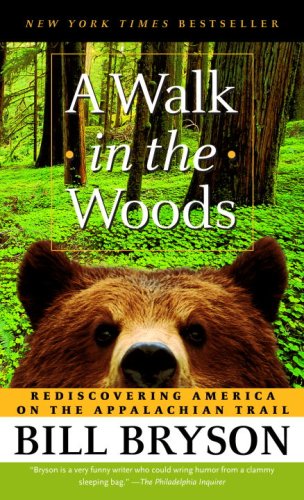
A Walk in the Woods- by Bill Bryson
In order to rediscover America by, as he puts it, "going out into an America that most people scarcely know is there," he set out to walk, in the company of Stephen Katz, his college roommate and sometime nemesis, the length of the Appalachian Trail. His account of that adventure is at once hilarious, inspiring, and even educational. (Goodreads)

The Wave: In Pursuit of the Rogues, Freaks, and Giants of the Ocean - by Susan Casey
For centuries, mariners have spun tales of gargantuan waves, 100-feet high or taller. Until recently scientists dis¬missed these stories. But in the past few decades, as a startling number of ships vanished and new evidence has emerged, oceanographers realized something scary was brewing in the planet’s water. As scientists scramble to understand this phenomenon, others view the giant waves as the ultimate challenge. These are extreme surfers who fly around the world trying to ride the ocean’s most destructive monsters. The pioneer of extreme surfing is the legendary Laird Hamilton, who, with a group of friends in Hawaii, figured out how to board suicidally large waves of 70 and 80 feet. Casey follows this unique tribe of peo¬ple as they seek to conquer the holy grail of their sport, a 100¬ foot wave (Goodreads)

Born to Run: A Hidden Tribe, Superathletes, and the Greatest Race the World has Never Seen - by Christopher McDougall
Born to Run is an epic adventure that began with one simple question: Why does my foot hurt? In search of an answer, Christopher McDougall sets off to find a tribe of the world’s greatest distance runners and learn their secrets, and in the process shows us that everything we thought we knew about running is wrong. With the help of Caballo Blanco, a mysterious loner who lives among the tribe, the author was able not only to uncover the secrets of the Tarahumara but also to find his own inner ultra-athlete, as he trained for the challenge of a lifetime: a fifty-mile race through the heart of Tarahumara country pitting the tribe against an odd band of Americans, including a star ultramarathoner, a beautiful young surfer, and a barefoot wonder. (Goodreads)

What are your favorite adventure books, fiction or non-fiction?

Your Suggestions:

From Seth @ Free Listens:
-The 39 Steps: The granddaddy of all man-on-the-run adventure books like The Bourne Identity, this short novel follows Richard Hannay across the English countryside as he tries to escape the police for a murder he didn't commit and expose a international conspiracy.
-The Hound of the Baskervilles. Probably the most famous and greatest of the Sherlock Holmes adventures.
-The Count of Monte Cristo Despite its massive length, this is an action packed revenge thriller.
-King Solomon's Mines This lost civilization novel is set in Africa in the Victorian Age, but it's less racist than you might assume. The main character, Alan Quartermain, is a wonderful scoundrel.

Into Thin Air by Jon Krakauer (Wendy from CaribousMom)
Into the Wild by Jon Krakauer (Laura from The Scarlet Letter)
Winterdance by Gary Paulsen (Wendy from CaribousMom)
Treasure Island by Robert Louise Stevenson (Allie from A Literary Odyssey)
180 Degrees South (Christine from Bookishly Boisterous)
A River of Doubt by Candice Millard (Belle from BookBelle)
Night Mail by Antoine de Saint Exupery (Stu from Winstonsdad)
Skeletons on the Zahara by Dean King (Christina from The Blue Bookcase)

Thursday, July 14, 2011

Guest Post: African Fiction

Today we are delighted to have a guest post from Christina's friend Leslie! Leslie has been a law librarian for three years, but she has been addicted to all things Sub-Saharan African dating back over ten years to four fantastic months she spent in East Africa. In fact, she just returned from two wonderful weeks in South Africa (you can read about her trip and see pictures on her blog). So when Christina offered her the opportunity to share some of her favorite African fiction with you, she jumped at the chance.

I am a Southerner, and I grew up pretty convinced that no other region could rival the Southern knack for stories. With all due respect to Eudora Welty, I was wrong. In college, when I was more thoroughly introduced to African fiction, I reassessed my traditional Southern bias and realized that when it comes to brilliant storytelling, writers from the African continent have a tremendous amount to offer. After all, they have a tremendous amount of writing material: colonial legacies; shifting alliances; corrupt leaders and political struggles for power; tradition wrestling with modernity; gender roles and feminism; rapidly changing social structures; beautiful landscapes; all combined with a wonderful tradition of meaningful storytelling as a way of communicating knowledge across generations.

In compiling a list of my favorite African fiction works, a few caveats and criteria: First, the writer has to be African. This means that they must have been born in Sub-Saharan Africa and be a citizen or national of an African country. I know, I love Out of Africa too. If it hadn’t been for Isak Dinesen/Karen Blixen, I might never have fallen in love with Africa, but she isn’t an African writer. Second, the book must be fiction, not a memoir or other work of non-fiction. It is my personal opinion that you will soon develop an addiction to Africa by reading these books, and you might then find yourself longing for some African non-fiction and history books to offer up some context. When that happens, please feel free to drop me a line if you are in need of some suggestions for those too! Happy African reading!

1. The Wizard of the Crow, Ngugi wa Thiongo (Kenya): Ngugi is probably my favorite African writer, and it was hard choosing just one of his books. I picked this one because, in addition to being one of his most recent, it is a compelling, simple story that is a perfect allegory for modern African politics. Part mystical fantasy, it showcases the disparate worlds of the powerful and powerless in a fictional African country, that too closely fits the profile of many modern African political states. Also try by this author: A Grain of Wheat, Devil on the Cross.

2. So Long a Letter, Mariama Ba (Senegal): What is so great about African literature is that in spite of the unequal status of women that exists in several African countries, there is no shortage of powerful and strong African women writers. Ba is just one example, and her female protagonists showcase that power and strength can be found in African women despite their treatment as inferiors. In So Long a Letter, Ba (deceased) wrote from the perspective of a woman wronged by her husband’s decision to take a second, much younger wife. The entire book (which is rather short), is written as a letter from the first wife to her husband. There are so many passages in this book that I underlined, highlighted and memorized; I don’t even know where to begin. Ba wrote in French, but the English translation I found was pretty perfect. Also try by this author: Scarlet Song.

3. The Ambiguous Adventure, Cheik Hamidou Kane (Senegal): This book is also a book in translation from the original French, but is a great introduction to how keenly Africans can write about navigating growing up in a world of conflicting cultural expectations. In this coming of age book, the central character must wrestle with his traditional African, Muslim upbringing and the modern world.

4. July’s People, Nadine Gordimer (South Africa): Gordimer wrote this book in 1981 as her prediction of how she believed apartheid would end in South Africa. The central characters, a white family more liberal in their sensitivities than the apartheid government, ultimately must flee their home and seek the protection of their former servant as violence envelops their country. I don’t want to ruin the story, but in particular, the metaphor presented by the family’s gun still gets to me. If you read it (or have read it), I would like to hear your thoughts on it. This book was banned in South Africa when it was published. Interestingly, Gordimer, a member of the African National Congress when it was a banned political organization in South Africa, also had her book banned in some schools in the Gauteng province by the post-apartheid ANC government. The ban was later overturned after an outcry from writers and other people across South Africa. Gordimer’s works are unparalleled in their ability to naturally question the privilege people of European descent in Africa encounter. If you spend any time in Sub-Saharan Africa, you should spend some time ruminating on that unfair privilege, and Gordimer’s books are a great place to start. Also try by this author: Burgher’s Daughter, The House Gun (her first post-apartheid work).

5. Purple Hibiscus, Chimamanda Ngozi Adichie (Nigeria): The central character is fifteen-year-old Kambili, daughter of a wealthy, Catholic father, who is subject to his harsh punishments. When political instability breaks out because of a coup, Kambili and her brother are sent to her aunt’s home, where she experiences happier family life. The plot takes off from there, and untangles complicated family relationships set against the transition from youth to adulthood. Also try by this author: Half of a Yellow Sun

6. Things Fall Apart, Chinua Achebe (Nigeria): Achebe is a must if you are really going to tackle with any depth African writing. This is a classic. Also read No Longer at Ease.

7. To Late the Phalarope, Alan Paton (South Africa): Sadly, Paton died before apartheid ended in South Africa. But his work seen as a part of the battle to end apartheid will stand the test of time. Also read Cry, the Beloved Country and Ah, But Your Land is Beautiful.

8. Nervous Conditions, Tsitsi Dangeremba (Zimbabwe): Told from the point of view of a young girl, struggling to attend school and deal with cultural conflicts, this is an unparalleled work of African feminism.

9. The Joys of Motherhood, Buchi Emecheta (Nigeria): The epitome of an African woman writer. Also read The Bride Price.

10. Song for Night, Chris Abani (Nigeria): This novella is written from the point of view of My Luck, forced into the life of a child soldier. It is powerful beyond measure.


On my reading list next:
Maps, Gifts, and Secrets, Nuruddin Farah: The “Blood in the Sun” trilogy by the Somalian author.
Snake Pit: Moses Isegawa (Uganda)
By the Sea and Paradise: Gurnah Abdulrazak (Zanzibar/Tanzania)

Tuesday, June 14, 2011

Guest Review: The Paris Wife by Paula McClain

Guest review by Kirsten. Find out more about Kirsten and read her review of Between Shades of Grey by Ruta Sepetys here.

Published: 2011

It’s about: Paula McClain’s The Paris Wife tells the fascinating story of Hadley Richardson, a 28 year old woman, who meets and marries the considerably younger and truly dashing Ernest Hemingway. Although he wed several times in his life, this first marriage had a profound influence on his early work as well as a cause for reflection and tribute in his final work, A Moveable Feast. In Paris, the Hemingways develop close and important relationships with writers and artists like Ezra Pound, Gertrude Stein, Alice Toklas, and Sherwood Anderson. When they first cross the Atlantic, Ernest Hemingway is another fledgling writer, virtually unknown. With Hadley’s support and encouragement, and the rich artistic environment surrounding them, he gradually gains recognition. As Hemingway’s fame steadily increases, his marriage begins to fall apart. Although they love each other, Hadley cannot share her husband’s attention and affection which becomes expected in their Parisian milieu. Ultimately, they let each other go.

I thought: This book contained everything I love–historical fiction, Paris in the 1920’s, literary superstars, European travel, and a dash of romance. McClain beautifully represents the tender relationship between Hemingway and his “Paris Wife” as well as the slow demise of their marriage. With McClain’s guidance, it’s not difficult to see why this seminal relationship was important to Ernest Hemingway until the end of his life. I could not put this book down. I particularly loved how McClain craftily evokes Hemingway’s novels throughout the book, although the story is revealed primarily in Hadley’s voice. At its core, it really is her story. When I finished, I pored over the Random House website for clues to McClain’s research and writing process. Much to my delight, the website includes an author Q&A, numerous photos of 1920’s Paris (including locations specifically mentioned in the novel,) author videos, and a reading group guide complete with recipes. Working at an independent bookstore, I know that this book is all the rage with book groups right now. For good reason, I absolutely loved it.

Thursday, April 14, 2011

Guest Review: Factory Girls by Leslie T. Chang

*Note: No Literary Blog Hop this week. The next one will be up two weeks from today. 

Guest review by Lanée. In a previous life Lanée studied Comparative Literature but now she spends the majority of her time attempting to transfer her knowledge of the English language into the minds of Chinese six-year-olds without hurting anyone.When she’s not working she’s reading, traveling, or lecturing husband on the finer points of grammar. She's currently living in Guangzhou, China where the better parts of the internet are blocked.

Published: 2008

It's about: Factory Girls follows the chaotic lives of two Chinese migrant workers and their interactions with Chang (the author) over the course of a year. Written by Chang in the first-person, the book delves not only into the complicated undercurrents of migrant life but also into her personal family history and experiences as a Chinese-American. While documenting her encounters with numerous migrant women in the bustling urban monstrosity that is Dongguan, Chang focuses the narrative intermittently on her two most stable contacts—Min and Chunming.

I thought: I have to admit that I thought Factory Girls started out a bit rough with what seemed a somewhat poorly organized account that fails to draw clear connections between narrative segments. But don’t let that deter you, whatever the book lacks in initial structure it quickly regains with an astonishingly intimate look into the lives of its protagonists. Chang manages to reach through the chaos of migrant life and uncover two quite personal and human stories through which she successfully examines the complicated questions behind the largest human migration in the history of the world. Plus the stuff she talks about is just really interesting.

Chang’s personal insights and unique perspective make the book especially engaging. Her commentary is sharp and funny and gives Western readers a hand up in connecting with an unfamiliar world. Chang does literally everything she can to break into the world of migrant women, bringing readers to English classes, factory dorms, dark bus rides, and countryside homes. Her tenacity is admirable and pays off in a wealth of intimate and gritty details.

Perhaps the greatest achievement of Factory Girls is that it manages to frankly portray an underprivileged sector of society without disintegrating into a sob story about the difficulties of migrant life. Chang describes both the reality of poor living conditions and exploitation as well as the excitement and lure that migrant lifestyle holds for many young women.

In the end Factory Girls is a really interesting read—one that explained, or at least put into words, a lot of things about China for me.

Verdict: Stick it on the shelf then lend it to a friend, especially if you plan to travel to China anytime soon.

Reading Recommendations: I found it a bit difficult to get into at first, but read on, it’s worth it.

Favorite excerpts: “I came to like Dongguan, which seemed a perverse expression of China at its most extreme. Materialism, environmental ruin, corruption, traffic, pollution, noise, prostitution, bad driving, short-term thinking, stress, striving, and chaos: If you could make it here, you’d make it anywhere.”

What I'm reading next: On the Road by Jack Keroac and Tina Fey’s memoir Bossypants

Thursday, April 7, 2011

Guest Review: The Curious Incident of the Dog in the Night-Time by Mark Haddon


Guest review by Rachel. Rachel is Christina’s cousin and an English MA student. She is currently procrastinating the writing of a thesis on the post-modern journey myth in House of Leaves and the video game Portal. Despite her elitist tendencies, she enjoys anime and popular video games.


Published: 2003


It’s about: A high-functioning autistic boy narrates his quest to solve the murder of a neighborhood dog. In the process he becomes more independent and opens at least one can of proverbial worms.


I thought: I had a hard time suspending my belief for the autistic child narrator. I know it allows authors to have an excuse to describe the world in a new and interesting way, but in this case, it’s unbelievable. Autistic children are notorious for their difficulty in verbalizing even simple needs, let alone complex scenes involving an awareness of what aspects of their disorder are unique and readers might find interesting (I assume it’s not Asperger’s because of the boy’s other extreme symptoms). Despite my personal difficulties, I really enjoyed the investigation half of this book. It made me think of how ordinary things could be puzzling to children (even children with autism). It also made me think about math(s), even though I still don’t understand The Monty Hall Problem.*

The last half (dealing with the solution to the mystery) wasn’t as fun to read. It just made me kind of annoyed. Haddon’s autistic narration style gets old after a while. The whole thing felt a little like Extremely Loud and Incredibly Close lite-edition, complete with a child investigating something and having lots of anxiety about it.


Verdict: In between. Buy it used or borrow it from a library or friend.


Reading Recommendations: This book could probably devastate a child who is grieving over the death of a loved one.


Warnings: Some vulgar language. Also, Christopher uses the word “sex.” His father sometimes drinks alcohol.


*You choose from three doors, 2 of which are goats and one of which is a car. They show you one of the goats from one of the other two doors, and it’s statistically in your best interest to change doors, even though intuitively it seems like that won’t really change anything.

Wednesday, April 6, 2011

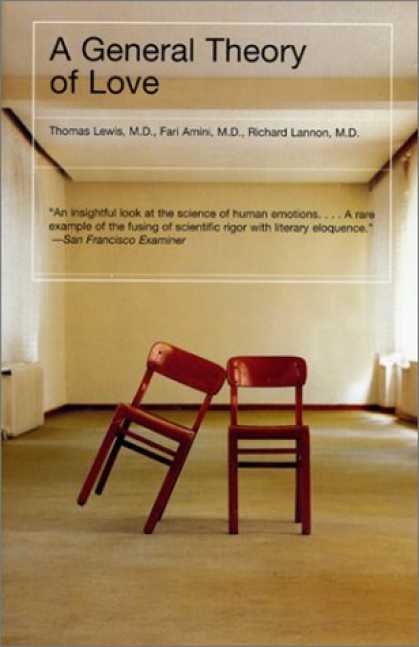
Guest Review: A General Theory of Love, by Thomas Lewis, Fari Amini, and Richard Lannon

Guest review by Andrea. Andrea is cousin to Blue Bookcase regular Christina. She spends most of her time with her three small children, but also enjoys making domestic and crafty things and reading books from every genre (though graphic novels and fantasy tend to get more attention than the rest).


Published: 2001


It's about: A scientific look at how and why love is important to human beings.


I thought: Sometimes I forget just how important love is. Like I need to tell myself, "Hey, remember that thing that's so important that ties you to all your favorite people, and is what we all live for? It's called LOVE; you might want to try it." Not that I hate people; I'm just self-absorbed a lot of the time.  This book has helped me to justify to my logical self taking the time to build relationships with important people in my life.  That's not something that really should need justification, but with so many other priorities, sometimes love gets lost.

I love how this book tied together scientific research, poetry, psychiatry, zoology, and personal experiences to form a coherent picture of the importance of love and interpersonal relationships. The text is a little prosaic, but full of interesting flavor, rather like a good curry.

The first part talks about the parts of the brain and how they evolved and their functions in relationships and consciousness.  It gets a little technical, but the terminology is necessary to understand what they are talking about later.  They also talk about how pop psychology's view of love (especially Freud) is completely wrong and not supported by studies.  The second part talks about how that relates to love, and how important love and good relationships are in the development of a child, in healing from illness, in learning -- in everything. Most of that was stuff I already "knew" (from life, religion, upbringing, child development classes, etc), but wasn't really applying. I mean, who's going to disagree with a statement like "Love is important"?  But does the way we live our lives reflect that?  Sometimes I think we mistake "being nice to people" for "loving people", but while the one may help you feel pleasant and is still a good idea, the joy and wholeness that come from knowing and being known are only available through love.

I thought one chapter at the end was a little doomsday-ish and didn't have quite as much evidence supporting it as the beginning chapters, but it was still interesting.

I think instead of "Homemaker" for occupation, I'm going to write "Child Limbic Brain Neuron Engineer". That sounds quite satisfying.


Verdict: Shelf! I want to read this again, and be able to loan it to people.


Reading Recommendations: I recommend it for adults who love and are interested in science/psychology


Warnings: They talk a little about Freudian psychology and evolutionary biology, which includes sex.  Nothing graphic or controversial, though.


Favorite excerpts: "Even after a peak parenting experience, children never transition to a fully self-tuning physiology. Adults remain social animals: they continue to require a source of stabilization outside themselves. That open-loop design means that in some important ways, people cannot be stable on their own - not should or shouldn't be, but can't be. This prospect is disconcerting to many, especially in a society that prizes individuality as ours does. Total self-sufficiency turns out to be a daydream whose bubble is burst by the sharp edge of the limbic brain. Stability means finding people who regulate you well and staying near them. (86)"


What I'm reading next: Castle Waiting, by Linda Medley

Wednesday, March 23, 2011

Guest Review: Between Shades of Grey by Ruta Sepetys


Today we are happy to feature a guest review by Kirsten! Kirsten spends most of her time working in the children's section at her local independent bookstore. (Ok, sometimes she helps with adult books–she's read a few of those, too.) She has four children--two in college, one in high school, and one in middle school.  She loves trying to play Mozart when she's walks past the piano; taking bubble baths with a good book; all things Wallace Stegner; Matisse's cut-outs; and torturing her youngest son by forcing him to take violin lessons.  Oh, also quirky independent movies and Italian food with her husband.


Published: March 2011

It’s about: Between Shades of Gray by Ruta Sepetys tells the painful story of fifteen year old Lina as she struggles to survive Stalin’s ethnic cleansing of the Baltic states during WWII.  As she anticipates art school and all things fifteen, Lina, her mother, and her nine year old brother are abruptly forced from their home in Lithuania, in the middle of the night.  Their father is sent to a Soviet prison.  The remaining family members are ruthlessly deported by crowded, filthy, cattle car, deep into Soviet Russia--many weeks journey. Lina documents the harrowing experience in her art and writing, risking everything by hiding her artwork in the inner folds of her meager suitcase.  Eventually, they find themselves in northern Siberia, at the edge of the arctic circle, facing an insurmountable winter.  

I thought: Having read many, many World War II novels and historical accounts--trust me, I’ve read a lot--I was surprised to find an historical event that I hadn’t previously encountered.  The Baltic states were essentially wiped off the map during WWII, not to regain their identity until the 1990s.  Stalin deported most of the inhabitants to Siberia to work them to death, unless they died from starvation or exposure first.  The few people that survived the brutal dehumanization and arctic cold, returned to a place that may have geographically been their home but bore no resemblance to their cultural heritage.  They held their family stories close to their hearts but didn’t speak of them until the demise of Soviet rule.
This book moved me.  Although the subject matter could be tough and disturbing for YA readers, it is presented in a sensitive and hopeful manner without being sentimental.  Ruta Sepetys has written a beautiful first novel.

Verdict: Stick it on the Shelf, right in the middle of your World War II collection--everyone has one, right?

Reading Recommendations: This would be a great companion novel to the true account, The Diary of Anne Frank.  A great choice for classroom discussion.  You’ll find an insightful author video and book group discussion ideas at the novel’s website www.betweenshadesofgray.com. 

Warnings: none

Favorite excerpt:  
“THEY TOOK ME IN MY NIGHTGOWN.
Thinking back, the signs were there—family photos burned in the fireplace, Mother sewing her best silver and jewelry into the lining of her coat late at night, and Papa not returning from work. My younger brother, Jonas, was asking questions. I asked questions, too, but perhaps I refused to acknowledge the signs. Only later did I realize that Mother and Father intended we escape. We did not escape.
We were taken.
June 14, 1941. I had changed into my nightgown and settled in at my desk to write my cousin Joana a letter. I opened a new ivory writing tablet and a case of pens and pencils, a gift from my aunt for my fifteenth birthday.
The evening breeze floated through the open window over my desk, waltzing the curtain from side to side. I could smell the lily of the valley that Mother and I had planted two years ago. Dear Joana.
It wasn't a knocking. It was an urgent booming that made me jump in my chair. Fists pounded on our front door. No one stirred inside the house. I left my desk and peered out into the hallway. My mother stood flat against the wall facing our framed map of Lithuania, her eyes closed and her face pulled with an anxiety I had never seen. She was praying.”

What I’m reading now: The Thirteenth Tale by Diane Setterfield.  This book has been recommended to me often over the years, but the Blue Bookcase review a few weeks ago pushed me over the edge.  I’m loving it.

Wednesday, October 27, 2010

Guest Post: Beth's Favorite Haunting Reads

Today we welcome back previous guest reviewer and my high school friend, Beth! Being a proud goth girl, she's up on all things creepy, so today she has agreed to share with us her favorite Halloweeny reads.

Hello ladies and gents of the Blue Bookcase! Elizabeth here once again to bring you the best delightfully frightful reads for Halloween! Everyone likes a good scare, and Halloween is the best time for it.

We'll start off the list with a series that actually got me hooked on two of my current loves, reading and horror.

Alvin Schwartz's Scary Stories to Tell in the Dark collection.
In these three small books you'll find tales of betrayed love, frightful witches and even the tale of the Texan wolf-girl. In these jaggedly illustrated books you'll learn just how frightening a scarecrow can be and why some one should always guard an open casket... For a fun night of nightmares and shadows, these books are great to read aloud with friends and kids. There's even spine tingling games and rituals!

Next on the terror list I give you Bentley Little's The Collection.
Yet again a collection of horror frightening enough to keep you up at night. This is not a book for kids, though, and I don't recommend it if you already have a fear of pillows or homicidal macaroni. The guy obsessed with the dead llama behind his bookstore isn't some one I'd get too chummy with either. Beware the places that don't make sense; those are always the worst places to let yourselves be trapped.

If you prefer your ghosties of a sweeter variety then I give to you The Graveyard Book by Neil Gaiman. Little Nobody Owens (Bod for short) lost his family to a horrible murderer as an infant but was rescued from the same fate by a community of ghosts in the local graveyard. What more could a boy want? Living in tombs and playing with the spirits of children long dead. Given the freedom of the graveyard, Bod begins his journey to find out just who he is, and just who it is that made him that way. The author of Coraline and The Sandman books, Neil Gaiman paints a vivid and touching tale with this lovely novel of coming into your own in a graveyard.

I also give you Carmilla by Joseph Sheridan Fanu. Narrated by a young Anglo-Austrian woman, we find that a mysterious and beautiful stranger is stranded at the castle in odd circumstances and becomes a guest, our narrator quickly forms a close bond with her, but is in for a terrifying surprise. Carmilla is a short and easy read, slightly erotic, as all good vampire tales are, and will give you goosebumps with its wonderful imagery of a dark castle and a frightening creature.

Lastly, but not leastly, I give you Tales of Terror and Mystery by Edgar Allan Poe. As a master of the macabre, Poe will have you shaking in your sheets with tales like The Black Cat, The Cask of Amontillado, The Fall of the House of Usher and the ever popular The Raven.

So my friends, I leave you with my top short reads for spooky fun. Remember gentle readers, sometimes thinking of things can bring them to life. When you close these books, and turn out the lights, try not to think of the ghoulies and ghosties and longe legged beasties lurking in the closet, under the bed and outside the window. After all, they're just stories, aren't they?

Thursday, September 30, 2010

Guest Review: Mr. Rosenblum's List by Natasha Solomons

For those of you who missed the post, we here at the Blue Bookcase are looking to expand our horizons and add a new writer! (Or more than one, perhaps) This concludes our session of "test-runs" for writers who look promising, so let's give a warm welcome to guest reviewer/aspiring BB writer, Lucia! Be sure to comment and tell us what you think! We'll be making our decision about who to keep on as regular writers in the next couple of weeks!


I call myself an in-betweener because there is never a box to check marked 'gap year.' Besides reading, other hobbies include, eating, dance, baking and most recently, learning French. I am currently working as a nanny while waiting to begin a law degree back in the land beneath the southern cross where we eat salty black yeast paste on toast for breakfast. I read at the phenomenal pace of a snail, but somehow go through books more quickly than I can locate storage space and money.

Published: 2010

It's About: Friendly Guidance for the Aspiring Englishman. Beginning in London as a German immigrant at the crest of WWII, and eventually resting nestled in the unruly English countryside of Dorset, Mr Jack Rosenblum dedicates his life to becoming the perfect English gentleman. When he and his reluctant wife Sadie are first handed the pamphlet entitledHelpful Information and Guidance for Every Refugee, the flimsy sheaf of paper becomes a recipe for life. Adding to the initial list, Mr Rosenblum observes those whom he perceives to be true Englishmen with frightening sharpness, structuring his life around every point noted. Sadie, however, would rather follow a different recipe, one that forces her to remember who they are and the family they've lost. Forever stamped as foreigners, the Rosenblum's unceasing struggle to blend in sets them on the route of an impossible undertaking.

I Thought: I found this to be a refreshingly different take on a book centred around the explosive impact of the Second World War. Solomon's sparkling novel focuses on the heartbreaking nativity of Mr Rosenblum as he and his family suffocate under the cruelties experienced by the many innocent Germans, attributing to the war and Hitler's Holocaust.

I thoroughly enjoyed the way in which Solomons integrated the highly endearing characters with an intriguing and unpredictable plot. Against the backdrop of vibrant descriptions which paint the Dorsetshire countryside, are littered several quirky characters which the author heavily contrasts with the repulsive behaviour of many others. Similarly, we see distinct contrasts between the characters of Jack and Sadie. His unwavering optimism against her aching sadness, his need to release himself from their past alternative to her panic in remaining bound to it. In this way, Solomons subtly evokes a melancholic atmosphere but through which a funny and touching story emerges, and I really loved this. The author strikes a fine balance between delivering her message and inventing a delightful plot and charming characters, and this was my favourite element of the novel.

In the traditional sense, Solomons keeps the plot rolling. There are rises and falls in suspense which push the boundaries of how believable the text is such that the plot teeters on crashing but catches itself just in time. There were moments when I felt that this nearly ruined the book but I was perhaps getting a little ahead of myself, as Solomon's holds everything together with absolute truth.

Verdict: Make room on the shelf.

Reading Recommendations: Eat it in one gulp.

Warnings: Beware the woolly pigs.

Favourite Excerpts: Please, be assured sir, that I am five foot three and a half inches of sheer tenacity.

'Baumtorte' – part of a category called 'cakes to help you remember.' Unlike Jack, Sadie preferred German to English because she liked the literal meanings of the words; they were put together like tidy building blocks and felt good in her mouth as she said them. 'Baumtorte' was a good word, meaning tree (Baum) cake (Torte), since it was made of layers like the rings of a tree.