Showing posts with label Historical Fiction. Show all posts

Wednesday, August 14, 2013

A Universal History of Iniquity by Jorge Luis Borges

Borges via
Reviewed by Susanna Allred

Published: 1935

It's about: Borges appropriates and tweeks lives of historical criminals--Chinese pirates, Old West gunslingers, New York street toughs--to explore paradox. Each entry into this collection masquerades as a truthful historical narrative; however, Borges liberally diverges from his source material, essentially turning factual events and people into props through which to set up elaborate philosophical ironies and paradoxes. For example, the protagonist of the first story in the collection, "The Cruel Redeemer Lazarus Morell", is a bloodthirsty and pious con man who induces enslaved African Americans to run away with his band of thieves, promising that if they allow him to sell them back into slavery, only to "steal" them away again, they will eventually be escorted North to freedom. Every time, of course, Morell eventually kills his victim when he begins to suspect the true nature of his "Redeemer." Eventually, one of Morell's confederates denounces his scheme to the authorities. Morell, ironically, believes his only hope of salvation lies in fomenting an insurrection among those slaves who still believe rumors of his benevolence--essentially taking on sincerely the role he had only maliciously affected before. The greater irony however, is that rich possibilities afforded by the potential turn of events are thwarted when Morell himself is robbed and killed by a petty thief who does not recognize him.

Part of the richness of A Universal History of Iniquity stems from Borges' ability to weave his dense, darkly humorous paradoxes into genres that tend to be consigned to the pulpy end of the high-low cultural divide. Borges sets his short stories into contexts modeled after Westerns, crime stories, and orientalizing adventure tales. His nominally historical characters participate in the theft, murder, and warfare endemic to these genres, but remain essentially flat characters who exist to be irony incarnate. One of the most intriguing stories, "Hakim, the Masked Dyer of Merv" purports to be the tale of a prophet who rises up in the Middle East in the 8th century to spearhead the meteoric rise of a blasphemous religion. Claiming that communion with God had made his face too brilliant for mortals to look upon, Hakim goes about imposing his religion through warfare while veiled, promising that men will be able to look on his face when they have accepted the truth. Hakim's truth is typically Borgesian.
The earth we inhabit is an error, an incompetent parody. Mirrors and paternity are abominable because they multiply and affirm it. Revulsion, disgust, is the fundamental virtue, and two rules of conduct (between which the Prophet left men free to choose) lead us to it; abstinence and utter licentiousness--the indulgence of the flesh or the chastening of it.
This being a collection of tales about violence and deceit, Hakim's charade is spoiled when one concubines lets slip that his supposedly glorified body is, in fact, riddled with leprosy. The suggestion, seemingly, is that an entire religion of degradation and heresy had sprung up to justify one man's physical corruption.

I thought: The entire collection boasts similarly clever, circuitous ironies that can be revisited endlessly. While the tales are all philosophically dense, they contain enough swashbuckling adventure to sustain interest in casual readers as well. The tone of scholarly historicity is a playful contrast to to the elaborately constructed labyrinths of plot twists that Borges builds into each story. The one entry into the collection that wears less well is "Man on Pink Corner", Borges' attempt to write a wholly fictional crime store that pivots around a knife fight between two Argentine street toughs. While exotic backdrops are a favorite for Borges, the setting and dialogue feel oddly forced or stilted in this attempt, as if Borges still needed to lean heavily on specific historical and literary texts in order to create lively literature of his own at this point.

While Borges eventually moved away from drawing so explicitly on other historical and literary sources (though his writing always remained famously inter-textual; many of his stories are literally books about books), the edition of A Universal History of Iniquity I read, which is part of Penguin Classics Collected Fictions, a complete anthology of Borges' short stories, contains helpful footnotes to each story. The footnotes are most enlightening and intriguing when highlighting Borges' divergence from his source material. For example, they confirm the existence of an actual set of "Rules for Pirates" in a book Borges cites in "The Widow Ching--Pirate" but the footnotes also reveal that Borges has (perhaps deliberately) appropriated and changed several other minor details of the story for apparently no reason. None of this really detracts from the stories themselves; rather, it adds to their enigmatic character.

Verdict: Stick it on the shelf or Rubbish Bin? On the shelf. 

Reading Recommendations: An interesting discussion of Borges the man and his propensity for certain themes.


Wednesday, July 17, 2013

Titus Andronicus

Possible illustration of Titus Andronicus

Reviewed by Susanna Allred

Published:1588-1593?

It's about: Titus Andronicus, a Roman general, and Tamora, wife of the Roman emperor engage in a bloody, bitter feud. Their mutual enmity begins when Titus conquers Tamora's tribe of Goths, takes her family captive, and sacrifices one of her sons to avenge the deaths in battle of his own sons. Tamora feigns reconciliation with Titus and marries the Roman emperor, Saturninus. With the assistance of her Moorish lover, Aaron, she engineers gory, violent revenge against Titus' family. The ensuing cycle of violence far outstrips other Shakespearean bloodbaths in graphic intensity. Where Hamlet featured stabbings, accidental and duelling-related; poisoning, and off-stage drowning; Titus Andronicus proudly makes human sacrifice, dismemberment, maiming, cannibalism, rape, beheading, what can only be described as honor killing, and a final, uniquely vindictive execution central plot points.

I thought: The violence in Titus Andronicus is so sensational that this play has traditionally been the least critically-regarded of Shakespeare's. The critic Gerald Massey famously excoriated it as "a perfect slaughter-house...it reeks of blood, it smells of blood, we almost feel that we have handled blood." Other critics have defensively tried to claim that it isn't Shakespeare's at all, so graphically over-the-top is the violence. Current  consensus holds that Titus Andronicus is Shakespeare's, but an early, unrefined effort in the mode of Renaissance-era revenge plays.

The play's most intriguing dimension is its attempt to personify pure evil. While Tamora and Titus begin their violent rampage as bereaved parents, Aaron, Tamora's lover, gleefully lends his manipulative genius to her campaign with no other motive than his own sadism. In one particularly illustrative scene, Aaron overhears Tamora's sons Demetrius and Chiron fighting over the right to romantically pursue Titus' daughter, Lavinia. Aaron's ingenious solution to the conundrum is to encourage the young men to take turns raping Lavinia, then cut out her tongue and cut off her hands so that she can neither speak nor write the names of her attackers. Unlike most of Shakespeare's other villains, who are compelling in part because their motivations are innate to human experience (such as Claudius' ambition or Iago's jealousy), Aaron's evil is so unmoderated that it actually becomes rather enigmatic. When Aaron is asked if he is not sorry for his many evil deeds, he retorts "Ay, that I had not done a thousand more." At his execution, he exclaims

I am no baby, I, that with base prayers 
I should repent the evils I have done: 
Ten thousand worse than ever yet I did
Would I perform, if I might have my will;
If one good deed in all my life I did, 
I do repent it from my very soul. 

This actually has the odd effect of making Aaron seem rather modern as a character type. Like the serial killers, sadists, and psychopaths who haunt contemporary film, television, and literature, Aaron is compelling because he is alien. Murdering to avenge one's dead child is ghastly but comprehensible. But, like Hannibal Lecter or Joffrey Baratheon, Aaron engineers suffering simply because he is compelled to. He hungers for cruelty in a way that normal humans hunger for love.

Unfortunately, Shakespeare's foray into literary psychopathy goes flat when he uses Aaron's blackness to characterize him as evil. While associating darker skin color with evil certainly isn't Shakespeare's innovation, he uses a tired trope in a ham-handed and pointless way. When Aaron brags that his evil makes him "like a black dog" it feels more like a stupid pun than clever symbolism. I think this actually makes Titus Andronicus valuable as a metric for Shakespeare's development as a writer. Othello, a deservedly more popular play, also makes use of the association of dark skin with evil, but with a much more nuanced understanding of the way such stereotypes might pervert a good man to do evil. Othello's rival Iago plays on Othello's fear that his skin color makes him repulsive to Desdemona to manipulate him into murdering her in a jealous rage. Othello is a man hounded by a stereotype; Aaron might well be the stereotype hounding him.

Verdict: Stick it on the shelf or Rubbish Bin? In-between. 

Reading Recommendations: Nick Schifrin studied American motivations for war in the Middle East through Titus Andronicus in this essay.

Warnings: Rape, murder, cannibalism, illegitimate births, mutilation, dismemberment, beheading, stabbing, human sacrifice.

Favorite excerpts:

Tis true; the raven doth not hatch a lark:
Yet have I heard,--O, could I find it now!--
The lion moved with pity did endure 
To have his princely paws pared all away:
Some say that ravens foster forlorn children,
The whilst their own birds famish in their nests:
O, be to me, though they hard heart say no, 
Nothing so kind, but something pitiful!

Wednesday, February 20, 2013

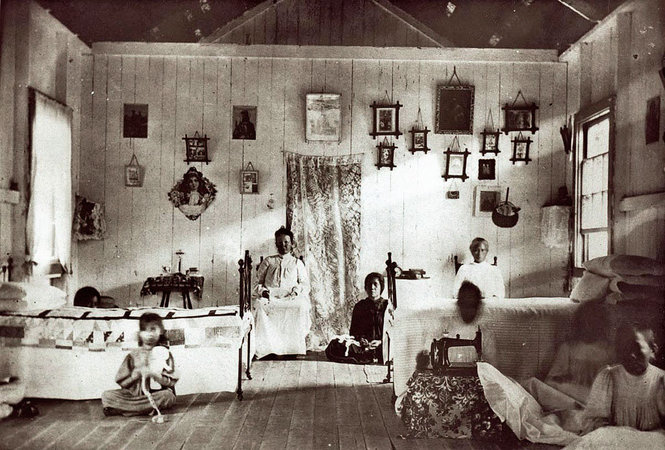
Review: Moloka'i by Alan Brennert

Bishop Home, via
Reviewed by Christina

Published: 2003

It's about:  Rachel Kalama is a happy seven-year-old girl living in Honolulu at the end of the 19th century.  But then her mother discovers a numb red sore on Rachel's leg, and there's only so long her family can keep it a secret: their little girl has leprosy, a feared, poorly understood, and shameful disease for which there was no cure or effective treatment.  Soon Rachel is removed from her family and shipped off to Kalaupapa, a leper colony on the island of Moloka'i.

On Moloka'i, Rachel grows up and finds life, love, and family (alongside a heaping dose of tragedy) among her fellow exiles and their caretakers.  Her life coincides with an eventful period in Hawaii's history; she sees the overthrow of the monarchy, the introduction and boom of tourism, WWII and the bombing of Pearl Harbor, and eventual statehood.  Rachel and the islanders get to experience a lot of twentieth-century inventions for the first time: recorded music, moving pictures, airplanes.  I loved reading about people's introductions to these and other pieces of modern life.

I thought: This is exactly the kind of novel I love: rich with well-researched historical and cultural details, a tragic and dramatic life story with memorable, complex characters.  It even has a medical element to boot!  There aren't really heroes and villains, just people struggling along with what they have and making choices based on their selves and their circumstances.  I should probably mention that I lived in Hawaii when I was in high school, and so the setting and trappings of Moloka'i have some special significance for me.  I loved that Brennert included lots of Hawaiian words, culture, and mythology.  Despite the author being haole, the book feels Hawaiian.

I also thought Alan Brennert did a decent job writing from a woman's perspective.  I forgot, sometimes, that Rachel was written by a man, and you really can't say that about some male authors.  My only complaint in that department is that all the female characters in Moloka'i seem unusually willing to part with their clothes, including disfigured teens who were raised in a convent and even some of the nuns!  This isn't the first time I've read a book by a male author that has a bunch of female characters casually getting naked regularly.  The tendency amuses me.

While I'm in complaint mode, I do have a few other things to mention.  Brennert's style is smooth and easy to read, but there is some slight cheesiness now and again.  I can tell that he is a screenwriter and OH how I wish some studio would pick up Moloka'i and make it into a miniseries.  Brennert's prose isn't high art, but it is capable enough to bring out his real strengths: storytelling and character development.   I really would have appreciated a more detailed map of Moloka'i than the one printed in the front of the book, and a glossary of Hawaiian terms and some pronunciation guidelines would have been nice.  My memories from 11th grade Modern History of Hawaii class are pretty fuzzy and I had to turn to google for clarifications.

Moloka'i may not be timeless great literature, but it's a full, beautiful story grounded in fact, with lots of Big Ideas to chew on: freedom and exile, forced exile/imprisonment and self-exile, parent-child relationships within and without biological ties, faith in the face of tragedy.  This book is going to stick with me, and it was just the thing to get me out of my post-Anna Karenina rut.  You can bet I'll be reading Alan Brennert's other Hawaii book, Honolulu.  

Verdict: Stick it on the shelf!

Kalaupapa today, via
(note the pali, cliffs that isolated the
settlement from the rest of the island)
Reading Recommendations:  I read this at a breakneck pace, and I'm not sure whether I read it so fast because I loved it or I loved it because I read it so fast.  But either way, I'd recommend reading this at a time when you can really sink into it and read a hundred pages or so each day.  Be prepared to cry, though; I am not generally a weepy reader but this book got me going more than once.

(And if you like this setting, be sure to check out the movie Princess Kaiulani.)

Warnings: A little fairly-descriptive sex, one brief but graphic scene of domestic violence, some swears.

Favorite excerpts:  "Grief and anger doesn't shock me." Catherine paused.  "Rachel, do you remember the day at the convent when we saw the old biplane?  Remember what I said?"
Rachel laughed without amusement.  "I don't even remember what I said."
"'Who can doubt the presence of God in the sight of men whom he has given wings.' I recall that so precisely because I've had time to consider my error."  She smiled. "God didn't give man wings; He gave him the brain and the spirit to give himself wings.  Just as He gave us the capacity to laugh when we hurt, or to struggle on when we feel like giving up.
"I've come to believe that how we choose to live with pain, or injustice, of death... is the true measure of the Divine within us.  Some, like Crossen, choose to do harm to themselves and others.  Others, like Kenji, bear up under their pain and help others to bear it.
"I used to wonder, why did God give children leprosy?  Now I believe: God doesn't give anyone leprosy.  He gives us, if we choose to use it, the spirit to live with leprosy, and with the imminence of death.  Because it is in our own mortality that we are most Divine."

What I'm reading next:  The Other Side of Normal by Jordan Smoller

Wednesday, January 30, 2013

Review: Crossing to Safety by Wallace Stegner

photograph of the author via

Reviewed by Christine-Chioma

Published: 1987

It's about: The book follows the lives of two married couples who meet and become friends while living in Madison, Wisconsin during the height of the Depression. The book explores the small details of their inner lives, the complex nuances of their friendships, and the minutiae of their marriages.

I thought: This is an intricate and well-crafted novel. Although it is not plot driven, I eagerly read it quickly. It was fascinating for me to read about the realistic quiet lives. I loved how interesting Stegner made situations that occur in every day life. It made me think a lot about the intimacies of friendships and the small details that make people whom they are. The novel is focused and well-written. I could tell that every detail was deliberate. I really came to know the Langs and Morgans. The introduction of my copy calls the book a "modern classic" and I'd have to agree. Since graduating from BYU in English I never wanted to read another scholarly article analyzing a work of literature  but this book (KIND OF) gives me that desire. It is one of those books that I think about over and over even after it is finished.

Reading Recommendation: I enjoyed this piece on Stegner. It gives a lot of information about him as an author and gives insight into some of his writing decisions. After reading the book I was very curious about the meaning of the title which is explained in the piece: "Stegner says there is a kind of crossing to safety for each character in the novel. 'Every one of these four lives crosses to a different kind of safety. And crosses something different. And takes with him something different." The Paris Review also had a good interview with Stegner.

Verdict: Stick it on the shelf or Rubbish Bin? Stick it on the shelf!

Warnings: I purposely read this book because it is squeaky clean

Favorite excerpts:

"And so, by circuitous and unpredictable routes, we converge toward midcontinent and meet in Madison, are are at once drawn together, braided and plaited into a friendship. It is a relationship that has no formal shape, there are no rules or obligations or bonds as in marriage or the family, it is held together by neither law nor property nor blood, there is no glue in it but mutual liking."

"No cautionary words had any effect on her. If you wanted something, you planned for it, worked for it and made it happen"

"You can plan all you want to. You can lie in your morning bed and fill whole notebooks with schemes and intentions. But within a single afternoon, within hours or minutes, everything you plan and something you have fought to make yourself can be undone as a slug is undone when salt is poured on him. And right up to the moment when you find yourself dissolving into foam you can still believe you are doing fine"

"Why? Because they are who they are. Why are they so helplessly who they are? Unanswered questions, perhaps unanswerable. In nearly forty years, neither had been able to change the other by as much as a punctuation mark."

"But Charity and Sally are stitched together with a thousand threads of feeling and shared experience. Each is for the other that one unfailingly understanding and sympathetic fellow-creature that everybody wishes for and many never find."

What I'm reading next: The Kitchen House by Kathleen Grissom

Monday, November 26, 2012

Review: The Summer Before the Storm by Gabriele Wills

Gabriele Wills 
Reviewed by Ingrid

Published: 2006

It's about: From the publisher's website:
"It’s the Age of Elegance in the summer playground of the affluent and powerful. Amid the pristine, island-dotted lakes and pine-scented forests of the Canadian wilderness, the young and carefree amuse themselves with glittering balls and friendly competitions. The summer of 1914 promises to be different when the ambitious and destitute son of a disowned heir joins his wealthy family at their cottage on Wyndwood Island. Through Jack’s introduction into the privileged life of the aristocratic Wyndhams and their illustrious social circle, he seeks opportunities and alliances to better himself, including in his schemes, his beautiful and audacious cousin, Victoria.

But their charmed lives begin to unravel with the onset of the Great War, in which many are destined to become part of the 'lost generation.'"

I thought: Lots and lots and lots of stuff happens in this book. Because the story moves so fast and there is so much drama all the time, I enjoyed reading for the story. However, the best part of the book were the delightful historical details; it's clear that this book was meticulously researched. I loved Will's descriptions of women's dresses and bathing costumes.

Unfortunately however, the characters felt very one-dimensional and artificial. Many suspiciously felt like 21st century characters who dressed and spoke like Edwardians, quite a few female characters were independant-minded and frustrated with the confining gender norms of their time. I was also disappointed with how much the author explained the characters' actions and motivations. Nothing was left for me to think about! This was disappointing. I like an author to trust me as a reader to understand underlying threads and work things through for myself.


Lastly, the book ends with an abrubt "to be continued in book 2..." which made me feel a bit cheated, although I suppose it did make me a little bit curious about book 2 of the series. Many threads were left hanging.

Verdict: I think I'll put this one (on the lower end of) in between. 

Warnings: Quite a lot of sex and swearing, which I admit felt a bit strange in a novel about the Edwardian era.

*I received a copy of this book to participate in Virtual Author Book Tours in exchange for an honest review. Follow the tour for this book here.


Friday, September 28, 2012

Review: Sophie's Choice by William Styron

The Gates of Auschwitz via
Reviewed by Connie

Published: 1979

It's about: "Stingo" is a 22-year-old Southerner who moves to New York in 1947 to become a novelist. Not long after moving into his Brooklyn apartment, he befriends an unlikely couple who live above him -- she, Sophie, is a beautiful Polish survivor of Aushwitz concentration camp; he, Nathan, is a charming Jewish research biologist prone to extreme fits of anger. The book follows the intertwining stories of all three characters, frequently including lengthy recollections of Sophie's experiences in Auschwitz.

I thought: I really, really enjoyed this book. It is beautifully done. I love how the story progresses, alternating among Stingo's struggles (to become a great writer, to reconcile his family's history with slavery, and to get laid), Nathan and Sophie's turbulent history, and Sophie's recollections of Germany-occupied Poland and her more than one-year stint in Auschwitz Concentration Camp. It varied the tone and pacing of the book enough to keep me interested for all 600 pages.

Also, it's just great story-telling. Sometimes, you learn something about Sophie's history only later to learn it was all a lie, a lie that Sophie tells Stingo and herself because she can't bear to admit the truth. Her Aushwitz experiences are not presented chronologically but in bits and pieces as Sophie becomes more comfortable opening up to Stingo and revealing her dark past.

Styron has been accused of pretentiousness because of the extensive and frequently obscure vocabulary he adopts in the book. It's true -- there are a lot of infrequently used words, words I haven't seen since studying for the GRE. But I found the prose endearing and well-suited to the voice of the main character, a self-important aspiring writer who even invents rave book reviews for his as yet unfinished, unpublished works.

I also find the elevated prose contrasts wonderfully with Stingo's twenty-two-year old sexual frustration to hilarious effect. For example, take the following passage:

"I was mulling all this over when I was made suddenly aware -- in the room directly over my head -- of a commotion so immediately and laceratingly identifiable, so instantly, to my tormented ears, apparent in its nature that I will avoid a more circumlocutory time might have required obliqueness of suggestion, and take the liberty of saying that it was the sound, the uproar, the frenzy of two people f***ing like crazed wild animals."

It's probably the former English major in me, but I feel like I could write about 10 different critical essays on various topics in this book. For example, I find Styron's comparison of anti-semitic Europe to racism and slavery in America very compelling. I won't share the many other topics I've thought of writing about, as they might spoil one of the surprises in the plot for you.

Perhaps my biggest complaint about this book is that though I find Stingo's sexual frustration generally amusing, there did come a point around page 400 when I found it rather wearying. I found myself thinking, "Oh come on, just lose your virginity already and quit fantasizing about and agonizing over it." Although, I imagine that's how Stingo also felt, so in a way, I was forced to relate to his experience in some way.

Verdict: Stick it on the shelf

Meryl Streep as Sophie
Reading Recommendations: I read this book before seeing the Oscar-winning movie adaptation starring Meryl Streep, which I plan to watch in the near future. I'd recommend doing the same, as the meaning of the title isn't clarified until the very end of the book. I imagine it would be harder to work your way through the near 600 pages of the book if you already know the ending.

Warnings: This is definitely an R-rated book. There's no shortage of f-words as well as other profanities used in reference to body parts. There are also several descriptive sex scenes.

Favorite excerpts:
"There are friends one makes at a youthful age in whom one simply rejoices, for whom one possesses a love and loyalty mysteriously lacking in the friendships made in afteryears, no matter how genuine."

"Someday I will understand Auschwitz. This was a brave statement but innocently absurd. No one will ever understand Auschwitz. What I might have set down with more accuracy would have been: Someday I will write about Sophie's life and death, and thereby help demonstrate how absolute evil is never extinguished from the world. Aushwitz itself remains inexplicable. The most profound statement yet made about Aushwitz was not a statement at all, but a response:
The query: 'At Aushwitz, tell me, where was God?'
And the answer: 'Where was man?'"

"I did not weep for the six million Jews or the two million Poles or the one million Serbs or the five million Russians -- I was unprepared to weep for all humanity -- but I did weep for these others who in one way or another had become dear to me, and my sobs made an unashamed racket across the abandoned beach; then I had no more tears to shed, and I lowered myself to the sand on legs that suddenly seemed strangely frail and rickety for a man of twenty-two."

What I'm reading next: The Casual Vacancy by JK Rowling (!!!)

Friday, September 14, 2012

Review: Tributary by Barbara K. Richardson

via
Reviewed by Connie

*I received a complimentary advanced review copy of this book in exchange for an honest review.

Published: September 15, 2012 (tomorrow)

It's about: This book follows the life of Clair Martin, who begins life in a Mormon settlement in 1870s Utah. Her life's journey takes her away from the teachings of the Mormon church, all the way to Louisiana, and finally back to Utah as she struggles to define who she is and what she believes.

I thought: I debated with how personal I should get when writing this review, but as the book centers around a strong female character who abandons her Mormon upbringing because it seems too patriarchal, and as I myself am a Mormon feminist, I finally concluded that my most valuable insight into this book is from a more personal perspective. So forgive me for this different style of review.

Clair Martin is certainly what the book blurb professes her to be -- a strong female who will bend to neither man nor religion. Richardson does a fair job of developing her character (though this is not true for the other characters, who tend to be over-simplified). She also does a commendable job writing about the allure and appeal of the Western landscape to those who have history there. However, the list of Richardson's successes ends here.

Obviously, Mormonism plays a huge role in this book, as the heroine begins her journey in a Mormon settlement in Utah and spends the book trying to define her religious beliefs. The author was a practicing Mormon early in life but left the church shortly after starting college in NYC because she found the church's teaching incongruous with her feminist beliefs. As a Mormon feminist myself, I was particularly interested in reading her perspective.

However, after carefully considering her treatment of the Mormons, I can't say that Richardson writes about Mormon history in a thoughtful, circumspect, or carefully considered manner. Instead, she simplifies, reduces, and vilifies Mormon history. For example, there is not a single Mormon character who is genuinely a kind, compassionate person. They are all creeps. All the men, especially, are sex-craved maniacs looking to force women into submission. **some spoilers here** The one character -- a bishop -- who at first appears to be genuine turns into a creep when he asks 18-year-old Clair to be his third wife. And when Clair later finds true love, she loses him when he returns to church activity and runs away to become a polygamist with three teenage wives. Another creep.**end spoilers**

Richardson's Mormon settlement is reduced to one elaborate, patriarchal scheme, headed up by a greedy Brigham Young and perpetuated by perverted men in leadership positions looking for sex and domination.

I would have respected and enjoyed the book much more had Richardson tried to depict Mormon history -- particularly in relation to the women -- more accurately and fairly. It is a complicated and nuanced past that Mormon feminists today still struggle to fully understand. Richardson's reductionist portrayal adds little to the conversation.

Verdict: Rubbish Bin

Reading Recommendations: Readers interested in learning more about the complicated relationship between Mormon beliefs and feminism should turn to more thoughtful books, such as Joanna Brooks' Book of Mormon Girl (read our review here).

Warnings: one scene of rape

What I'm reading next: Still working on Sophie's Choice. It's a long one.

Wednesday, September 12, 2012

Review: Fugitive Pieces by Anne Michaels

Via

Reviewed by Christine-Chioma (previously reviewed by Julie)

Published: 1996

It's about: During World War II, Athos Roussos, a Greek archaeologist, rescues a young Polish jew, Jakob Beer, after the massacre of Jakob's family. The novel explores the life, losses, and loves of both men. A young Canadian, Ben, whose parents survived the Holocaust, is drawn to Jakob and his life.

I thought: I had a hard time getting into the book, which is surprising because it had elements of things I really enjoy in literature: loss, historical fiction about World War II, memory, loneliness, and well-written prose. I think it's because I never really connected with Jakob's character. I was fascinated by the people surrounding him: Athos, Alex, Michaela, Nikos, Ben and Naomi. But I just could not muster up enough interest in Jakob--but maybe that was his role as the main narrator? At times I found the book to be too dense-- there were a few passages that went over my head by being too poetic. I found the last third of the book to be more fascinating that the first half. I did appreciate the deeper themes and questions that were addresses. The story stayed with me after I read it and helped me ponder more about the human condition.

Verdict: Stick it on the shelf or Rubbish Bin? In-Between. It's definitely worth reading, but I wouldn't personally want to re-read it or own it because I did not love it. But I didn't hate it. It's just in-between.

Reading Recommendations: I'd suggest you try to read it all at once. I read it really slowly and maybe that's why some of the poeticism went over my head and felt too disconnected.

Warnings: It's pretty heavy but nothing too graphic

Favorite excerpts: "But Athos, whether one believes or not has nothing to do with being a Jew. Let me put it this way: the truth doesn't care what we think of it."

It's Hebrew tradition that the forefathers are referred to as "we," not "they." "When we were delivered from Egypt..." This encourages empathy and responsibility to the past, but more important, it collapses time. The Jew is forever leaving Egypt. A good way to teach ethics. If moral choices are eternal, individual actions take on immense significance no matter how small: not for this life only.

There were the few, like Athos who choose to do good at great personal risk; those who never confused objects and humans, who knew the difference between naming and the named. Because the rescuers couldn't lose sight, literally, of the human, again and again they give us the same explanation for their heroism: "What choice did I have?"

What I'm reading next: Something from my classics list. 

Monday, September 10, 2012

Audiobook Review: The Postmistress by Sarah Blake


Audiobook reviewed by Christina
(Read Lucia's review of the print version here.) 

Published: 2010

It's about:  Three American women deal with feeling powerless in the face of WWII.  Emma is a young newlywed whose doctor husband cannot disconnect from a patient's death.  Iris is the capable postmistress of a small Cape Cod town called Franklin.  Frankie is a war correspondent in London and, later, Europe.  Their three points of view highlight different experiences of war and tragedy.

I thought:  Not gonna beat around the bush:  I wasn't wild about this audiobook.  Of the three main characters, I was only interested in one of them: Frankie.  Emma's and Iris' lives revolved mostly around romance and waiting for news and holding down the fort.  I didn't feel that their perspectives added anything new to the Women in Wartime body of narratives.  Frankie's story rang true and raw and real to me; I wish she hadn't had to share the book.  And why is it named after Iris?  She is not the driving force- Frankie is.

The reader, Orlagh Cassidy, can't be blamed for my unenthusiastic attitude toward The Postmistress.  Her pacing and expression are excellent, and I like the tone and timbre of her voice.  She was pleasant to listen to, and she did a decent (if imperfect) job with the heavy load of French and German in the text.  I'd be happy to listening to more of her reading.

In comparison to other audiobooks I've listened to, this one is very slow, with an ill-defined plot arc.  More than half way through it still felt like Ms. Blake was laboriously setting things up.  I kept waiting and wondering how the characters related to one another and where the story was going.  There seemed to be a ton of romance (way more than I personally prefer in my fiction) and the deeper themes kept slipping through my fingers.  Part of this could just be my own tendency to forget or gloss over details when I'm listening as opposed to reading.  I think I would have appreciated the slow pace, the themes, the prose, if I had been reading.  But when I'm listening to a book, the story has to be particularly strong.  That just wasn't the case here.   

Verdict: I'll put the audiobook In-Between.  Lucia loved the print version, and I think I would have liked it better in that format.

Warnings: Sex, swears, war crimes.

What I'm listening to next:  Pride and Prejudice and Zombies by Seth Grahame-Smith

Wednesday, August 29, 2012

Review: Yellow Star by Jennifer Roy

childen in the Lodz ghetto (via)
Yellow Star by Jennifer Roy

Reviewed by Ingrid

Published: 2006

It's about: Written in simple free verse, this is the fictionalized, first person account of a young girl named Sylvia who survived WWII hidden in the Lodz ghetto.  The story is based on extensive interviews with the author's aunt Sylvia, one of only twelve children and 800 survivors to come out of the ghetto at the end of the war.

I thought: A wonderful woman named Shauna who works with my dad gave me this book. Shauna told me that her younger daughter loves this book and rereads it every year, and knowing that I also read a lot of holocaust books when I was younger, she thought I would enjoy it.

And I did! The author did a great job of presenting an unsettling, emotionally heavy story in a way that is accessible to young readers and doesn't whitewash. Because the narrator is only 4 1/2 when the story begins, the writing is very simple. While written in verse, the story is clearly meant to be read primarily, if not solely as a narrative. I wasn't sure what to make of this at first, but as I finished the book I realized the verse form was fitting and worked quite well - it simplified the text down to the basics without making it feel dumbed-down. It truly made the narrative feel as if it were told by a child. I loved how Jennifer Roy was willing to risk using free-verse in a rather unconventional way. It worked beautifully.

I would highly recommend this book as a good introduction to WWII for young readers. While it does have some violence, it isn't anything that older children couldn't handle. For example, Sylvia tells us that people are shot in the street, but she never witnesses it directly and so it isn't described in detail. This book is a good introduction to questions of morality as played out in the real world.

Verdict: Stick it on the shelf.

Reading Recommendations: While anyone could enjoy this book, I especially would recommend it to elementary/middle school aged readers. (Ages 6-12)

Warnings: Some violence.

Favorite excerpts:

"Dora feels bad for me
having to stay inside all the time,
so she brings home funny stories and jokes
to cheer me up.
We sit together on her bed in the evening
and talk.
She tells me about the factory.
Now they are making munitions.
Bullets and weapons
for the Nazis to win the war.

The Nazis want to take over the world,
Dora believes.
They think that they are better than everyone else,
and they especially hate the Jews.

'Why do they hate us so much?' I want to know.
I have asked this before, but maybe
I'll understand better,
now that I'm older.
'They think we killed their God,' replies Dora.

This makes little sense to me,
because no on I know ever killed anyone.
Then I become worried.

'God is dead?' I say.

'Not our God, their God,' Dora says.
I'm still confused but I'm relieved.
God is still alive.

Then I have a new worry.
If God dies, who will run the world?
I hope it's not the Nazis.
I want to ask Dora about this,
but she has fallen asleep."

Sunday, August 19, 2012

Review: The Meaning of Night by Michael Cox

via
 Reviewed by Christina

Full Title: The Meaning of Night: A Confession

Published: 2006

It's about:  It's a mystery-thriller set in Victorian England.  A down-on-his-luck scholar named Edward Glyver confesses the multiple betrayals that led him, ultimately, to murder at least one person.  

I thought: The cover of The Meaning of Night has a scintillating tagline: "A secret buried.  A love betrayed.  A destiny revealed."  Those three short sentences didn't inspire much hope in this reader.  Why should a book need a tagline, anyway?  Not a good sign.

And that tagline does this book a disservice.  The Meaning of Night is actually much smarter and better-crafted than its cover lets on.  It's written in a mock-autobiography format, complete with a forward by a fictional modern-day scholar who has kindly added footnotes throughout.  I know it's a little gimmicky, but I still like the fake-relic thing when I happen upon it in literature.  And Michael Cox does a great job with Edward's legit-sounding Victorian voice.  So that, initially, earned him a few points in my book.  He earned a bunch more points by showing a huge knowledge base of the time and period.  I love seedy Victorian London settings, and The Meaning of Night is full of exquisite historical details: explanations of current events, slang, and lifestyle tidbits.  Cox does slip into the territory of pedantry, though; there must be at least a hundred footnotes in this book that give nothing but the location of a pub or hotel.  Not every detail adds to the story.

The narrative opens with Edward killing an unsuspecting stranger.  I know this was meant to be an edgy hook, establishing our protagonist as an antihero, but it didn't work for me.  Painting Edward as a murderer right off the bat made him a pretty distasteful character.  I didn't particularly want him to succeed, and so my interest in his story waned.  Given that this is a fairly long book (nearly 700 pages) with a complex plot and mysteries within mysteries, I consider an unlikeable narrator to be a pretty major flaw.  Also, little amusing detail here: Edward's girl is a hooker with a heart of gold and her name is... wait for it... Bella.

Overall, The Meaning of Night is a decent novel, but it's not my favorite genre and it didn't capture my imagination the way it intended to.  It's certainly not a waste of time, but not a must-read either.

Verdict: In-Between

Reading Recommendations:  This one is kinda wintery.  Pick it up when you want something mildly shocking to carry you through the dull cold nights.

Warnings: Some violence and sex, slightly more descriptively told than you'd normally expect if it were truly penned in the mid-19th century.  It's pretty tame, though, by today's standards.

Favorite excerpts: “Non sum qualis eram.” (I am not what I was)   (Wouldn't that be a cool tattoo?)

“The boundaries of this world are forever shifting - from day to night, joy to sorrow, love to hate, and from life itself to death; and who can say at what moment we may suddenly cross over the border, from one state of existence to another, like heat applied to some flammable substance?” 

What I'm reading next:  Anarchy Evolution by Greg Graffin and Steve Olson

Wednesday, June 6, 2012

Review: Snow Flower and the Secret Fan by Lisa See

fan with nushu script
Reviewed by Connie

Published: 2005

It's about: "This novel takes place in 19th century China, when girls had their feet bound, then spent the rest of their lives in seclusion with only a single window from which to see. Illiterate and isolated, they were not expected to think, be creative, or have emotions. But in one remote county, women developed their own secret code, nu shu – "women's writing" – the only gender-based written language to have been found in the world. Some girls were paired as "old-sames" in emotional matches that lasted throughout their lives. They painted letters on fans, embroidered messages on handkerchiefs, and composed stories, thereby reaching out of their windows to share their hopes, dreams, and accomplishments. An old woman tells of her relationship with her "old-same," their arranged marriages, and the joys and tragedies of motherhood—until a terrible misunderstanding written on their secret fan threatens to tear them apart." (taken from the book website)

I thought: The historical aspects of this novel are fascinating. As a woman with a background in literature and women's studies, I was particularly interested in a woman's role in 19th century Chinese culture and the secret nushu script, which I had never heard of. The scenes describing footbinding were especially interesting/gruesome/shocking. I knew they wanted little feet, but did you know the ideal foot size was 7 centimeters, or the size of a THUMB? So they systematically broke all the bones in their feet. HOLY---.

Aside from the interesting historical elements, I was also captivated by the depiction of an intimate friendship between women and the emotional truth with which See tells it. Any female who has had a female best friend will most likely deeply connect with their story. And it's told in very lyrical prose, which adds another dimension to reading about the friendship.

BUT -- there is a but. I found the ending unsatisfying. By the end of the book, I felt like I had invested so much in Snow Flower and Lily's friendship that they -- and I -- deserved more. After really enjoying the entire book, I finished it feeling very unsatisfied, even cheated.

Verdict: Despite the disappointing ending, I would still stick it on the shelf

Reading Recommendations: I'm not sure that most men would appreciate this story, but as a woman, I really connected with it. I would recommend it to a woman who enjoys novels with historical elements.

Warnings: mild references to "bed business" and one pretty mild scene of physical intimacy (not sex) between two young girls

Favorite excerpts:
"Anyone who says that women do not have influence in men's decisions makes a vast and stupid mistake."

"We [daughters] may be worthless. We may be raised for another family. But often we are loved and cherished, despite our natal families' best efforts not to have feelings for us... Maybe as parents we try not to care. I tried not to care about my daughter, but what could I do? She nursed at my breast like my sons had, she cried her tears in my lap, and she honored me by becoming a good and talented woman in nu shu."

What I'm reading next: Memories of my Melancholy Whores by Gabriel Garcia Marquez

Wednesday, May 2, 2012

Review: Kristin Lavransdatter by Sigrid Undset

Sigrid Undset via
Kristin Lavransdatter by Sigrid Undset, trans. Tiina Nunnally


Reviewed by Ingrid

Published: 1922

It's about: This trilogy of novels follows the entire life of a woman named Kristin Lavransdatter in medieval Norway. As a child Kristin was very close to her father, Lavrans, and this relationship guides her emotions and actions her whole life. As a teenager, Kristin betrays her father's trust when she develops a relationship with a tall, dark, handsome man with a sword named Erlend, becomes pregnant, and breaks off her betrothal to another man that her father chose for her. Kristin is racked with guilt and regret her whole life, while both her love and resentment toward Erlend grow and evolve throughout their marriage. A book written by a woman about a woman's life of course touches on all the things that affected women's lives during the middle ages and beyond - discovering the world as a young girl, puberty, attention from boys and awakening sexual desire, marriage, pregnancy, birth, and motherhood.

Praised for its nuanced depiction of one woman's life, Kristin Lavransdatter won the nobel prize for literature in 1928.

I thought: I've had this book sitting on my shelf for years. I was hesitant to read it because it was long and because I thought it would be boring. The beginning was a bit slow, but as soon as Kristin met Erlend and they had a certain encounter in a barn, I was hooked. I read hundreds of pages a day because I couldn't get enough ... then I realized the end was coming soon and I slowed way down because I didn't want it to end. As Kristin grew in her experience, she kept surprising me - sometimes she would make silly mistakes, and other times huge and beautiful sacrifices for those she loved, and lots of other delightful things in between. So much happens in this book, and it always kept me interested and surprised.

I think the thing I liked the most about this book was the emotional depth of the characters. I felt for them like I felt for the characters in War and Peace, my favorite book. It's like these people are on the same wavelength as me. Sure, they live on farms in 14th century Norway, churn milk, eat goat meat, and sometimes all sleep together in one big bed, but I get them. They make huge, life changing mistakes, they do stupid things, meaningful things, and totally and utterly redeem themselves in the end because they do just the things that make me love them so much more.

The reason I thought this book would be boring was the fact that, because Kristin was a devout Catholic, it has quite a bit of religion in it. Not to worry - there are no long tracts or rants, Tolstoy-style. Kristin makes friends with monks, goes to church, lives with nuns for a little while, worships, and prays. When I think of catholicism in the middle ages, I think of dogma and corruption. What I don't usually think about is how that religion actually plays itself out in people's lives. Kristin's religion and her worship is the organizing principle of her life. But the light it shines onto Kristin's life is what brings out the depth of her story. Maybe because I am a religious person myself, I understood why Kristin found so much peace and comfort in the every day religious rituals she learned from her devout father, Lavrans, and that she later taught to her own sons. It drew everything together in such a meaningful and lovely way.

Verdict: Stick it on the shelf!

Reading Recommendations: Or, rather, a viewing recommendation: The short film "The Danish Poet" was my first introduction to Kristin and Sigrid Undset. It won an Academy Award in 2007 for best short film.


Warnings: Wikipedia says of this book, "Kristin Lavransdatter was notable and to some extent controversial in its time, for its explicit characterization of sex in general and female sexuality in particular; and its treatment of morally ambiguous situations." This is more of a reason to read the book rather than to not read it. Sex exists in this book, but it isn't described in any sort of detail.

Favorite excerpts: "[Kristin's] heart was withered with anguish, but rigid and mute, she waited for the next one to die; she expected it, like an inevitable fate. She had never fully understood what she had been given when God bestowed on her so many children. The worst of it was that in some ways she had understood. But she had thought more about the troubles, the pain, the anguish, and the strife--even though she had learned over and over again, from her yearning every time a child grew out of her arms, and from her joy every time a new one lay at her breast, that her happiness was inexpressibly greater than her struggles or pain. She had grumbled because the father of her children was such an unreliable man, who gave so little thought to the descendants who would come after him. She always forgot that he had been no different when she broke God's commandments and trampled on her own family in order to win him."

What I'm reading next: Mormon Enigma: Emma Hale Smith by Linda King Newell and Valeen Tippets Avery

Review: Russian Winter by Daphne Kalotay

Soviet ballerina Ekaterina Maximova as Giselle at the Bolshoi

Reviewed by Christina

Published: 2010

It's about:  According to the back cover: "When Nina Revskaya puts her remarkable jewelry collection up for auction, the former Bolshoi Ballet star finds herself overwhelmed by memories of her homeland, and of the events, both glorious and heartbreaking, that changed her life half a century earlier.  It was in Russia that she discovered the magic of dance and fell in love, and where, faced with Stalinist aggression, a terrible discovery incited a deadly act of betrayal - and an ingenious escape to the West.
Nina has kept her secrets for half a lifetime.  But now Drew Brooks, an inquisitive associate at a Boston auction house, and Grigori Solodin, a professor who believes Nina's jewels hold the key to unlocking his past, begin to unravel her story- setting in motion a series of revelations that will have life-altering consequences for them all."

I thought: Woah!  Why haven't I heard more about this book?  It is a superbly researched, complex, yet clearly-told saga, and I cannot for the life of me understand why it wasn't a huge smash hit bestseller.  It has everything: love, loss, intrigue, the arts, enduring and dynamic characters, a decades-old family mystery, Soviets squelching the proletariat (and everyone else)... What's not to like?  Kalotay's style is straightforward, but laced with just the right tinges of drama.  A story like this could have devolved into melodrama, but it didn't.  The characters' thoughts and actions stayed within realistic limits.

I'd hate to give too much away because I so enjoyed the unfolding of the mysteries within the story.  Much of the narrative is flashback- Nina Revskaya reliving her life in 1940's-50's Moscow, during a period when she rose in the ranks of the Bolshoi to eventually become a star ballerina.  This book is stuffed with amazingly horrible and darkly amusing information about life in communist Russia;  I loved feeling like I was learning a lot while also being swept away by Nina's life story.  I wish I had read it before living in a post-Communist country.  I feel I understand current Russian culture better after having read all the history within Russian Winter.

If I had to name a complaint, it'd be that title.  Russian Winter doesn't really say anything about the story.  It's such a blah title that I had trouble getting excited about starting the book.  I held onto it for over a year before finally picking it up.  As usual, I don't have any better ideas (alas, I have a critical mind rather than a creative one).  Russian Amber would have been more meaningful, at least.  Hm...   I've got it!  How about this: In Soviet Russia, Ballet Dances You!

Verdict: Stick it on the shelf!

Reading Recommendations: Russophiles and ballet people will love this the most, but it's so accessible that I certainly wouldn't limit my recommendation there.  Check it out if you like to learn about history while you read fiction.  Even if you don't go ga-ga over the story, the research will engage you.  This is a smart but not a heady read, so I'd also recommend it for vacations and holidays.

Warnings:  Unmarried people sleep together and there are a few ensuing abortions.  Nothing even remotely descriptive or uncomfortable to read.  

Favorite excerpts: “...She looked at the people around her and felt not just that she was surrounded by strangers, but that she herself was strange, somehow, that something kept her from ever fully bridging the gap between who she was and who all these other people, making their way through the very same day, were.”

“No, solitude did not trouble her. She could spend long minutes gazing out the window, hours listening to the BBC on the public radio station. She relished the very texture of her privacy, its depth of space and freedom, much of an entire day hers alone.” 

What I'm reading next:  Perfect Madness: Motherhood in the Age of Anxiety by Judith Warner

Monday, April 9, 2012

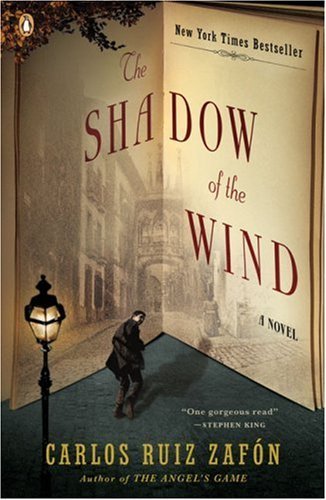
Review: The Shadow of the Wind by Carlos Ruiz Zafón

via

Reviewed by Christine-Chioma


Published: 2001


It's about: The novel starts in 1945 with Daniel visiting the Cemetery of Forgotten Books and rescuing the last remaining copy of The Shadow of the Wind by Julian Carax. A mysterious person, calling himself the devil, is going around destroying all of the works of Carax. As Daniel tries to investigate the mystery his own life and those he cares about are put in danger.


I thought: Zafón is a superb writer. I loved the way he weaved the story and the observations made through Daniel's voice. There was a clever theme of shadows throughout the novel that I only really noticed at the end. I really appreciated the many layers and mysteries of the novel--there are multiple stories within this story (the long italicized portions are the best parts of the book). The story is very plot-driven but still fleshes out the psychology of the main characters (although I wish we had gotten more insight into Daniel's father). There are a few magical realism elements which made the story all the more intriguing.  It's a pretty serious novel but there are definitely some lighter moments like the time a father says the books in his house are wasted because the only person reading them is a girl and as you can tell from my favorite excerpts, the book is kind of a love letter to readers. It really had me contemplating the human condition, which I think is a very important aspect of literature.


By the way, the book has the most awesome covers. Apparently a sequel is coming out soon. Not sure if I'll read it, because I thought the ending was pretty complete.

Verdict: I definitely want to re-read it and look for more clues and allusions, but I'd skip some paragraphs for sure. Sometimes it was a bit much for me (see the Warnings section) hence it's In-between. 


Reading Recommendations: Definitely have a friend read it too. I really wanted to discuss it and hear other opinions. I did find a reading guide that also had a brief interview with the author. If you read Spanish I would recommend reading it in the orignal since translations are never as good. Also it's not really for the faint of heart. 


Warnings: A few sex scenes, one was pretty graphic. Lots of swear words. Some disturbing violence. What I really found gratuitous were Fermin's sexual innuendos and vulgar comments anytime a female was around or mentioned. It made me feel gross like I was in a boy's locker room. It almost made me stop reading it. I kind of wish there could be an edited version.


Favorite excerpts: 
"Once, in my father's bookshop, I heard a regular customer say that few things leave a deeper mark on a reader than the first book that finds its way into his heart. Those first images, the echo of words we think we have left behind, accompany us throughout our lives and scultp a palace in our memory to which, sooner or latter--no matter how many books we read, how many worlds we discover, or how much we learn or forget--we will return."

“Every book, every volume you see here, has a soul. The soul of the person who wrote it and of those who read it and lived and dreamed with it. Every time a book changes hands, every time someone runs his eyes down its pages, its spirit grows and strengthens.” 


"This is a world of shadows, Daniel, and magic is a rare asset. That book taught me that by reading, I could love more intensely. It could give me back the sight I had lost. For that reason alone, a book that didn't matter to anyone change my life."


"I told her how until that moment I had not understood that this was a story about lonely people, about absence and loss, and that was why I had take refuge in it until it became confused with my own life, like someone who has escaped in the pages of a novel because those whom he needs to love seem nothing more than ghosts inhabiting the mind of a stranger"


“Bea says that the art of reading is slowly dying, that it's an intimate ritual, that a book is a mirror that offers us only what we already carry inside us, that when we read, we do it with all our heart and mind, and great readers are becoming more scarce by the day.” 

What I'm reading next: An Invisible Sign of My Own by Aimee Bender

Sunday, February 26, 2012

Audiobook Review: The Paris Wife narrated by Carrington MacDuffie

Guest-reviewer Kirsten reviewed this for us in June, 2011, and Christine-Chioma also reviewed the book yesterday


Wedding of Ernest and Hadley
Reviewed by Connie

Published: 2011

It's about: This recent historical fiction memoir tells the story of Ernest Hemingway's first wife, Hadley Richardson, and their doomed 5-year marriage. It follows Hemingway from a nobody in Chicago to an up-and-coming writer in Paris in the 1920s. We also catch glimpses of some of the Hemingways' famous friends, like Gertrude Stein, Ezra Pound, and F. Scott & Zelda Fitzgerald.

I thought: I listened to this in audiobook format via my recent Audible.com membership (see the banner in the sidebar), and the first thing I had to get over was the narrator's voice. Though I grew somewhat used to her by the end, I was vexed by her presentation of Hadley's voice. It was one part whiny toddler, one part annoying mother baby-talking to that whiny toddler. Combine this with the fact that for the first half of the book, Hadley is as weak and annoying as those voices sound, and I had a rough time getting into it.

In fact, this audiobook made me consider my expectations for characters and how they affect my opinions of the book. Especially recently, I find that I grow annoyed with weak female characters. I want them all to be strong, solid, independent, and in the beginning, Hadley is anything but. She is needy and naive and sickeningly willing to fall into the background of Hemingway's life, and that made me despise her. Now, whether or not that's fair, or whether that's reason to not like a book, I'll have to save that discussion for another day.

Toward the middle of the novel, though, Hadley begins to change. There is one line in the book (I can't quote it exactly, as I don't have a hard copy) when someone refers to her as "Ernest's Hadley" and she says, "Maybe I'm my own Hadley." In a world of flappers and drunkards and "modern women" with bobs and short hemlines, Hadley remains her same old-fashioned self, still stuck on her long hair and her out-of-fashion clothes and her out-dated writers. But by the end of the novel, it becomes clear that though Hadley is no modern woman, she is ever the stronger for resisting the trend.

The book's beginnings sound like a bad romance novel, enhanced by MacDuffie's annoying voice for Hadley, full of "He held me close to him, and I wondered if he could feel my heart beating"s, but the novel follows the curve of the Hemingway's relationship, and by the end, I can comfortably say it is a natural and accurate progression. After all, I suppose we are all in a kind of bad romance novel when we first fall in love.

The writing is sometimes cliche (like the romance in the beginning) but sometimes really beautiful. MacDuffie's narration grew less annoying to me as well, so by the end, it was not a bad audiobook after all.

Verdict: Stick it on the shelf

Reading Recommendations: There's an interesting article on this book over at the Guardian, written by a writer who was named after Hadley. It's worth a read. Also, check out Ingrid's review of A Moveable Feast, Hemingway's memoir about this same time in his life. As a matter of fact, I think I'm going to start reading A Moveable Feast pretty soon, to get Hemingway's perspective.

Warnings: some drunkenness and other lasciviousness

What I'm reading next: The Guernsey Literary and Potato Peel Society by Mary Ann Shaffer and Annie Barrows